How to create a Regional Economic Communities dataset. PART TWO: consolidating string variables to dummy variables

Click here to read PART ONE of the blog series on creating the Regional Economic Communities dataset

Packages we will need:

library(tidyverse)
library(countrycode)
library(WDI)

There are eight RECs in Africa. Some countries are only in one of the RECs, some are in many. Kenya is the winner with membership in four RECs: CEN-SAD, COMESA, EAC and IGAD.

In this blog, we will create a consolidated dataset for all 54 countries in Africa that are in a REC (or TWO or THREE or FOUR groups). Instead of a string variable for each group, we will create eight dummy group variables for each country.

To do this, we first make a vector of all the eight RECs.

patterns <- c("amu", "cen-sad", "comesa", "eac", "eccas", "ecowas", "igad", "sadc")

We put the vector of patterns in a for-loop to create a new binary variable column for each REC group.

We use the str_detect(rec_abbrev, pattern)) to see if the rec_abbrev column MATCHES the one of the above strings in the patterns vector.

The new variable will equal 1 if the variable string matches the pattern in the vector. Otherwise it will be equal to 0.

The double exclamation marks (!!) are used for unquoting, allowing the value of var_name to be treated as a variable name rather than a character string.

Then, we are able to create a variable name that were fed in from the vector dynamically into the for-loop. We can automatically do this for each REC group.

In this case, the iterated !!var_name will be replaced with the value stored in the var_name (AMU, CEN-SAD etc).

We can use the := to assign a new variable to the data frame.

The symbol := is called the “walrus operator” and we use it make or change variables without using quotation marks.

for (pattern in patterns) {
  var_name <- paste0(pattern, "_binary")
  rec <- rec %>%
    mutate(!!var_name := as.integer(str_detect(rec_abbrev, pattern)))
}

This is the dataset now with a binary variables indicating whether or not a country is in any one of the REC groups.

However, we quickly see the headache.

We do not want four rows for Kenya in the dataset. Rather, we only want one entry for each country and a 1 or a 0 for each REC.

We use the following summarise() function to consolidate one row per country.

rec %>%
group_by(country) %>%
  summarise(
    geo = first(geo),
    rec_abbrev = paste(rec_abbrev, collapse = ", "),
    across(ends_with("_binary"), ~ as.integer(any(. == 1)))) ->  rec_consolidated

The first() function extracts the first value in the geo variable for each country. This first() function is typically used with group_by() and summarise() to get the value from the first row of each group.

We use the the across() function to select all columns in the dataset that end with "_binary".

The ~ as.integer(any(. == 1)) checks if there’s any value equal to 1 within the binary variables. If they have a value of 1, the summarised data for each country will be 1; otherwise, it will be 0.

The following code can summarise each filtered group and add them to a new dataset that we can graph:

summ_group_pop <- function(my_df, filter_var, rec_name) {
  my_df %>%
    filter({{ filter_var }} == 1) %>% 
    summarize(total_population = sum(pop, na.rm = TRUE)) %>% 
    mutate(group = rec_name)
}

filter_vars <- c("amu_binary", "cen.sad_binary", "comesa_binary", 
                 "eac_binary", "eccas_binary", "ecowas_binary",
                 "igad_binary", "sadc_binary")
group_names <- c("AMU", "CEN-SAD", "COMESA", "EAC", "ECCAS", "ECOWAS",
                 "IGAD", "SADC")

rec_pop_summary <- data.frame()

for (i in seq_along(filter_vars)) {
  summary_df <- summ_group_pop(rec_wdi, !!as.name(filter_vars[i]), group_names[i])
  rec_pop_summary <- bind_rows(rec_pop_summary, summary_df)
}

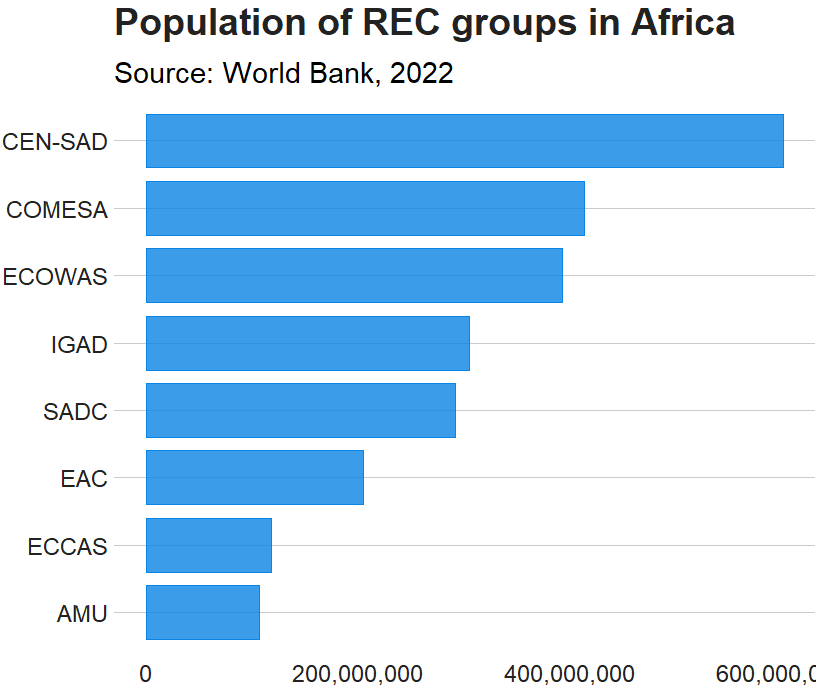
And we graph it with geom_bar()

rec_pop_summary %>% 
  ggplot(aes(x = reorder(group, total_population),
             y = total_population)) + 
  geom_bar(stat = "identity", 
           width = 0.7, 
           color = "#0a85e5", 
           fill = "#0a85e5") +
  bbplot::bbc_style() + 
  scale_y_continuous(labels = scales::comma_format()) +
  coord_flip() + 
  labs(x = "RECs", 
       y = "Population", 
       title = "Population of REC groups in Africa", 
       subtitle = "Source: World Bank, 2022")
Cline Center Coup d’État Project Dataset

tailwind_palette <- c("001219","005f73","0a9396","94d2bd","e9d8a6","ee9b00","ca6702","bb3e03","ae2012","9b2226")

add_hashtag <- function(my_vec){
    hash_vec <-  paste0('#', my_vec)
    return(hash_vec)
  
  tailwind_hash <- add_hashtag(tailwind_palette)

Coups per million people in each REC

create_stateyears(system = "cow") %>% 
    add_democracy() -> demo

rec_wdi %>% 
  select(!c(year, country)) %>% 
  left_join(demo, by = c("cown" = "ccode")) %>% 
  filter(year > 1989) %>% 
  filter(amu_binary == 1) %>% 
  group_by(year) %>% 
  summarize(mean_demo = mean(v2x_polyarchy, na.rm = TRUE)) %>% 
  mutate(rec = "AMU") -> demo_amu

We can use a function to repeat the above code with all eight REC groups:

 create_demo_summary <- function(my_df, filter_var, group_name) {
  my_df %>%
    select(!c(year, country)) %>% 
    left_join(demo, by = c("cown" = "ccode")) %>% 
    filter(year > 1989) %>% 
    filter({{ filter_var }} == 1) %>% 
    group_by(year) %>% 
    summarize(mean_demo = mean(v2x_polyarchy, na.rm = TRUE)) %>% 
    mutate(rec = group_name)
}

rec_democracy_df <- data.frame()

for (i in seq_along(filter_vars)) {
  summary_df <- create_demo_summary(rec_wdi, !!as.name(filter_vars[i]), group_names[i])
  rec_democracy_df <- bind_rows(rec_democracy_df, summary_df)
}

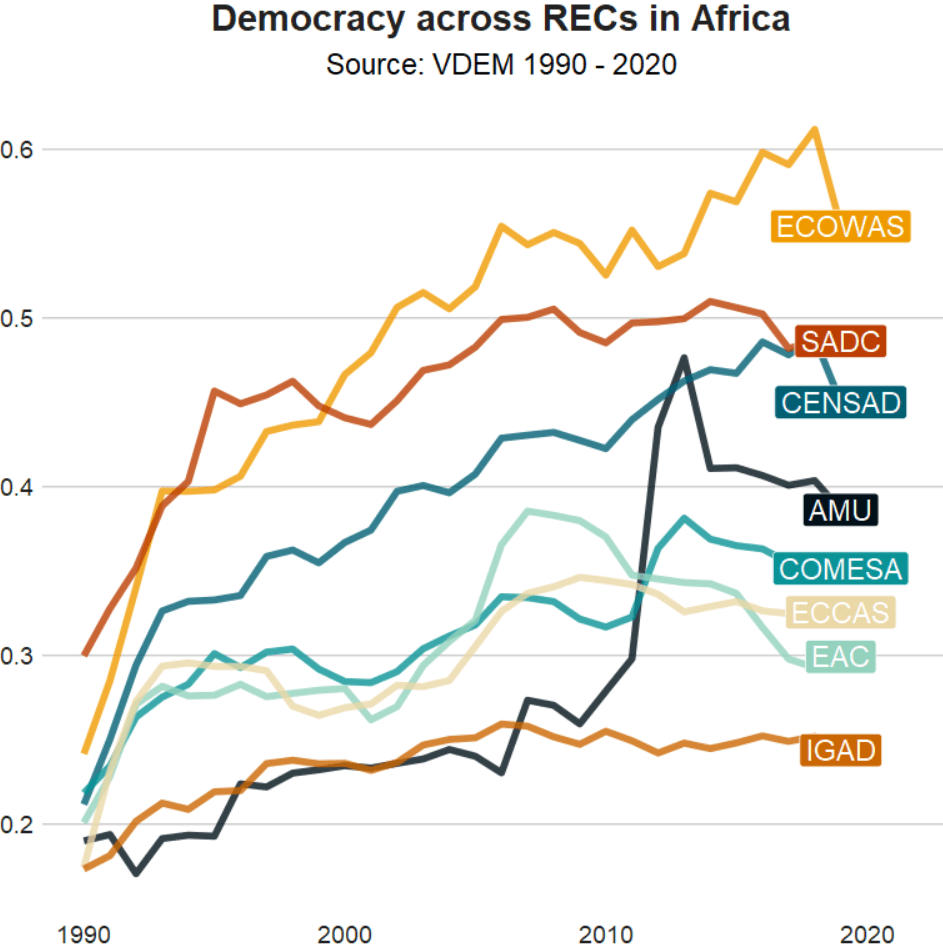
And we graph out the average democracy scores cross the years

rec_democracy_df %>% 
  ggplot(aes(x = year, y = mean_demo, group = rec)) + 
  geom_line(aes(fill = rec, color = rec), size = 2, alpha = 0.8) + 
  # geom_point(aes(fill = rec, color = rec), size = 4) + 
  geom_label(data = . %>% group_by(rec) %>% filter(year == 2019), 
             aes(label = rec, 
                 fill = rec, 
                 x = 2019), color = "white",
             legend = FALSE, size = 3) +  
  scale_color_manual(values = tailwind_hash) + 
  scale_fill_manual(values = tailwind_hash) + 
  theme(legend.position = "none")
How to create a Regional Economic Communities dataset. PART ONE: Scraping data with rvest in R

Click here for part two on the REC dataset.

Packages we will need:

library(tidyverse)
library(rvest)
library(janitor)
library(ggflags)
library(countrycode)

The Economic Community of West African States (ECOWAS) has been in the news recently. The regional bloc is openly discussing military options in response to the coup unfolding in the capital of Niger.

This made me realise that I know VERY VERY LITTLE about the regional economic communities (REC) in Africa.

Ernest Aniche (2015: 41) argues, “the ghost of [the 1884] Berlin Conference” led to a quasi-balkanisation of African economies into spheres of colonial influence. He argues that this ghost “continues to haunt Africa […] via “neo-colonial ties” today.

To combat this balkanisation and forge a new pan-Africanist approach to the continent’s development, the African Union (AU) has focused on regional integration.

This integration was more concretely codified with 1991’s Abuja Treaty.

One core pillar on this agreement highlights a need for increasing flows of intra-African trade and decreasing the reliance on commodity exports to foreign markets (Songwe, 2019: 97)

Broadly they aim mirror the integration steps of the EU. That translates into a roadmap towards the development of:

Free Trade Areas:

  • AU : The African Continental Free Trade Area (AfCFTA) aims to create a single market for goods and services across the African continent, with the goal of boosting intra-African trade.
  • EU : The European Free Trade Association (EFTA) is a free trade area consisting of four European countries (Iceland, Liechtenstein, Norway, and Switzerland) that have agreed to remove barriers to trade among themselves.

Customs Union:

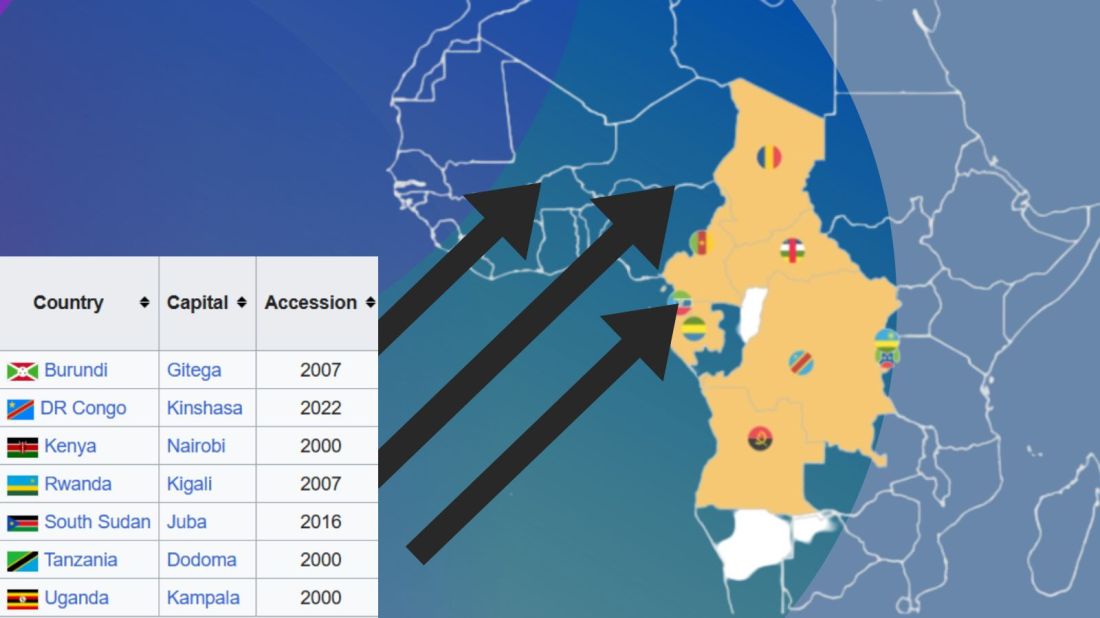
  • AU: The East African Community (EAC) is an REC a customs union where member states (Burundi, Kenya, Rwanda, South Sudan, Tanzania, and Uganda) have eliminated customs duties and adopted a common external tariff for trade with non-member countries.
  • EU: The EU’s Single Market is a customs union where goods can move freely without customs duties or other barriers across member states.

Common Market:

  • AU: Many RECs such the Southern African Development Community (SADC) is working towards establishing a common market that allows for the free movement of goods, services, capital, and labor among its member states.
  • EU: The EU is a prime example of a common market, where not only goods and services, but also people and capital, can move freely across member countries.

Economic Union:

  • AU: The West African Economic and Monetary Union (WAEMU) is moving towards an economic union with shared economic policies, a common currency (West African CFA franc), and coordination of monetary and fiscal policies.
  • EU: Has coordinated economic policies and a single currency (Euro) used by several member states.

The achievement of a political union on the continent is seen as the ultimate objective in many African countries (Hartzenberg, 2011: 2), such as the EU with its EU Parliament, Council, Commission and common foreign policy.

According to a 2012 UNCTAD report, “progress towards regional integration has, to date, been uneven, with some countries integrating better at the regional and/or subregional level and others less so”.

So over this blog, series, we will look at the RECs and see how they are contributing to African integration.

We can use the rvest package to scrape the countries and information from each Wiki page. Click here to read more about the rvest package and web scraping:

First we will look at the Arab Maghreb Union (AMU). We feed the AMU wikipedia page into the read_html() function.

With `[[`(3) we can choose the third table on the Wikipedia page.

With the janitor package, we can can clean the names (such as remove capital letters and awkward spaces) and ensure more uniform variable names.

We pull() the country variable and it becomes a vector, then turn it into a data frame with as.data.frame() . Alternatively we can just select this variable with the select() function.

We create some more variables for each REC group when we merge them all together later.

We will use the str_detect() function from the stringr package to filter out the total AMU column row as it is non-country.

read_html("https://en.wikipedia.org/wiki/Arab_Maghreb_Union") %>% 
  html_table(header = TRUE, fill = TRUE) %>% 
  `[[`(3) %>%  
  clean_names()  %>% 
  pull(country) %>% 
  as.data.frame() %>% 
  mutate(rec = "Arab Meghreb Union",
         geo = "Maghreb", 
         rec_abbrev = "AMU") %>% 
  select(country = '.', everything()) %>% 
  filter(!str_detect(country, fixed("Arab Maghreb", ignore_case = TRUE))) -> amu

We can see in the table on the Wikipedia page, that it contains a row for all the Arab Maghreb Union countries at the end. But we do not want this.

We use the str_detect() function to check if the “country” variable contains the string pattern we feed in. The ignore_case = TRUE makes the pattern matching case-insensitive.

The ! before str_detect() means that we remove this row that matches our string pattern.

We can use the fixed() function to make sure that we match a string as a literal pattern rather than a regular expression pattern / special regex symbols. This is not necessary in this situation, but it is always good to know.

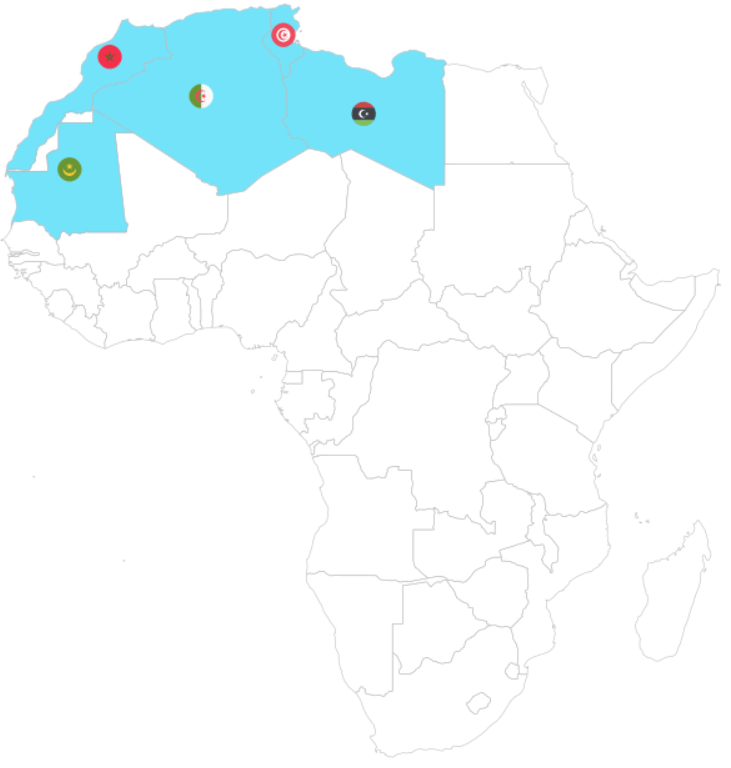
For this example, I will paste the code to make a map of the countries with country flags.

Click here to read more about adding flags to maps in R

First we download a map object from the rnaturalearth package

world_map <- ne_countries(scale = "medium", returnclass = "sf")

To add the flags on the map, we need longitude and latitude coordinates to feed into the x and y arguments in the geom_flag(). We can scrape these from the web too.

We add iso2 character codes in all lower case (very important for the geom_flag() step)) with the countrycode() function.

Click here to read more about the countrycode package.

read_html("https://developers.google.com/public-data/docs/canonical/countries_csv") %>%
  html_table(header = TRUE, fill = TRUE) %>% 
  `[[`(1) %>% 
  select(latitude, 
         longitude, 
         iso_a2 = country) %>% 
  right_join(world_map, by = c("iso_a2" = "iso_a2")) %>% 
  left_join(amu, by = c("admin" = "country")) %>% 
  select(latitude, longitude, iso_a2, geometry, admin, region_un, rec, rec_abbrev) %>% 
  mutate(amu_map = ifelse(!is.na(rec), 1, 0),
         iso_a2 = tolower(iso_a2)) %>%
  filter(region_un == "Africa") -> amu_map

Set a consistent theme for the maps.

theme_set(bbplot::bbc_style() +   theme(legend.position = "none",
                                        axis.text.x = element_blank(),
                                        axis.text.y = element_blank(),
                                        axis.title.x = element_blank(),
                                        axis.title.y = element_blank()))

And we can create the map of AMU countries with the following code:

amu_map %>% 
  ggplot() + 
  geom_sf(aes(geometry = geometry,
              fill = as.factor(amu_map), 
              alpha = 0.9),
          position = "identity",
          color = "black") + 
  ggflags::geom_flag(data = . %>% filter(rec_abbrev == "AMU"), 
                     aes(x = longitude,
                         y = latitude + 0.5,
                         country = iso_a2), 
                     size = 6) +
  scale_fill_manual(values = c("#FFFFFF", "#b766b4")) 

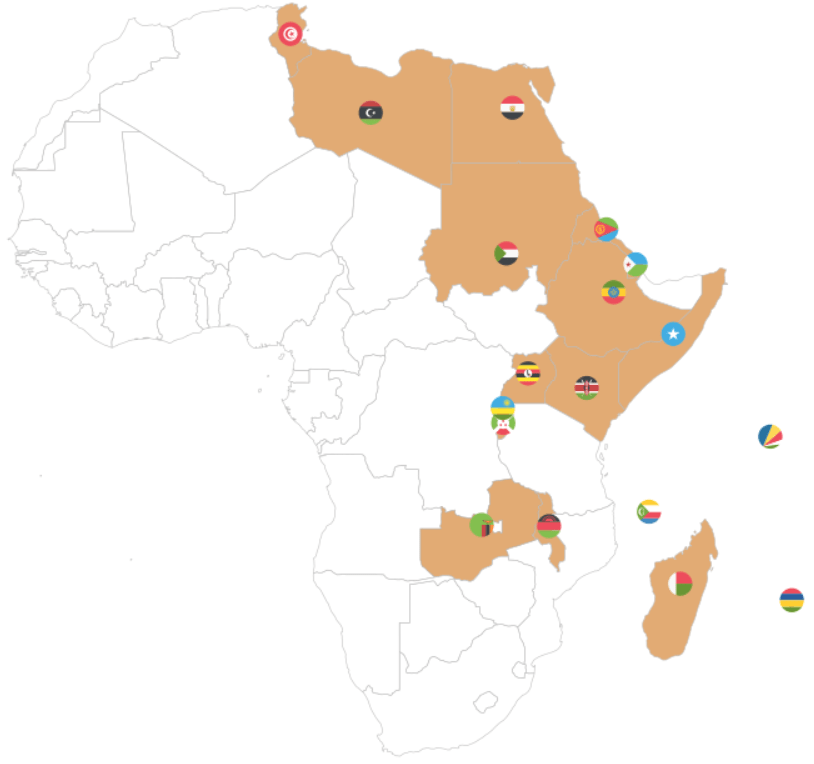
Next we will look at the Common Market for Eastern and Southern Africa.

If we don’t want to scrape the data from the Wikipedia article, we can feed in the vector of countries – separated by commas – into a data.frame() function.

Then we can separate the vector of countries into rows, and a cell for each country.

data.frame(country = "Djibouti, 
           Eritrea, 
           Ethiopia,
           Somalia,
           Egypt,
           Libya,
           Sudan,
           Tunisia,
           Comoros,
           Madagascar,
           Mauritius,
           Seychelles,
           Burundi,
           Kenya,
           Malawi,
           Rwanda,
           Uganda,
           Eswatini,
           Zambia") %>% 
  separate_rows(country, sep = ",") %>%  
  mutate(country = trimws(country)) %>%
  mutate(rec = "Common Market for Eastern and Southern Africa", 
         geo = "Eastern and Southern Africa",
         rec_abbrev = "COMESA") -> comesa

The separate_rows() function comes from the tidyr package.

We use this to split a single column with comma-separated values into multiple rows, creating a “long” format.

With the mutate(country = trimws(country)) we can remove any spaces with whitespace trimming.

Onto the third REC – the Community of Sahel-Sahara States.

read_html("https://en.wikipedia.org/wiki/Community_of_Sahel%E2%80%93Saharan_States") %>% 
  html_table(header = TRUE, fill = TRUE) %>% 
  `[[`(5) %>%  
  janitor::clean_names()  %>% 
  pull() %>% as.data.frame() %>%
  select(country = '.', everything()) %>% 
  mutate(country = str_replace_all(country, "\\\n", ",")) %>% 
  separate_rows(country, sep = ",") %>% # create a column of words from the one cell vector of words!
  mutate(country = trimws(country)) %>%  # remove the white space
  mutate(rec = "Community of Sahel–Saharan States",
         geo = "Sahel Saharan States", 
         rec_abbrev = "CEN-SAD") -> censad

Fourth, onto the East African Community REC.

read_html("https://en.wikipedia.org/wiki/East_African_Community") %>% 
    html_table(header = TRUE, fill = TRUE) %>% 
    `[[`(2) %>%  
    janitor::clean_names() %>%
    pull(country) %>% 
    as.data.frame() %>% 
    mutate(rec = "East African Community",
           geo = "East Africa", 
           rec_abbrev = "EAC") %>% 
    select(country = '.', everything()) %>% 
  filter(str_trim(country) != "") -> eac

Fifth, we look at ECOWAS

read_html("https://en.wikipedia.org/wiki/Economic_Community_of_West_African_States") %>% 
  html_table(header = TRUE, fill = TRUE) %>% 
  `[[`(2) %>%  
  janitor::clean_names() %>%
  pull(country) %>% 
  as.data.frame() %>% 
  mutate(rec = "Economic Community of West African States",
         geo = "West Africa", 
         rec_abbrev = "ECOWAS") %>%
  select(country = '.', everything()) %>% 
  filter(str_trim(country) != "")  %>% 
  filter(str_trim(country) != "Total")  -> ecowas

Next the Economic Community of Central African States

read_html("https://en.wikipedia.org/wiki/Economic_Community_of_Central_African_States") %>% 
  html_table(header = TRUE, fill = TRUE) %>% 
  `[[`(4) %>%  
  janitor::clean_names() %>% 
  pull(country) %>% 
  as.data.frame() %>% 
    mutate(rec = "Economic Community of Central African States",
           geo = "Central Africa", 
           rec_abbrev = "ECCAS") %>% 
  select(country = '.', everything()) -> eccas

Seventh, we look at the Intergovernmental Authority on Development (IGAD)

data.frame(country = "Djibouti, Ethiopia, Somalia, Eritrea, Sudan, South Sudan, Kenya, Uganda") %>%  
separate_rows(country, sep = ",") %>%  
mutate(rec = "Intergovernmental Authority on Development", 
           geo = "Horn, Nile, Great Lakes",
           rec_abbrev = "IGAD") -> igad

Last, we will scrape Southern African Development Community (SADC)

read_html("https://en.wikipedia.org/wiki/Southern_African_Development_Community") %>% 
  html_table(header = TRUE, fill = TRUE) %>% 
  `[[`(3) %>%  
  janitor::clean_names() %>% 
  pull(country) %>% 
  as.data.frame() %>% 
  select(country = '.', everything()) %>% 
  mutate(country = sub("\\[.*", "", country),
    rec = "Southern African Development Community",
         geo = "Southern Africa", 
         rec_abbrev = "SADC") %>% 
  filter(!str_detect(country, fixed("Country", ignore_case = FALSE))) -> sadc

We can combine them all together with rbind to make a full dataset of all the countries.

  rbind(amu, censad, comesa, eac, eccas, ecowas, igad, sadc) %>% 
  mutate(country = trimws(country)) %>% 
  mutate(rec_abbrev = tolower(rec_abbrev)) -> rec

In the next blog post, we will complete the dataset (most importantly, clean up the country duplicates and make data visualisations / some data analysis with political and economic data!

References

Hartzenberg, T. (2011). Regional integration in Africa. World Trade Organization Publications: Economic Research and Statistics Division Staff Working Paper (ERSD-2011-14). PDF available

PDF available

UNCTAD (United Nations Conference on Trade and Development) (2021). Economic Development in Africa Report 2021: Reaping the Potential Benefits of the African Continental Free Trade Area for Inclusive Growth. PDF available

Songwe, V. (2019). Intra-African trade: A path to economic diversification and inclusion. Coulibaly, Brahima S, Foresight Africa: Top Priorities for the Continent in, 97-116. PDF available