Graphing female politicians in Irish parliament R PART 1: Predicting names

Packages we will be using:

library(gender)
library(tidyverse)
library(stringi)
library(toOrdinal)
library(rvest)
library(janitor)
library(magrittr)

I heard a statistic a while ago that there are more men named Mike than total women in charge of committees in the US Senate.

In this blog, we can whether the number of women in the Irish parliament outnumber any common male name.

A quick glance on the most common names in the Irish parliament, we can see that from 1921 to 2024, there have been over 600 seats won by someone named John.
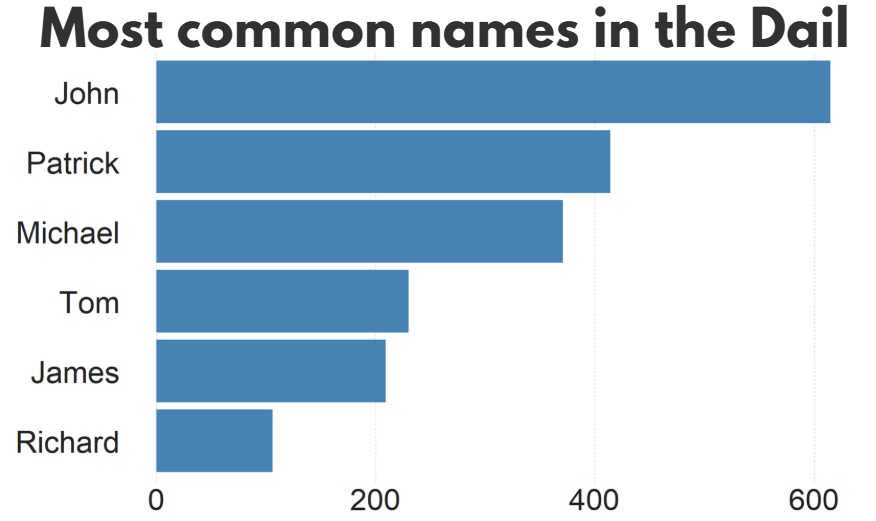
There are a LOT of men in Irish politics with the name Patrick (and variants thereof).

Worldcloud made with wordcloud2() package!

So, in this blog, we will:

  1. scrape data on Irish TDs,
  2. predict the gender of each politician and
  3. graph trends on female TDs in the parliament across the years.

The gender package attempts to infer gender (or more precisely, sex assigned at birth) based on first names using historical data.

Of course, gender is a spectrum. It is not binary.

As of 2025, there are no non-binary or transgender politicians in Irish parliament.

In this package, we can use the following method options to predict gender based on the first name:

1. “ssa” method uses U.S. Social Security Administration (SSA) baby name data from 1880 onwards (based on an implementation by Cameron Blevins)

2. “ipums” (Integrated Public Use Microdata Series) method uses U.S. Census data in the Integrated Public Use Microdata Series (contributed by Ben Schmidt)

3. “napp” uses census microdata from Canada, UK, Denmark, Iceland, Norway, and Sweden from 1801 to 1910 created by the North Atlantic Population Project

4. “kantrowitz” method uses the Kantrowitz corpus of male and female names, based on the SSA data.

5. The “genderize” method uses the Genderize.io API based on user profiles from social networks.

We can also add in a “countries” variable for just the NAPP method

For the “ssa” and “ipums” methods, the only valid option is “United States” which will be assumed if no argument is specified. For the “kantrowitz” and “genderize” methods, no country should be specified.

For the “napp” method, you may specify a character vector with any of the following countries: “Canada”, “United Kingdom”, “Denmark”, “Iceland”, “Norway”, “Sweden”.

We can compare these different method with the true list of the genders that I manually checked.

So let’s look at the 33rd Dail from Wikipedia.

https://en.wikipedia.org/wiki/33rd_D%C3%A1il

We can create a new variable with separate() so that it only holds the first name of each politician. We will predict the gender based on this.

dail_33 %<>% 
  separate(
    col = "name",
    into = c("first_name", "rest_name"),
    sep = " ",
    remove = FALSE,
    extra = "merge",
    fill = "warn") 

Irish names often have fadas so we can remove them from the name and make it easier for the prediction function.

remove_fada <- function(x) {
  stri_trans_general(x, id = "Latin-ASCII")
}

dail_33 %<>% 
  mutate(first_name = remove_fada(first_name)) 

Now we’re ready.

We can extract two variables of interest with the gender() function:

  1. gender variable (prediction of male or female name) and
  2. proportion_male (level of certainty about that prediction from 0 to 1).

If the method is confident about predicting male, it will give a higher score.

dail_33 %<>% 
  rowwise() %>%
  mutate(
    gender_ssa = gender(first_name, method = "ssa")$gender[1],  
    prop_male_ssa = gender(first_name, method ="ssa")$proportion_male[1])  

We can add both these to the dail_33 data.frame and check how confident the SSA method is about predicting the gender of all the names.

We can now create a histogram of this level of certainty about the prediction.

Before we graph it out, we

  • filter out the NA values,
  • remove duplicate first names,
  • round up the certainty to three decimal points and
  • choose the bin size for the histogram
  • find some nice hex colours for the graphs
dail_33 %<>% 
  filter(is.finite(prop_male_ssa)) %>% 
  distinct(first_name, .keep_all = TRUE) %>% 
  mutate(
    prop_male_ssa = round(prop_male_ssa, 3),
    bin_category = cut(prop_male_ssa, breaks = 10, labels = FALSE))

 gender_palette <- c("#f72585","#b5179e","#7209b7","#560bad","#480ca8","#3a0ca3","#3f37c9","#4361ee","#4895ef","#4cc9f0")

We can graph it out with the above palette of hex colours.

We can add label_percent() from the scales package for adding percentage signs on the x axis.

dail_33 %>%
  ggplot(aes(x = prop_male_ssa, fill = prop_male_ssa, 
group = prop_male_ssa)) +
  geom_histogram(binwidth = 0.05, color = "white") +  
  scale_fill_gradientn(colors = gender_palette) +  
 # my_style() +
  scale_x_continuous(labels = scales::label_percent()) +
  theme(legend.position = "none")
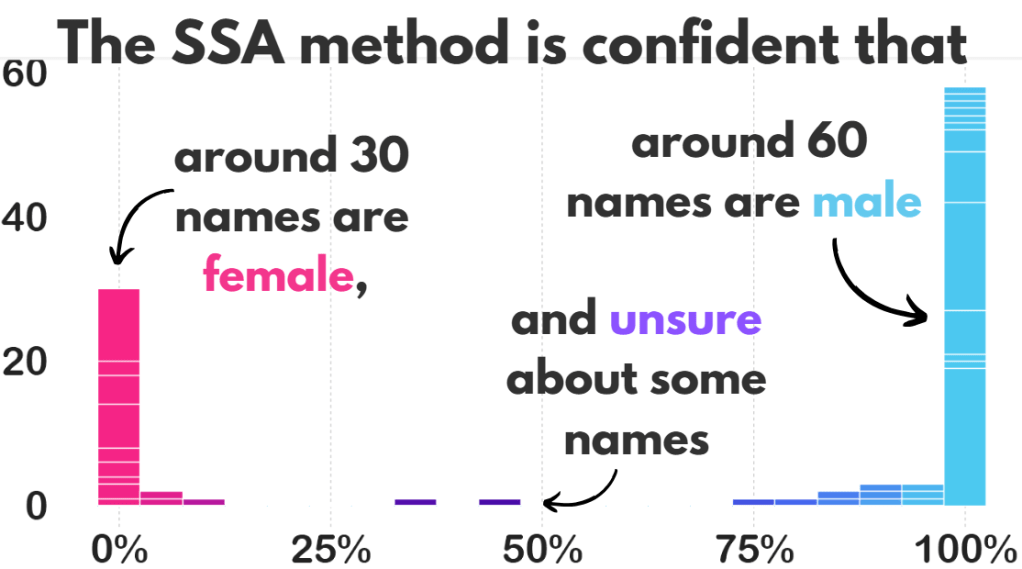
I added the arrows and texts on Canva.

Don’t judge. I just hate the annotate() part of ggplotting.

Two names that the prediction function was unsure about:

  full_name     prop_male_ssa  gender_ssa
    
Pat Buckley      0.359         female    
Jackie Cahill    0.446         female  

In these two instances, the politicians are both male, so it was good that the method flagged how unsure it was about labeling them as “female”.

And the names that the function had no idea about so assigned them as NA:

Violet-Anne Wynne    
Aindrias Moynihan    
Donnchadh Ó Laoghaire
Bríd Smith           
Sorca Clarke         
Ged Nash             
Peadar Tóibín 

Which is fair.

We can graph out whether the SSA predicted gender are the same as the actual genders of the TDs.

So first, we create a new variable that classifies whether the predictions were correct or not. We can also call NA results as incorrect. Although god bless any function attempting to guess what Donnchadh is.

dail_33 %>%
    mutate(correct = ifelse(gender == gender_ssa, "Correct", "Incorrect"), correct = ifelse(is.na(gender_ssa), "Incorrect", correct)) -> dail_correct

And graph it out:

dail_correct %>%
  ggplot(aes(x = gender, y = gender_ssa, color = correct )) +
  geom_jitter(width = 0.3, height = 0.3, alpha = 0.5, size = 4) +
  labs(
    x = "Actual Gender",
    y = "Predicted Gender",
    color = "Prediction") +
  scale_color_manual(values = c("Correct" = "#217653", "Incorrect" = "#780000")) +
  # my_style()
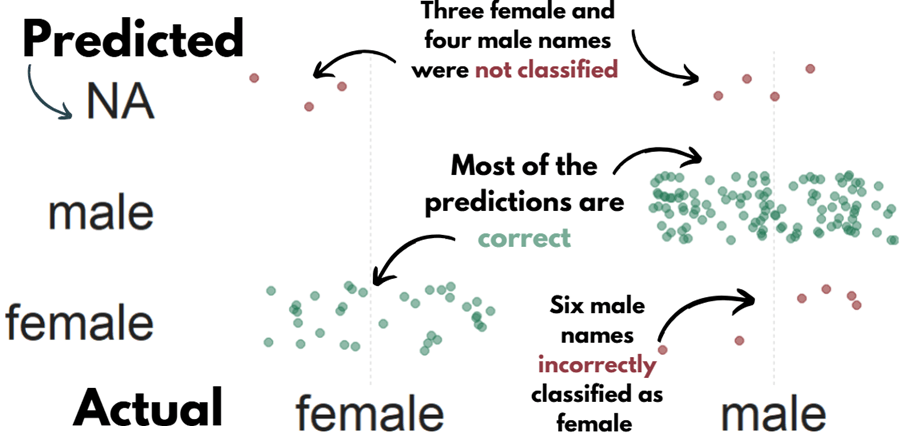
 dail %<>% 
   select(first_name, contains("gender")) %>% 
   distinct(first_name, .keep_all = TRUE) %>%  
   mutate(across(everything(), ~ ifelse(. == "either", NA, .))) 

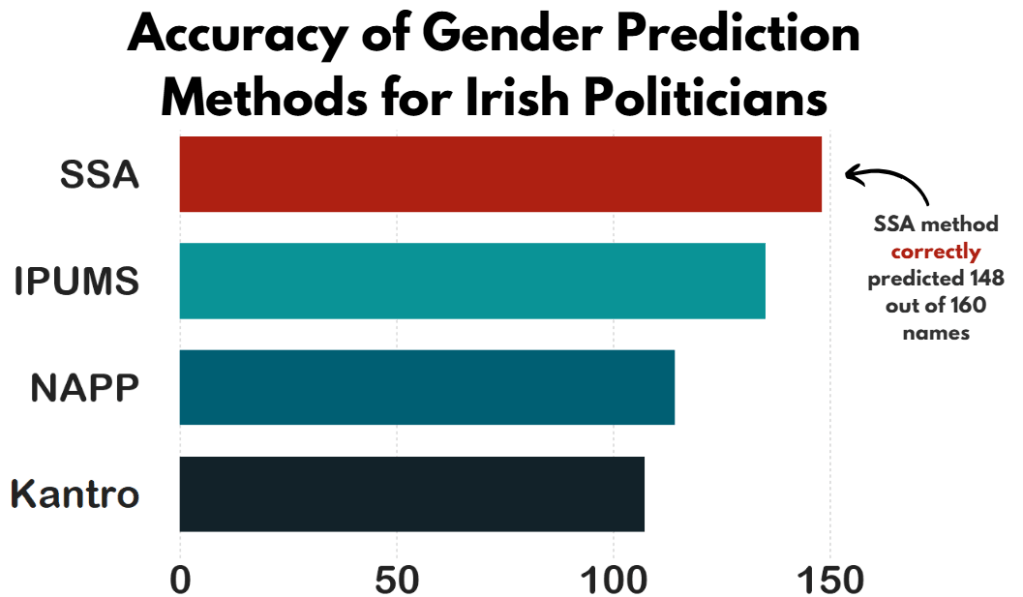
Now, we can compare the SSA method with the other methods in the gender package and see which one is most accurate.

First, we repeat the same steps with the gender() function like above, and change the method arguments.

dail_33 %<>% 
  rowwise() %>%
  mutate(
    gender_ipums = gender(first_name, method = "ipums")$gender[1])

dail_33 %<>% 
  rowwise() %>%
  mutate(gender_napp = gender(first_name, method = "napp")$gender[1])

dail_33 %<>% 
  rowwise() %>%
  mutate(gender_kantro = gender(first_name, method = "kantrowitz" )$gender[1])

dail_33 %<>% 
  rowwise() %>%
  mutate(gender_ize = gender(first_name, method = "genderize" )$gender[1])

Or we can remove duplicates with purrr package

dail_33 %<>% 
  rowwise() %>%
  mutate(across(
    c("ipums", "napp", "kantrowitz", "genderize"), 
    ~ gender(first_name, method = .x)$gender[1], 
    .names = "gender_{.col}"
  ))

Then we calculate which one is closest to the actual measures.

dail_33 %>% 
summarise(accuracy_ssa = mean(ifelse(is.na(gender == gender_ssa), FALSE, gender == gender_ssa)),

     accuracy_ipums = mean(ifelse(is.na(gender == gender_ipums), FALSE, gender == gender_ipums)),

     accuracy_napp = mean(ifelse(is.na(gender == gender_napp), FALSE, gender == gender_napp)),

     accuracy_kantro = mean(ifelse(is.na(gender == gender_kantro), FALSE, gender == gender_kantro))) -> acc

Or to make it cleaner with across()

acc <- dail_33 %>%
  summarise(across(
    c(gender_ssa, gender_ipums, gender_napp, gender_kantro),
    ~ mean(ifelse(is.na(gender == .x), FALSE, gender == .x)),
    .names = "accuracy_{.col}"
  ))

Pivot the data.frame longer so that each method is in a single variable and each value is in an accuracy method.

acc %<>%
  pivot_longer(cols = everything(), names_to = "method", values_to = "accuracy") %>% 
  mutate(method = fct_reorder(method, accuracy, .desc = TRUE)) %>% 
  mutate(method = factor(method, levels = c("accuracy_kantro", "accuracy_napp", "accuracy_ipums", "accuracy_ssa"))) 

my_pal <- c(
  "accuracy_kantro" = "#122229",
  "accuracy_napp" = "#005f73",
  "accuracy_ipums" = "#0a9396",
  "accuracy_ssa" = "#ae2012")

And then graph it all out!

We can use scale_x_discrete() to change the labels of each different method

# Cairo::CairoWin()

acc %>% 
  ggplot(aes(x = method, y = accuracy, fill = method)) +  
  geom_bar(stat = "identity", width = 0.7) +
  coord_flip() + 
  ylim(c(0,160)) +
  theme(legend.position = "none",
        text = element_text(family = "Arial Rounded MT Bold")) +
  scale_fill_manual(values = sample(my_pal)) +
  scale_x_discrete(labels = c("accuracy_ssa" = "SSA",
                              "accuracy_napp" = "NAPP",
                              "accuracy_ipums" = "IPUMS", 
                              "accuracy_kantro" = "Kantro")) +
# my_style() 

Once again, I added the title and the annotations in Canva. I will never add arrow annotations in R if I have other options.
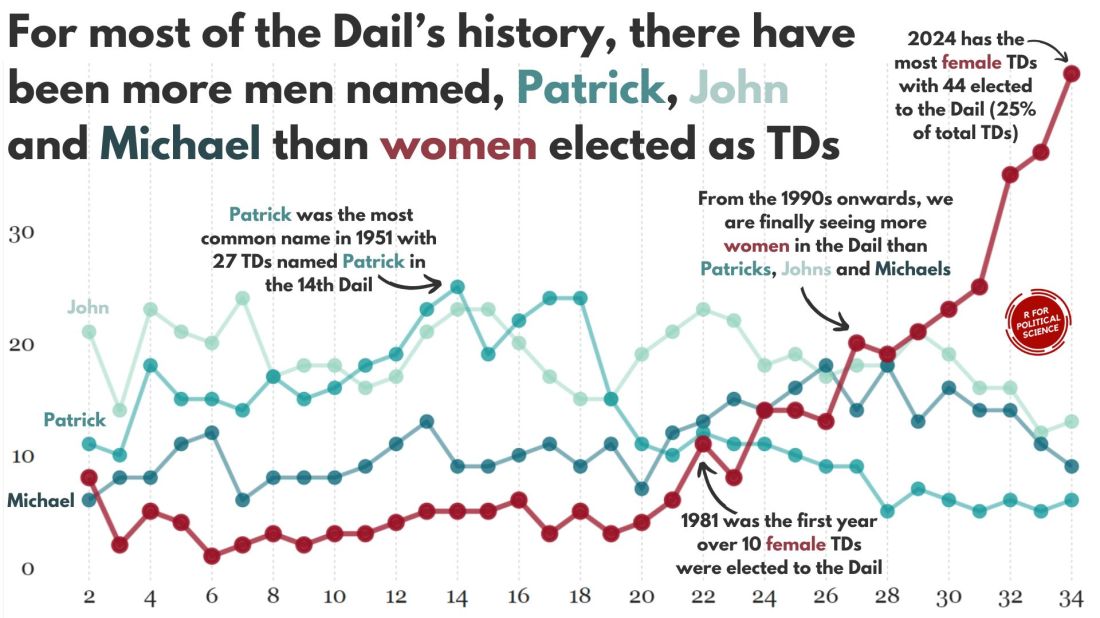
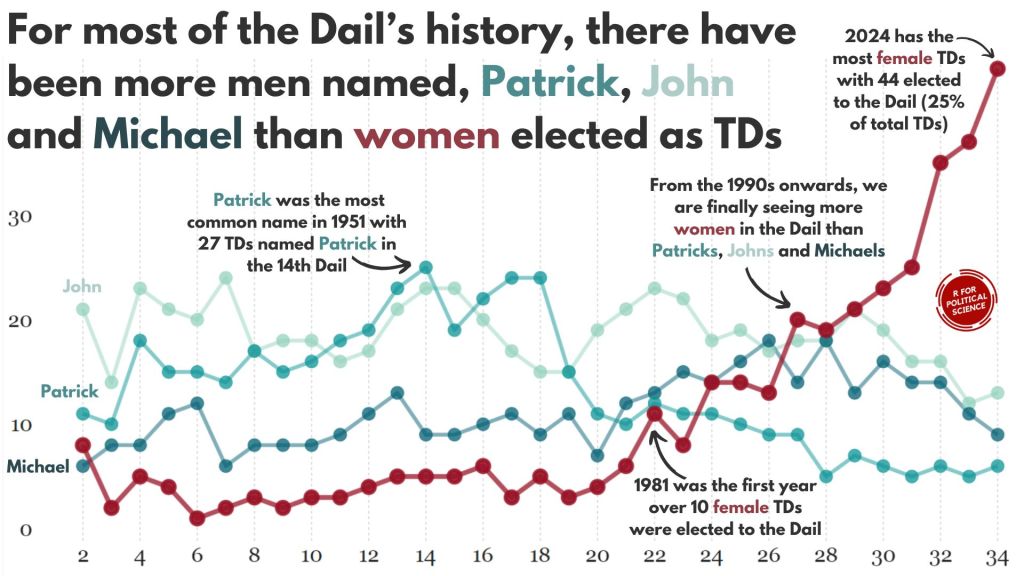
Coming up next, PART 2 on how we can analyse variations on women in the Irish parliament, such as the following graph:
How to web scrape and graph 2024 Irish election data with R

Packages we will use:

library(tidyverse)
library(rvest)
library(janitor)
library(magrittr)
library(ggparliament)
library(ggbump)
library(bbplot)

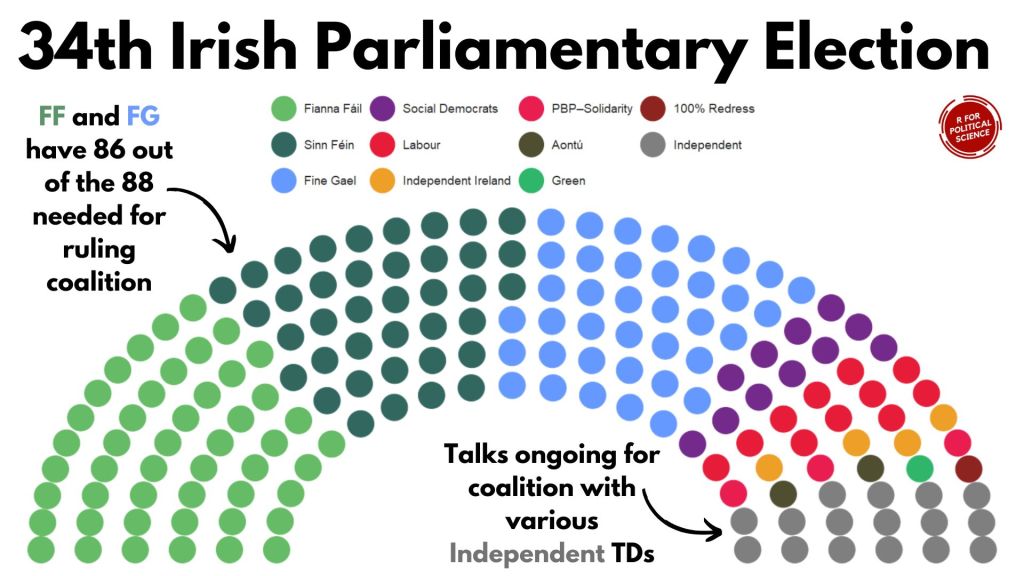
I am an Irish person living abroad. I did NOT follow the elections last year. So, as penance (as I just mentioned, I am Irish and therefore full of phantom Catholic guilt for neglecting political news back home), we will be graphing some of the election data and familiarise ourselves with the new contours of Irish politics in this blog.

Click here to visit the wikipedia page we will be scraping with the rvest package.

Click here to read more about the rvest package for webscraping.

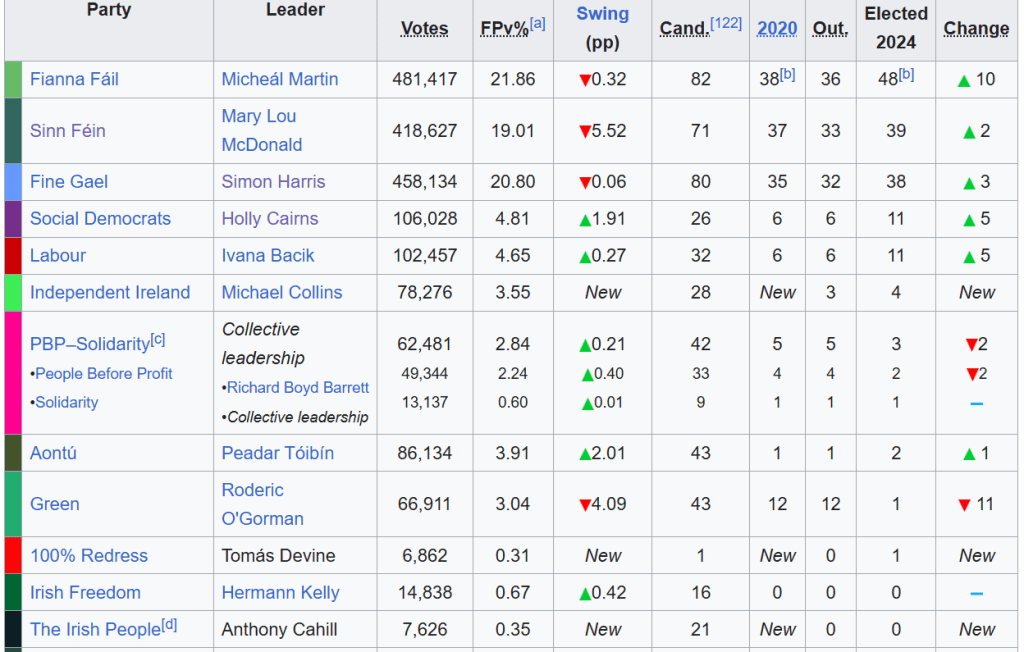
The data we want is in the 11th table on the page:

The columns that we will want are the Party and the Elected 2024 columns.

So using the read_html() function, we can feed in the URL, save all the tables with html_table() and then only keep the eleventh table with `[[`(11)

read_html("https://en.wikipedia.org/wiki/2024_Irish_general_election") %>% 
  html_table(header = TRUE, fill = TRUE) %>% 
  `[[`(11) -> dail_2024

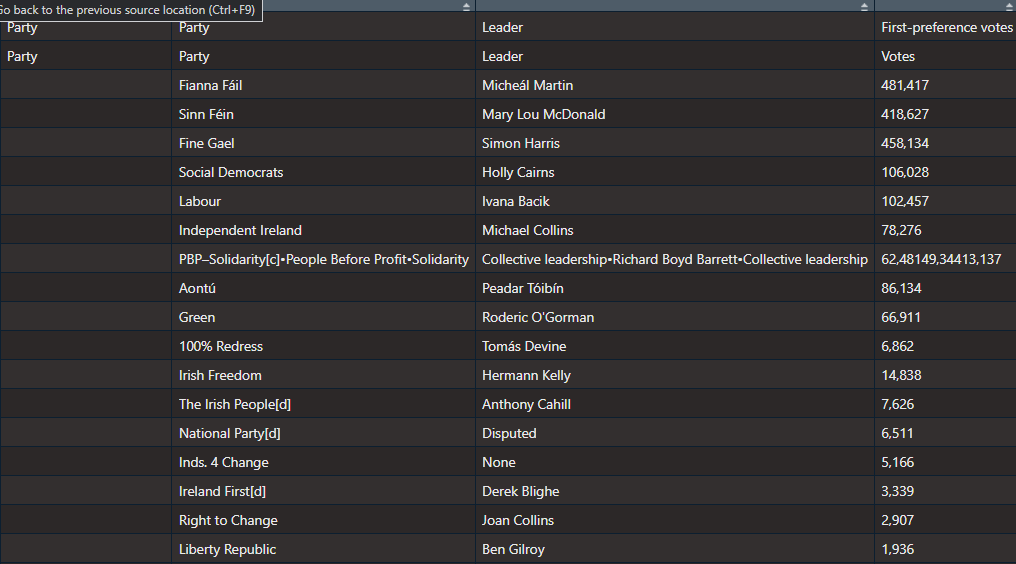
It’s a bit of a hot mess at this stage.

Right now, all the variable names are empty.

We can use the row_to_names() function from the janitor package. This moves a row up to became the variable names. Also we can use clean_names() (also a janitor package staple) to make every variable lowercase snake_case with underscores.

dail_2024 %<>% 
  row_to_names(row_number = 2) %>% 
  clean_names() %>% 

As you can see in the table above, the PBP cell is very crowded. This is due to the fact that many similar left-wing parties formed a loose coaltion when campaigning.

Because they are all in one cell, every number was shoved together without spaces. So instead of each party in the loose grouping, it was all added together. It makes the table wholly incorrect; the PBP coalition did not win trillions of votes.

Things like this highlights the importance of always checking the raw data after web scraping.

So I just brute recode the value according to what is actually on the Wiki page.

dail_2024 %<>% 
  mutate(elected2024 = if_else(party_2 == "PBP–Solidarity[c]•People Before Profit•Solidarity", "3", elected2024))

Next we need to remove the annoying [footnotes in square brackets] on the page with some regex nonsense.

dail_2024 %<>% 
  mutate(across(everything(), ~ str_replace(., "\\[.*$", ""))) 

And finally, we just need to select, rename and change the seat numbers from character to numeric

dail_2024 %<>%  
  select(party = party_2, seats = elected2024)  %>% 
  mutate(seats= parse_number(seats))

Next, we just need to graph it out with the geom_parliament_seats() layer of the ggplot graph with ggparliament package.

Click here to read more about the ggparliament package:

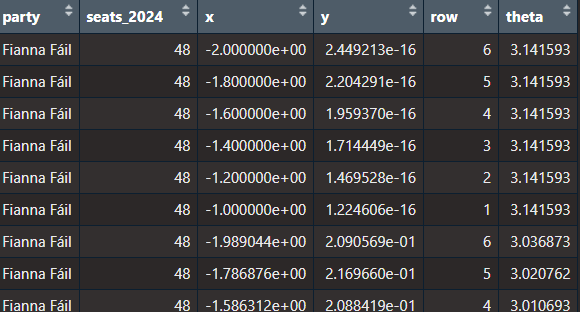
First, we generate the circle coordinates

dail_2024_coord <- parliament_data(election_data = dail_2024,
                   type = "semicircle", 
                   parl_rows = 6,  
                   party_seats = dail_2024$seats_2024)

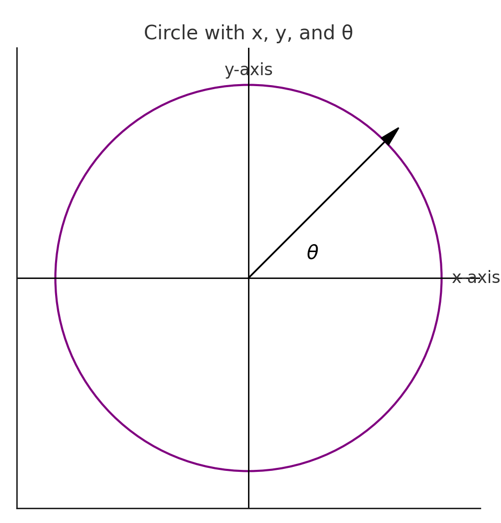
x: the horizontal position of a point in the semi-circle graph.

y: the vertical position of a point in the semi-circle graph.

row: The row or layer of the semi-circle in which the point (seat) is positioned. Rows are arranged from the base (row 1) to the top of the semi-circle.

theta: The angle (in radians) used to calculate the position of each seat in the semi-circle. It determines the angular placement of each point, starting at 0 radians (rightmost point of the semi-circle) and increasing counterclockwise to π\piπ radians (leftmost point of the semi-circle).

We want to have the biggest parties first and the smallest parties at the right of the graph

dail_elected %<>% 
  mutate(party = fct_reorder(party, table(party)[party], .desc = TRUE))

and we can add some hex colors that represent the parties’ representative colours.

dail_elected_coord %<>% 
  mutate(party_colour = case_when(party == "Fianna Fáil" ~ "#66bb66",
                       party == "Fine Gael" ~ "#6699ff",
                       party == "Green" ~ "#2fb66a",
                       party == "Labour" ~ "#e71c38",
                       party == "Sinn Féin" ~ "#326760",
                       party == "PBP–Solidarity" ~ "#e91d50",
                       party ==  "Social Democrats" ~ "#742a8b",
                       party == "Independent Ireland" ~ "#ee9f27",
                       party == "Aontú" ~ "#4f4e31",
                       party == "100% Redress" ~ "#8e2420"))

And we graph out the ggplot with the simple bbc_style() from the bbplot package

dail_elected_coord %>% 
  ggplot(aes(x = x, y = y,
             colour = party)) +
  geom_parliament_seats(size = 13) +
  bbplot::bbc_style()  +
  ggtitle("34th Irish Parliament") +
  theme(text = element_text(size = 50),
        legend.title = element_blank(),
        axis.text.x = element_blank(),
        axis.text.y = element_blank())  +
  scale_colour_manual(values = dail_elected_coord$party_colour,
                      limits = dail_elected_coord$party)

HONESTY TIME… I will admit, I replaced the title as well as the annotated text and arrows with Canva dot comm

Hell is … trying to incrementally make annotations to go to place we want via code. Why would I torment myself when drag-and-drop options are available for free.

Next, let’s compare this year with previous years

I was also hoping to try replicate this blog post about bump plots with highlighted labels from the r-graph-gallery website.

We can use this kind of graph to highlight a particular trend.

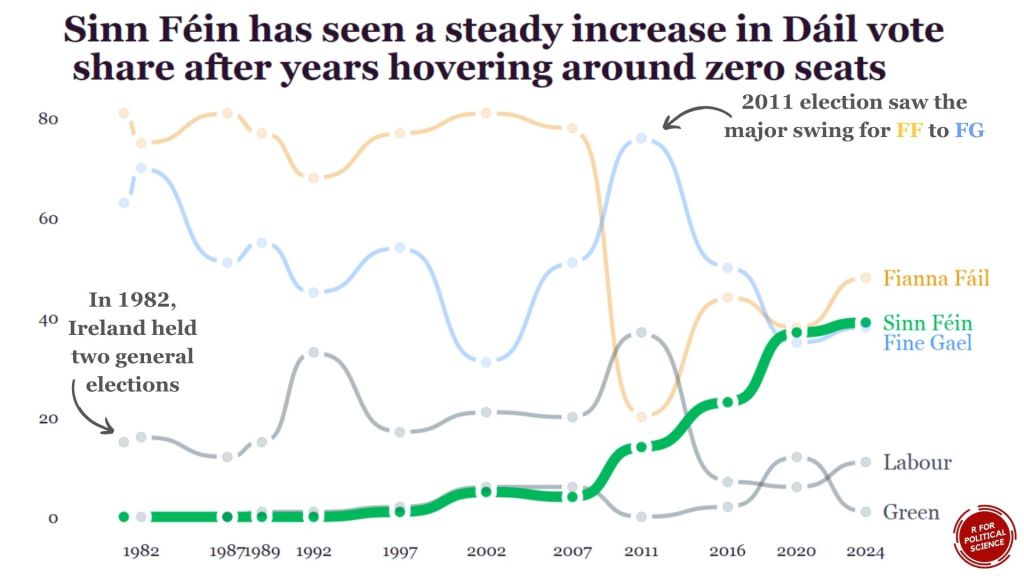
For example, the rise of Sinn Fein as a heavy-hitter in Irish politics.

We will need to go to many of the Wikipedia pages on the elections and scrape seat data for the top parties for each year.

Annoyingly, across the different election pages, the format is different so we have to just go by trial-and-error to find the right table for each election year and to find out what the table labels are for each given year.

Since going to many different pages ends up with repeating lots of code snippets, we can write a process_election_data() function to try cut down on replication.

process_election_data <- function(url, table_index, header_row, party_col, seats_col, top_parties, extra_mutate = NULL) {
  read_html(url) %>%
    html_table(header = TRUE, fill = TRUE) %>%
    `[[`(table_index) %>%
    row_to_names(row_number = header_row) %>%
    clean_names() %>%
    mutate(across(everything(), ~ str_replace(., "\\[.*$", ""))) %>%
    select(party = !!sym(party_col), seats = !!sym(seats_col)) %>%
    mutate(seats = parse_number(seats)) %>%
    filter(party %in% top_parties)
}

In this function, mutate(across(everything(), ~ str_replace(., "\\[.*$", ""))) removes all those annoying footnotes in square brackets from the Wiki table with regex code.

Annoyingly, the table for the 2024 election is labelled differently to the table with the 2016 results on le Wikipedia. So when we are scraping from each webpage, we will need to pop in a sliiiightly different string.

We can use the sym() and the !! to accomodate that.

When we type on !! (which the coder folks call bang-bang), this unquotes the string we feed in. We don’t want the function to treat our string as a string.

After this !! step, we can now add them as variables within the select() function.

We will only look at the biggest parties that have been on the scene since 1980s

top_parties <- c("Fianna Fáil", "Fine Gael", "Sinn Féin", "Labour Party", "Green Party")

Now, we feed in the unique features that are unique for scraping each web page:

dail_2024 <- process_election_data(
  url = "https://en.wikipedia.org/wiki/2024_Irish_general_election
  table_index = 11,
  header_row = 2,
  party_col = "party_2",
  seats_col = "elected2024",
  top_parties = top_parties)

dail_2020 <- process_election_data(
  url = "https://en.wikipedia.org/wiki/2020_Irish_general_election",
  table_index = 10,
  header_row = 2,
  party_col = "party_2",
  seats_col = "elected2020",
  top_parties = top_parties)

dail_2016 <- process_election_data(
  url = "https://en.wikipedia.org/wiki/2016_Irish_general_election",
  table_index = 10,
  header_row = 3,
  party_col = "party_2",
  seats_col = "elected2016_90",
  top_parties = top_parties)

dail_2011 <- process_election_data(
  url = "https://en.wikipedia.org/wiki/2011_Irish_general_election",
  table_index = 14,
  header_row = 2,
  party_col = "party_2",
  seats_col = "t_ds",
  top_parties = top_parties)

dail_2007 <- process_election_data(
  url = "https://en.wikipedia.org/wiki/2007_Irish_general_election",
  table_index = 8,
  header_row = 2,
  party_col = "party_2",
  seats_col = "seats",
  top_parties = top_parties)

dail_2002 <- process_election_data(
  url = "https://en.wikipedia.org/wiki/2002_Irish_general_election",
  table_index = 8,
  header_row = 2,
  party_col = "party_2",
  seats_col = "seats",
  top_parties = top_parties)

dail_1997 <- process_election_data(
  url = "https://en.wikipedia.org/wiki/1997_Irish_general_election",
  table_index = 9,
  header_row = 2,
  party_col = "party_2",
  seats_col = "seats",
  top_parties = top_parties)

dail_1992 <- process_election_data(
  url = "https://en.wikipedia.org/wiki/1992_Irish_general_election",
  table_index = 6,
  header_row = 2,
  party_col = "party_2",
  seats_col = "seats",
  top_parties = top_parties)

dail_1989 <- process_election_data(
  url = "https://en.wikipedia.org/wiki/1989_Irish_general_election",
  table_index = 5,
  header_row = 2,
  party_col = "party_2",
  seats_col = "seats",
  top_parties = top_parties)

dail_1987 <- process_election_data(
  url = "https://en.wikipedia.org/wiki/1987_Irish_general_election",
  table_index = 5,
  header_row = 2,
  party_col = "party_2",
  seats_col = "seats",
  top_parties = top_parties)

dail_1982_11 <- process_election_data(
  url = "https://en.wikipedia.org/wiki/November_1982_Irish_general_election",
  table_index = 5,
  header_row = 2,
  party_col = "party_2",
  seats_col = "seats",
  top_parties = top_parties)

dail_1982_2 <- process_election_data(
  url = "https://en.wikipedia.org/wiki/February_1982_Irish_general_election",
  table_index = 5,
  header_row = 2,
  party_col = "party_2",
  seats_col = "seats",
  top_parties = top_parties)

After we scraped every election, we can join them together

dail_years <- dail_2024 %>% 
  left_join(dail_2020, by = c("party")) %>% 
  left_join(dail_2016, by = c("party")) %>% 
  left_join(dail_2011, by = c("party")) %>% 
  left_join(dail_2007, by = c("party")) %>% 
  left_join(dail_2002, by = c("party")) %>%   
  left_join(dail_1997, by = c("party")) %>% 
  left_join(dail_1992, by = c("party")) %>% 
  left_join(dail_1989, by = c("party")) %>% 
  left_join(dail_1987, by = c("party")) %>% 
  left_join(dail_1982_11, by = c("party")) %>% 
  left_join(dail_1982_2, by = c("party"))

Or I can use a list and iterative left joins.

dail_list <- list(
  dail_2024,
  dail_2020,
  dail_2016,
  dail_2011,
  dail_2007,
  dail_2002,
  dail_1997,
  dail_1992,
  dail_1989,
  dail_1987,
  dail_1982_11,
  dail_1982_2)

dail_years <- reduce(dail_list, left_join, by = "party")

For the x axis ticks, we can quickly make a vector of all the election years we want to highlight on the graph.

election_years <- c(2024, 2020, 2016, 2011, 2007, 2002, 1997, 1992, 1989, 1987, 1982)

Next we pivot the data to long format:

dail_years %>% pivot_longer(
  cols = starts_with("seats_"),
  names_to = "year",
  names_prefix = "seats_",
  values_to = "seats") -> dail_longer

Then we can add specific hex colours for the main parties.

dail_longer %<>%
  mutate(color = ifelse(party == "Sinn Féin", "#2fb66a",
         ifelse(party == "Fine Gael","#6699ff",
         ifelse(party == "Fianna Fáil","#ee9f27","#495051"))))

Next, we can create a final_positions data.frame so that can put the names of the political parties at the end of the trend line instead of having a legend floating at top of the graph.

final_positions <_ dail_longer %>%
  group_by(party) %>%
  filter(year == max(year))  %>% 
  mutate(color = ifelse(party == "Sinn Féin", "#2fb66a",
         ifelse(party == "Fine Gael","#6699ff",
         ifelse(party == "Fianna Fáil","#ee9f27", "#495051")))

Click here to read more about the ggbump package

dail_longer %>% 
  ggplot(aes(x = year, y = seats, group = party)) +

  geom_bump(aes(color = color,
           alpha = ifelse(party == "Sinn Féin", 0.5, 0.2),
           linewidth = ifelse(party == "Sinn Féin", 0.8, 0.7)),
            smooth = 5) +

  geom_text(data = final_positions,
            aes(color = color,
            y = ifelse(party == "Fine Gael", seats - 3, seats),
            label = party,
            family = "Georgia"),
            x = x_position + 1.5,  
            hjust = 0, 
            size = 10) +

  geom_point(color = "white", 
             size = 6, 
             stroke = 3) +
  
  geom_point(aes(color = color,
             alpha = ifelse(party == "Sinn Féin", 0.5, 0.1)),
             size = 4) +

  scale_linewidth_continuous(range = c(2, 5)) +

  scale_alpha_continuous(range = c(0.2, 1)) +

  bbplot::bbc_style()  +

  theme(legend.position = "none",
        plot.title = element_text(size = 48)) +

  scale_color_identity() + 

  scale_x_continuous(limits = c(1980, 2030), breaks = election_years) +

  labs(title = "Sinn Féin has seen a steady increase in Dáil vote\n share after years hovering around zero seats")

Tips and code snippets to improve ggplot graphs and plots in R

Some code snippets to improve graph appearance and readability!

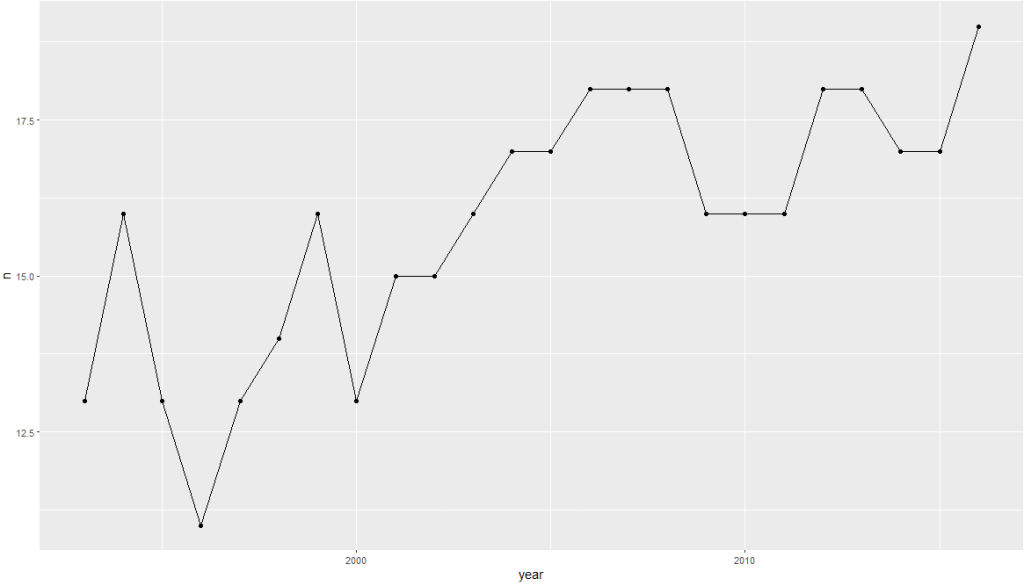
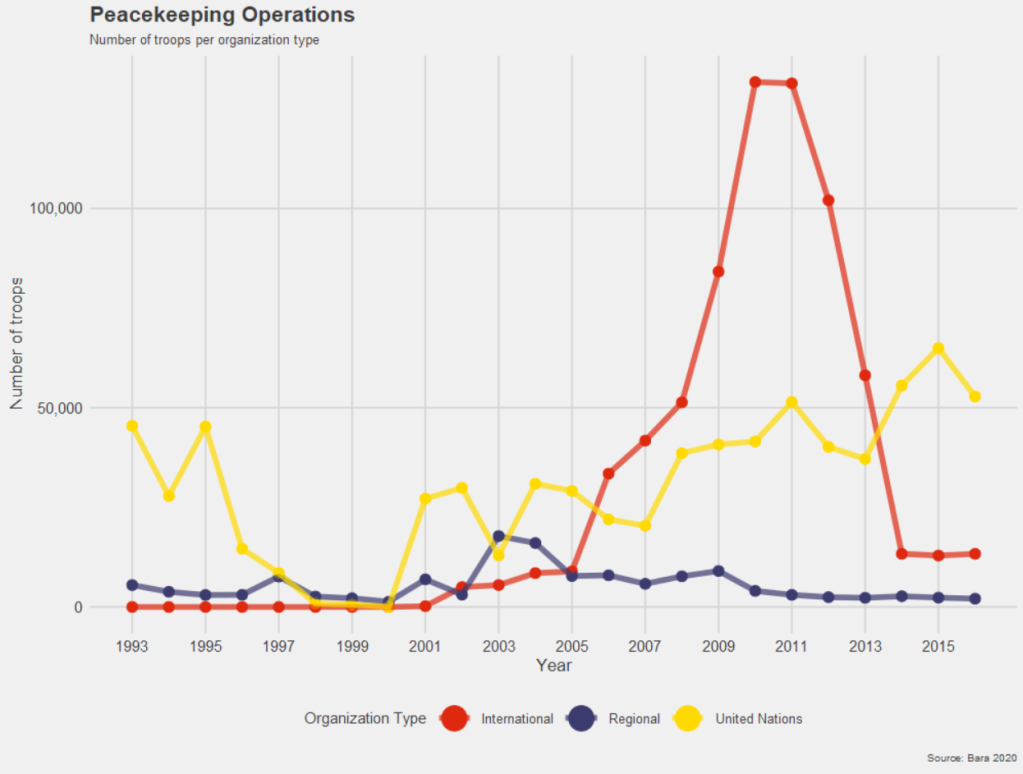
Compare the first basic graph with the second more informative graph.

Happy Birthday Reaction GIF - Find & Share on GIPHY
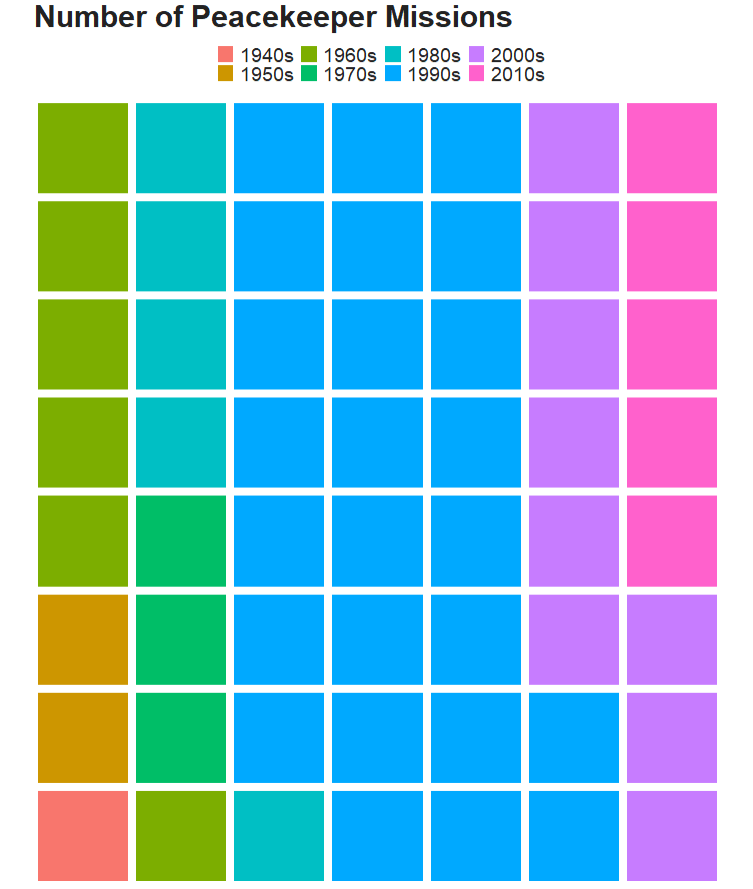
pko %>% 
  group_by(year) %>% 
  count() -> ya

ya %>% 
  ggplot(aes(x = year,
             y = n)) +
  geom_point() + geom_line()

Dealing with the z and y axes can be a pain.

yo %>% 
  ggplot(aes(x = year, y = n)) + 
  geom_point() + 
  geom_line() +
  scale_x_continuous(breaks = seq(min(yo$year, na.rm = TRUE), 
                                  max(yo$year, na.rm = TRUE), 
                                  by = 1)) + 
  scale_y_continuous(limits = c(0, max(yo$n, na.rm = TRUE)),
                     breaks = function(limits) seq(floor(limits[1]), ceiling(limits[2]), by = 1)
  )

In this code:

The breaks argument of scale_y_continuous() is set using a custom function that takes limits as input (which represents the range of the y-axis determined by ggplot2 based on your data).

seq() generates a sequence from the floor (rounded down) of the minimum limit to the ceiling (rounded up) of the maximum limit, with a step size of 1.

This ensures that the sequence includes only whole integers.

Using floor() for the start of the sequence ensures you start at a whole number not greater than the smallest data point, and ceiling() for the end of the sequence ensures you end at a whole number not less than the largest data point.

This approach allows the y-axis to dynamically adapt to your data’s range while ensuring that only whole integers are used as ticks, suitable for counts or other integer-valued data.

pko %>% 
  pivot_longer(!c(cown, year),
               names_to = "organization",
               values_to = "troops") %>% 
  group_by(year, organization) %>% 
  summarise(sum_troops = sum(troops, na.rm = TRUE)) %>% 
  ungroup() -> yo


pal <- c("totals_intl" = "#DE2910",
         "totals_reg" = "#3C3B6E", 
         "totals_un" = "#FFD900")

yo %>% 
  ggplot(aes(x = year, y = sum_troops,
             group = organization,
             color = organization)) + 
  geom_point(size = 3) +
  geom_line(size = 2, alpha = 0.7)  + 
  scale_y_continuous(labels = scales::label_comma()) + 
  # scale_y_continuous(limits = c(0, max(yo$n, na.rm = TRUE))) +
  scale_x_continuous(breaks = seq(min(yo$year, na.rm = TRUE), 
                                  max(yo$year, na.rm = TRUE), 
                                  by = 2)) +
  ggthemes::theme_fivethirtyeight() +
  scale_color_manual(values =  pal,
                     name = "Organization Type",  
                     labels = c("International",
                                "Regional",
                                "United Nations")) +
  labs(title = "Peacekeeping Operations",
       subtitle = "Number of troops per organization type",
       caption = "Source: Bara 2020",
       x = "Year",
       y = "Number of troops") +
  
  guides(color = guide_legend(override.aes = list(size = 8))) + 
  theme(text = element_text(size = 12),  # Default text size for all text elements
        plot.title = element_text(size = 20, face="bold"),  # Plot title
        axis.title = element_text(size = 16),  # Axis titles (both x and y)
        axis.text = element_text(size = 14),  # Axis text (both x and y)
        legend.title = element_text(size = 14),  # Legend title
        legend.text = element_text(size = 12))  # Legend items

Cairo::CairoWin()    
Happy Season 5 GIF by The Office - Find & Share on GIPHY

Next, we will look at changing colors in our maps.

We have a map and we want to make the colors pop more.

Click here to read about downloading the V-DEM and map data:

   geom_tile(data = data.frame(value = seq(0, 1, length.out = length(colors))), 
             aes(x = 1, y = value, fill = value), 
             show.legend = FALSE) +
   scale_fill_gradientn(colors = colors, 
                        breaks = scales::pretty_breaks(n = length(colors)),
                        labels = scales::number_format(accuracy = 1)) +

Creation of data for geom_tile():

data = data.frame(value = seq(0, 1, length.out = length(colors))) 

This line creates a data.frame with a single column named value. The column contains a sequence of values from 0 to 1. The length.out parameter is set to the length of the colors vector, meaning the sequence will be of the same length as the number of colors you have defined. This ensures that the gradient will have the same number of distinct colors as are in your colors vector.

geom_tile()

geom_tile(aes(x = 1, y = value, fill = value), show.legend = FALSE)

geom_tile() is used here to create a series of rectangles (tiles). Each tile will have its y position set to the corresponding value from the sequence created earlier. The x position is fixed at 1, so all tiles will be in a straight line. The fill aesthetic is mapped to the value, so each tile’s fill color will be determined by its y value. The show.legend = FALSE parameter hides the legend for this layer, which is typically used when you want to create a custom legend.

scale_fill_gradientn()

scale_fill_gradientn(colors = colors, breaks = scales::pretty_breaks(n = length(colors)), labels = scales::number_format(accuracy = 1)) 

scale_fill_gradientn() creates a color scale for the fill aesthetic based on the colors vector that we supplied.

The breaks argument is set with scales::pretty_breaks(n = length(colors)), which calculates ‘pretty’ breaks for the scale, basically nice round numbers within the range of your data, and it is set to create as many breaks as there are colors.

The labels argument is set with scales::number_format(accuracy = 2), which specifies how the labels on the legend should be formatted. The accuracy = 2 parameter means that the labels will be formatted to one decimal place

How to graph proportions with the waffle and treemapify packages in R

Packages we will need:

library(tidyverse)
library(magrittr)
library(waffle)
library(treemapify)

In this blog, we will look at visualising proportions in a few lines.

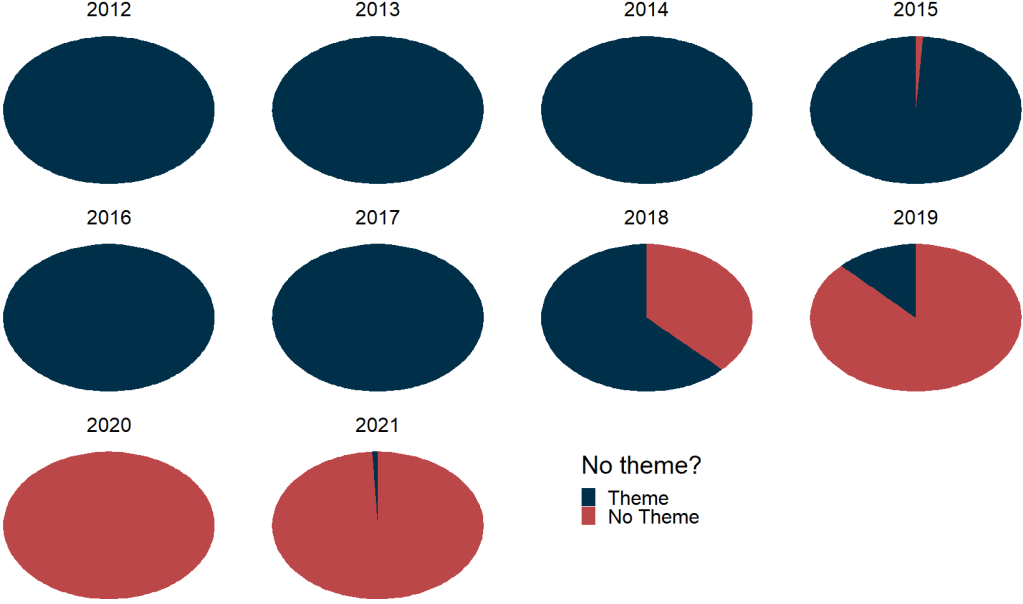
I have some aid data and I want to see what proportion of the aid does not have a theme category.

This can be useful to visualise incomplete data across years or across categories.

First, we can make a waffle chart with the waffle package.

30 Rock Pizza GIF - Find & Share on GIPHY

First, we will create a binary variable that has 1 if the theme is “Other Theme” and 0 if it has a theme value. We will do this for every year.

aid_data %>% 
  group_by(start_year) %>% 
  mutate(binary_variable = as.numeric(theme_1 == "Other Theme")) %>% 
  ungroup() %>% count()
# Groups:   start_year [10]
   start_year     n
        <int> <int>
 1       2012     1
 2       2013     3
 3       2014    17
 4       2015    91
 5       2016   100
 6       2017    94
 7       2018   198
 8       2019   144
 9       2020   199
10       2021   119

Then we will count the number of 0 and 1s for each year with group_by(start_year, binary_variable)

aid_data %>% 
  group_by(start_year) %>% 
  mutate(binary_variable = as.numeric(theme_1 == "Other Theme")) %>%
  ungroup() %>% 
  group_by(start_year, binary_variable) %>% 
  count() %>% 
# A tibble: 14 × 3
# Groups:   start_year, binary_variable [14]
   start_year binary_variable     n
        <int>           <dbl> <int>
 1       2012               0     1
 2       2013               0     3
 3       2014               0    17
 4       2015               0    90
 5       2015               1     1
 6       2016               0   100
 7       2017               0    94
 8       2018               0   124
 9       2018               1    74
10       2019               0    18
11       2019               1   126
12       2020               1   199
13       2021               0     1
14       2021               1   118

We can do the two steps above together in one step and then create the ggplot object with the geom_waffle() layer.

For the ggplot layers:

We use the binary_variable in the fill argument.

We use the n variable in the values argument.

We will facet_wrap() with the start_year argument.

aid_date %>%
 group_by(start_year) %>% 
  mutate(binary_variable = as.numeric(theme_1 == "Other Theme")) %>%
  ungroup() %>% 
  group_by(start_year, binary_variable) %>% 
  count() %>% 
  ggplot(aes(fill = as.factor(binary_variable), values = n)) +
  geom_waffle(color = "white", size = 0.3, n_rows = 10, flip = TRUE) +
  facet_wrap(~start_year, nrow = 1, strip.position = "bottom") + 
  bbplot::bbc_style() +
  scale_fill_manual(values =c("#003049", "#bc4749"),
                    name = "No theme?",
                    labels = c("Theme", "No Theme")) +
  theme(axis.text.x.bottom = element_blank(),
        text = element_text(size = 40))

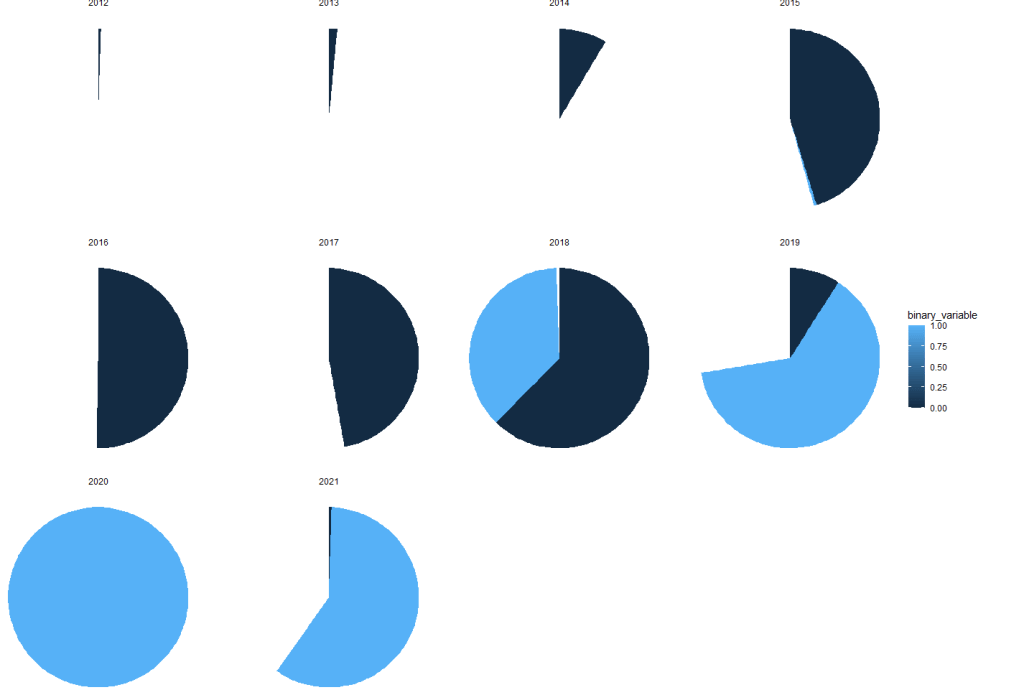
We can see that all the years up to 2018 have most of the row categorised. After 2019, it all goes awry; most of the aid rows are not categorised at all. Messy.

Although, I prefer the waffle charts, because it also shows a quick distribution of aid rows across years (only 1 in 2012 and many in later years), we can also look at pie charts

We can facet_wrap() with pie charts…

… however, there are a few steps to take so that the pie charts do not look like this:

Get Out Ugh GIF - Find & Share on GIPHY

We cannot use the standard coord_polar argument.

Rather, we set a special my_coord_polar to use as a layer in the ggplot.

my_coord_polar <- coord_polar(theta = "y")
my_coord_polar$is_free <- function() TRUE

Then we use the same count variables as above.

We also must change the facet_wrap() to include scales = "free"

aid_data %>%
  group_by(start_year) %>% 
  mutate(binary_variable = as.numeric(theme_1 == "Other Theme")) %>% 
  ungroup() %>% 
  group_by(start_year, binary_variable) %>% 
  count() %>% 
  ungroup() %>% 
  ggplot(aes(x = "", y = n, fill = as.factor(binary_variable))) +
  geom_bar(stat="identity", width=1) +
  my_coord_polar +
  theme_void() + 
  facet_wrap(~start_year, scales = "free")+ 
  scale_fill_manual(values =c("#003049", "#bc4749"),
                    name = "No theme?",
                    labels = c("Theme", "No Theme"))

And we can create a treemap to see the relative proportion of regions that receieve an allocation of aid:

First some nice hex colors.

pal <- c("#005f73", "#006f57", "#94d2bd", "#ee9b00", "#ca6702", "#8f2d56", "#ae2012")

Then we create characters strings for the numeric region variable and use it for the fill argument in the ggplot.

aid_data %>% 
  mutate(region = case_when(
    pol_region_6 == 1 ~ "Post-Soviet",
    pol_region_6 == 2 ~ "Latin America",
    pol_region_6 == 3 ~ "MENA",
    pol_region_6 == 4 ~ "Africa",
    pol_region_6 == 5 ~ "West",
    pol_region_6 == 6 ~ "Asia",
    TRUE ~ "Other"))  %>% 
  group_by(region) %>% 
  count() %>% 
  ggplot(aes(area = n, fill = region, 
             label = paste(region, n, sep = "\n"))) +
  geom_treemap(color = "white", size = 3) +
  geom_treemap_text(
    place = "centre",
    size = 20) +
  theme(legend.position = "none")  +
  scale_fill_manual(values = sample(pal))

How to graph bubble charts and treemap charts in R

Packages we will need:

library(tidyverse)
library(bubbles)
library(treemapify)
library(democracyData)
library(magrittr)

In this blog, we will look at different types of charts that we can run in R.

Approve Always Sunny GIF by It's Always Sunny in Philadelphia - Find & Share on GIPHY

Both the bubble and treemap charts are simple to run.

Before we begin, we will choose some hex colors for the palette. I always use the coolors palettes website to find nice colours.

pal <- c("#bc4749", "#005f73", 
         "#0a9396", "#94d2bd", 
         "#bb3e03","#003049",
         "#fca311", "#99d98c",
         "#9a5059", "#ee9b00")

First, we can download the data we will graph.

In this case, we will use the DD (democracies and dictatorships) regime data from PACL dataset on different government regimes.

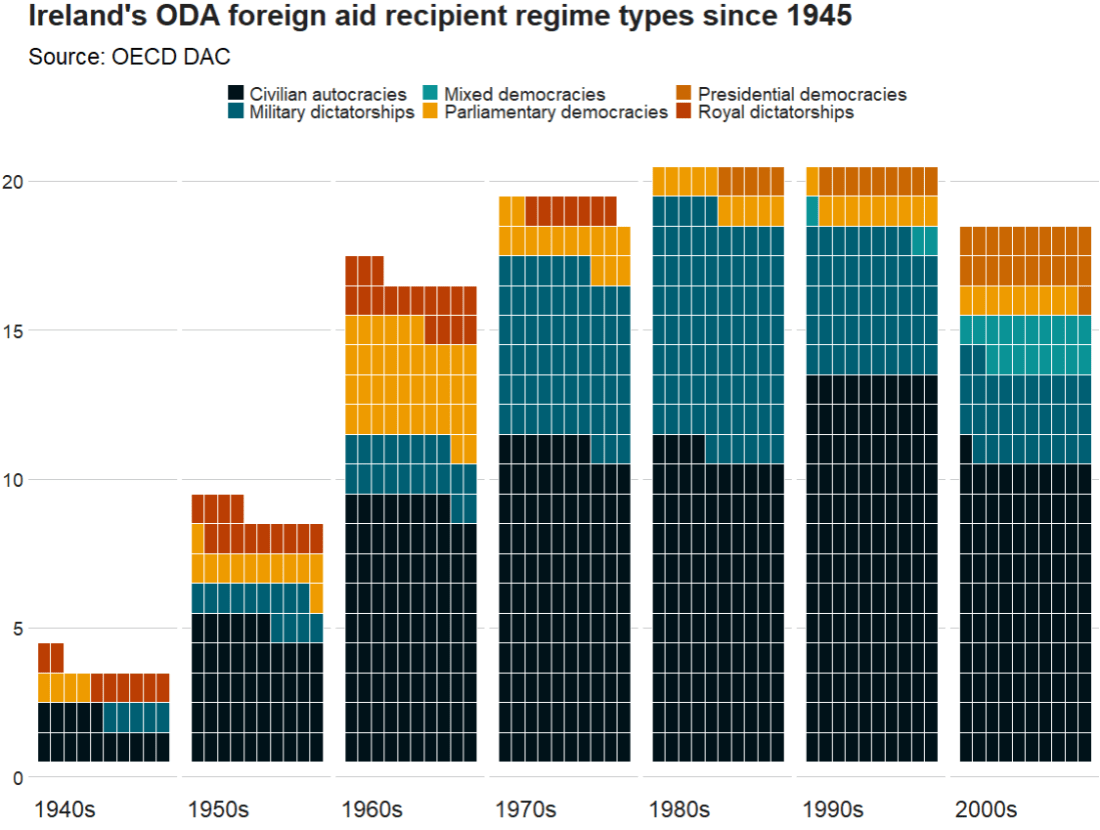
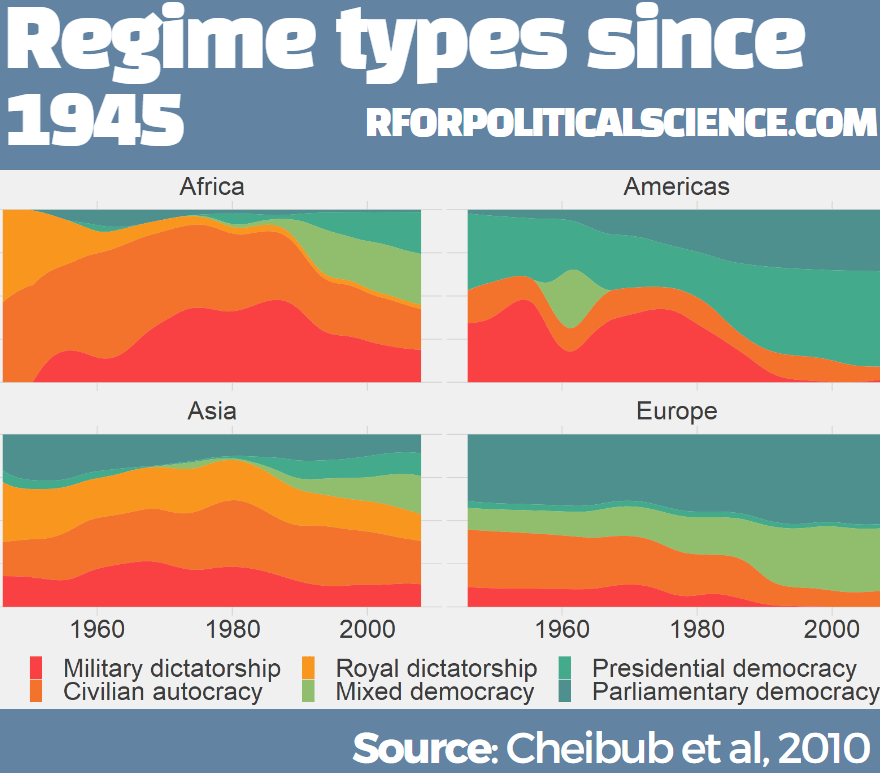
The DD dataset encompasses annual data points for 199 countries spanning from 1946 to 2008. The visual representations on the left illustrate the outcomes in 1988 and 2008.

Cheibub, Gandhi, and Vreeland devised a six-fold regime classification scheme, giving rise to what they termed the DD datasets. The DD index categorises regimes into two types: democracies and dictatorships.

Democracies are divided into three types: parliamentary, semi-presidential, and presidential democracies.

Dictatorships are subcategorized into monarchic, military, and civilian dictatorship.

democracyData::pacl -> pacl

First, we create a new variable with the regime names, not just the number. The values come from the codebook.

Tv Show Drinking GIF - Find & Share on GIPHY
pacl %<>% 
  mutate(regime_name = ifelse(regime == 0, "Parliamentary democracies",
                 ifelse(regime == 1, "Mixed democracies",
                 ifelse(regime == 2, "Presidential democracies",
                 ifelse(regime == 3, "Civilian autocracies",
                 ifelse(regime == 4, "Military dictatorships",
                 ifelse(regime ==  5,"Royal dictatorships", regime))))))) %>%
  mutate(regime = as.factor(regime)) 
  order pacl_country  year regime_name        
  <dbl> <chr>        <dbl> <chr>              
1     1 Afghanistan   1946 Royal dictatorships
2     2 Afghanistan   1947 Royal dictatorships
3     3 Afghanistan   1948 Royal dictatorships
4     4 Afghanistan   1949 Royal dictatorships
5     5 Afghanistan   1950 Royal dictatorships
6     6 Afghanistan   1951 Royal dictatorships

We want to count the number of different regime types.

pacl %>% 
  group_by(regime_name) %>% 
  count() -> pacl_count

We can graph out the geom_treemap() layer in the ggplot() object

pacl_count %>% 
  ggplot(aes(area = n, fill = regime_name, 
           label = paste(regime_name, n, sep = "\n"))) +
  geom_treemap(color = "white", size = 3) +
  geom_treemap_text(
    place = "centre",
    size = 20) +
  theme(legend.position = "none") + 
  scale_fill_manual(values = sample(pal)) 

And we can use the bubbles() function from the bubbles package.

Unfortunately, it is not pipable into ggplot, so it is hard to edit factors such as the font size.

bubbles::bubbles(label = pacl_count$regime_name,
                 value = pacl_count$n, 
                 color = sample(pal, size = length(pacl_count$regime_name)))

Thank you for reading!

How to graph Locally Weighted Scatterplot Smoothing (LOESS) in R

The loess method in ggplot2 fits a smoothing line to our data.

We can do this with the method = "loess" in the geom_smooth() layer.

LOESS stands “Locally Weighted Scatterplot Smoothing.” (I am not sure why it is not called LOWESS … ?)

The loess line can help show non-linear relationships in the scatterplot data, while taking care of stopping the over-influence of outliers.

Loess gives more weight to nearby data points and less weight to distant ones. This means that nearby points have a greater influence on the squiggly-ness of the line.

The degree of smoothing is controlled by the span parameter in the geom_smooth() layer.

When we set the span, we can choose how many nearby data points are considered when estimating the local regression line.

A smaller span (e.g. span = 0.5) results in more local (flexible) smoothing, while a larger span (e.g. span = 1.5) produces more global (smooth) smoothing.

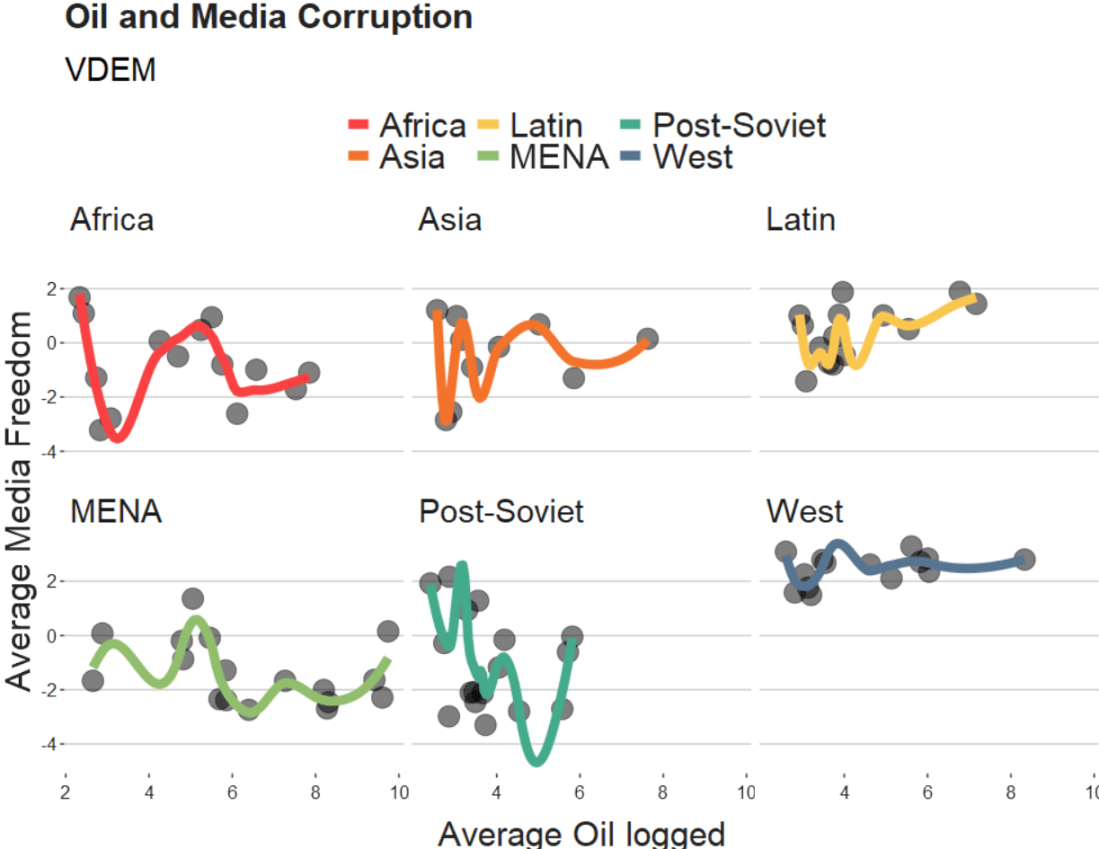
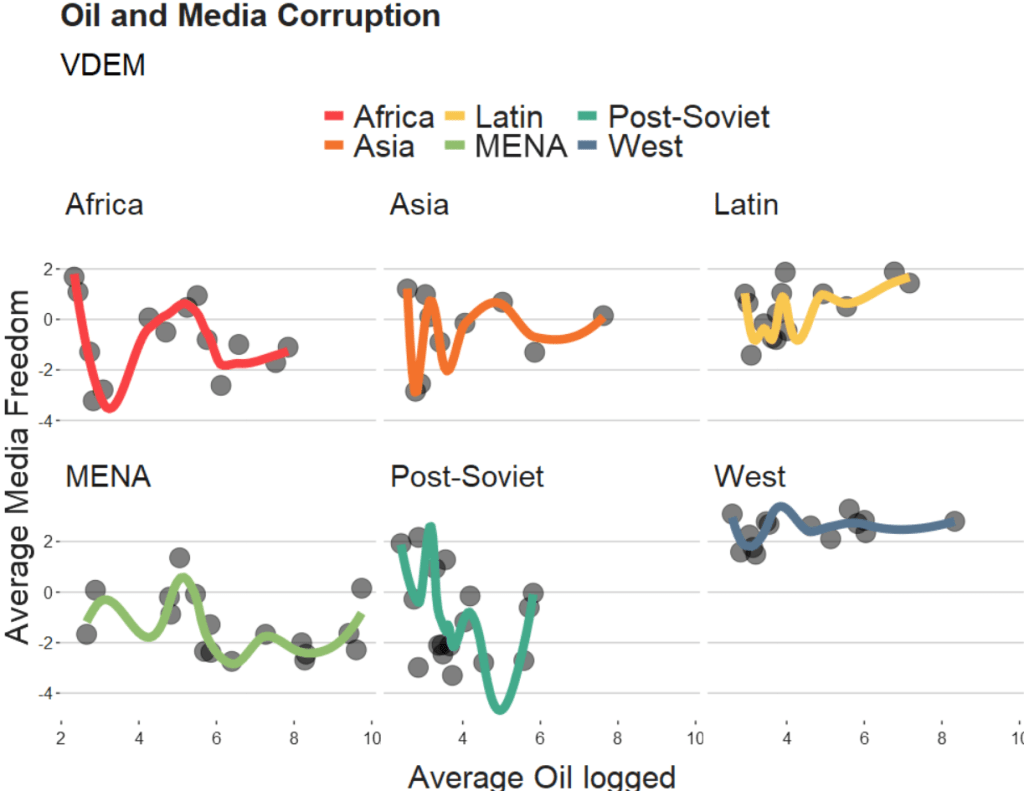
We will take the variables from the Varieties of Democracy dataset and plot the relationship between oil produciton and media freedoms across different regions.

df %>% 
  ggplot(aes(x = log_avg_oil,
             y = avg_media)) +
  geom_point(size = 6, alpha = 0.5) + 
  geom_smooth(aes(color = region), 
              method = "loess", 
              span = 2,
              se = FALSE,
              size = 3,
              alpha = 0.6) + 
  facet_wrap(~region) + 
  labs(title = "Oil and Media Corruption", subtitle = "VDEM",
       x = "Average Oil logged",
       y = "Average Media Freedom") +
  scale_color_manual(values = my_pal) + 
  my_theme()

If we change the span to 0.5, we get the following graph:
              span = 0.5
George Costanza Dancing GIF by Crave - Find & Share on GIPHY

When examining the connection between oil production and media freedoms across various regions, there are many ways to draw the line.

If we think the relationship is linear, it is no problem to add method = "lm" to the graph.

However, if outliers might overly distort the linear relationship, method = "rlm" (robust linear model” can help to take away the power from these outliers.

Linear and robust linear models (lm and rlm) can also accommodate parametric non-linear relationships, such as quadratic or cubic, when used with a proper formula specification.

For example, “geom_smooth(method=’lm’, formula = y ~ x + I(x^2))” can be used for estimating a quadratic relationship using lm.

If the outcome variable is binary (such as “is democracy” versus “is not democracy” or “is oil producing” versus “is not oil producing”) we can use method = “glm” (which is generalised linear model). It models the log odds of a oil producing as a linear function of a predictor variable, like age.

If the relationship between age and log odds is non-linear, the gam method is preferred over glm. Both glm and gam can handle outcome variables with more than two categories, count variables, and other complexities.

How to graph different distributions for political science analysis in R. PART 1: Binomial, Bernoulli and Geometric Distributions.

Packages we will need:

library(tidyverse)

In this blog, we will look at three distributions.

Distributions are fundamental to statistical inference and probability.

Cbc No GIF by Kim's Convenience - Find & Share on GIPHY

The data we will be using is on Irish legislative elections from 1919.

Binomial Distribution

First we can look at the binomial distribution.

We can model the number of successful elections (e.g., a party winning) out of a fixed number of elections (trials).

In R, we use rbinom() to create the distribution.

rbinom(n, size, prob)

We need to feed in three pieces of information into this function

Parameters

  • n: The number of random samples we want.

  • size: The number of trials.

  • prob: The probability of success for each trial.

We can use rbinom() to simulate 100 elections and see how likely there will be a change in the party in power.

ire_leg %>% 
  filter(leg_election_change != "No election") %>% 
  summarise(avg_change = mean(change_binary, na.rm = TRUE))

When we print this, we learn that in 20% of the elections in Ireland, there has been a change in winning party.

So we will use the Binomial distribution to simulate 10 years of elections.

We will do this 100 times and create a graph of change probabilities.

Essentially we can visualise how likely there will we see a change in the party in power.

First, we choose how many times we want to estimate the probability

num_simulations <- 100  

Next, we choose the number of years that we want to look at

years <- 10

Then, we set the probability that an election ends with new party in power :

probability_of_change <- 0.2 

And we throw them all together into the rbinom() function

simulations <- rbinom(n = num_simulations, 
size = years, 
prob = probability_of_change)

proportion_of_changes <- mean(simulations > 0)

We can see that there is an 87% chance that the party in power will change in the next 10 years, according to 100 simulations.

We can use geom_histogram() to examine the distributions

ggplot(data.frame(simulations), aes(x = simulations)) +
  geom_histogram(binwidth = 1, fill = "#023047",
                 color = "black", alpha = 0.7) +
  labs(title = "Distribution of Party Changes",
       x = "Number of Changes",
       y = "Probability") +
  scale_y_continuous(labels = scales::percent_format(scale = 1)) +
  scale_x_continuous(breaks = seq(0, 5, by = 1)) +
  bbplot::bbc_style()

And if we think the probability is high, we can graph that too.

So we can set the probability that the party in power wll change in one year to 0.8

probability_of_change <- 0.8 

Geometric Distribution

While we use the binomial distribution to simulate the number of sucesses in a fixed number of trials, we use the geometric distribution to simulate number of trials needed until the first success (e.g. first instance that a new party comes into power after an election).

It can answer questions like, “On average, how many elections did a party need to contest before winning its first election?”

# Set the probability of that a party will change power in one year
prob_success <- 0.2   

# Generate values for the number of years until the first change in power
trials_values <- 1:20  

# Calculate the PMF values for the geometric distribution
pmf_values <- dgeom(trials_values - 1, prob = prob_success)

# Create a data frame
df <- data.frame(k = trials_values, pmf = pmf_values)

The dgeom() function in R is used to calculate the probability mass function (PMF) for the geometric distribution.

It returns the probability of obtaining a specific number of trials (k) until the first success occurs in a sequence of independent Bernoulli trials.

Each trial has a constant probability of success (p).

In this instance, the dgeom() function calculates the PMF for the number of trials until the first success (from 0 to 10 years).

This is estimated with a success probability of 0.2.

prob_success <- 0.2  

# Generate the number of trials until the first success
trials_values <- 1:20  

# Calculate the PMF values 
pmf_values <- dgeom(trials_values - 1, prob = prob_success)

# Create a data frame
my_dist <- data.frame(k = trials_values, pmf = pmf_values)

And we will graph the geometric distribution

my_dist %>%
  ggplot(aes(x = k,  y = pmf)) +
  geom_bar(stat = "identity", 
           fill = "#023047",
           alpha = 0.7) +
  labs(title = "Geometric Distribution",
    x = "Number of Years Until New Party",
    y = "Probability") +
  my_theme()

To interpret this graph, there is a 20% chance that there will be a new party next year and 10% chance that it will take 3 yaers until we see a new party in power.

Bernoulli Distribution

Nature of Trials

The Bernoulli distribution is the most simple case where each election is considered as an independent Bernoulli trial, resulting in either success (1) or failure (0) based on whether a party wins or loses.

  • The binomial distribution focuses on the number of successful elections out of a fixed number of trials (years).

  • The geometric distribution focuses on the number of trials (year) required until the first success (change of party in power) occurs.

  • The Bernoulli distribution is the simplest case, treating each change as an independent success/failure trial.

Thank you for readdhing. Next we will look at F and T distributiosn in police science resaerch.

How to create a Regional Economic Communities dataset. PART ONE: Scraping data with rvest in R

Click here for part two on the REC dataset.

Packages we will need:

library(tidyverse)
library(rvest)
library(janitor)
library(ggflags)
library(countrycode)

The Economic Community of West African States (ECOWAS) has been in the news recently. The regional bloc is openly discussing military options in response to the coup unfolding in the capital of Niger.

This made me realise that I know VERY VERY LITTLE about the regional economic communities (REC) in Africa.

Ernest Aniche (2015: 41) argues, “the ghost of [the 1884] Berlin Conference” led to a quasi-balkanisation of African economies into spheres of colonial influence. He argues that this ghost “continues to haunt Africa […] via “neo-colonial ties” today.

To combat this balkanisation and forge a new pan-Africanist approach to the continent’s development, the African Union (AU) has focused on regional integration.

This integration was more concretely codified with 1991’s Abuja Treaty.

One core pillar on this agreement highlights a need for increasing flows of intra-African trade and decreasing the reliance on commodity exports to foreign markets (Songwe, 2019: 97)

Broadly they aim mirror the integration steps of the EU. That translates into a roadmap towards the development of:

Free Trade Areas:

  • AU : The African Continental Free Trade Area (AfCFTA) aims to create a single market for goods and services across the African continent, with the goal of boosting intra-African trade.
  • EU : The European Free Trade Association (EFTA) is a free trade area consisting of four European countries (Iceland, Liechtenstein, Norway, and Switzerland) that have agreed to remove barriers to trade among themselves.

Customs Union:

  • AU: The East African Community (EAC) is an REC a customs union where member states (Burundi, Kenya, Rwanda, South Sudan, Tanzania, and Uganda) have eliminated customs duties and adopted a common external tariff for trade with non-member countries.
  • EU: The EU’s Single Market is a customs union where goods can move freely without customs duties or other barriers across member states.

Common Market:

  • AU: Many RECs such the Southern African Development Community (SADC) is working towards establishing a common market that allows for the free movement of goods, services, capital, and labor among its member states.
  • EU: The EU is a prime example of a common market, where not only goods and services, but also people and capital, can move freely across member countries.

Economic Union:

  • AU: The West African Economic and Monetary Union (WAEMU) is moving towards an economic union with shared economic policies, a common currency (West African CFA franc), and coordination of monetary and fiscal policies.
  • EU: Has coordinated economic policies and a single currency (Euro) used by several member states.

The achievement of a political union on the continent is seen as the ultimate objective in many African countries (Hartzenberg, 2011: 2), such as the EU with its EU Parliament, Council, Commission and common foreign policy.

According to a 2012 UNCTAD report, “progress towards regional integration has, to date, been uneven, with some countries integrating better at the regional and/or subregional level and others less so”.

So over this blog, series, we will look at the RECs and see how they are contributing to African integration.

We can use the rvest package to scrape the countries and information from each Wiki page. Click here to read more about the rvest package and web scraping:

First we will look at the Arab Maghreb Union (AMU). We feed the AMU wikipedia page into the read_html() function.

With `[[`(3) we can choose the third table on the Wikipedia page.

With the janitor package, we can can clean the names (such as remove capital letters and awkward spaces) and ensure more uniform variable names.

We pull() the country variable and it becomes a vector, then turn it into a data frame with as.data.frame() . Alternatively we can just select this variable with the select() function.

We create some more variables for each REC group when we merge them all together later.

We will use the str_detect() function from the stringr package to filter out the total AMU column row as it is non-country.

read_html("https://en.wikipedia.org/wiki/Arab_Maghreb_Union") %>% 
  html_table(header = TRUE, fill = TRUE) %>% 
  `[[`(3) %>%  
  clean_names()  %>% 
  pull(country) %>% 
  as.data.frame() %>% 
  mutate(rec = "Arab Meghreb Union",
         geo = "Maghreb", 
         rec_abbrev = "AMU") %>% 
  select(country = '.', everything()) %>% 
  filter(!str_detect(country, fixed("Arab Maghreb", ignore_case = TRUE))) -> amu

We can see in the table on the Wikipedia page, that it contains a row for all the Arab Maghreb Union countries at the end. But we do not want this.

We use the str_detect() function to check if the “country” variable contains the string pattern we feed in. The ignore_case = TRUE makes the pattern matching case-insensitive.

The ! before str_detect() means that we remove this row that matches our string pattern.

We can use the fixed() function to make sure that we match a string as a literal pattern rather than a regular expression pattern / special regex symbols. This is not necessary in this situation, but it is always good to know.

For this example, I will paste the code to make a map of the countries with country flags.

Click here to read more about adding flags to maps in R

First we download a map object from the rnaturalearth package

world_map <- ne_countries(scale = "medium", returnclass = "sf")

To add the flags on the map, we need longitude and latitude coordinates to feed into the x and y arguments in the geom_flag(). We can scrape these from the web too.

We add iso2 character codes in all lower case (very important for the geom_flag() step)) with the countrycode() function.

Click here to read more about the countrycode package.

read_html("https://developers.google.com/public-data/docs/canonical/countries_csv") %>%
  html_table(header = TRUE, fill = TRUE) %>% 
  `[[`(1) %>% 
  select(latitude, 
         longitude, 
         iso_a2 = country) %>% 
  right_join(world_map, by = c("iso_a2" = "iso_a2")) %>% 
  left_join(amu, by = c("admin" = "country")) %>% 
  select(latitude, longitude, iso_a2, geometry, admin, region_un, rec, rec_abbrev) %>% 
  mutate(amu_map = ifelse(!is.na(rec), 1, 0),
         iso_a2 = tolower(iso_a2)) %>%
  filter(region_un == "Africa") -> amu_map

Set a consistent theme for the maps.

theme_set(bbplot::bbc_style() +   theme(legend.position = "none",
                                        axis.text.x = element_blank(),
                                        axis.text.y = element_blank(),
                                        axis.title.x = element_blank(),
                                        axis.title.y = element_blank()))

And we can create the map of AMU countries with the following code:

amu_map %>% 
  ggplot() + 
  geom_sf(aes(geometry = geometry,
              fill = as.factor(amu_map), 
              alpha = 0.9),
          position = "identity",
          color = "black") + 
  ggflags::geom_flag(data = . %>% filter(rec_abbrev == "AMU"), 
                     aes(x = longitude,
                         y = latitude + 0.5,
                         country = iso_a2), 
                     size = 6) +
  scale_fill_manual(values = c("#FFFFFF", "#b766b4")) 

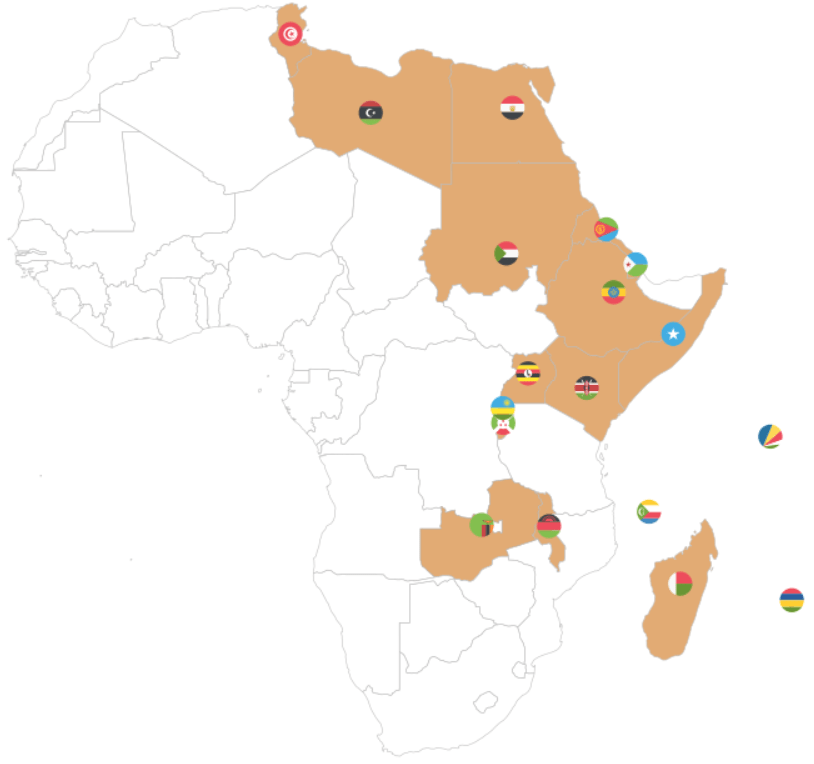
Next we will look at the Common Market for Eastern and Southern Africa.

If we don’t want to scrape the data from the Wikipedia article, we can feed in the vector of countries – separated by commas – into a data.frame() function.

Then we can separate the vector of countries into rows, and a cell for each country.

data.frame(country = "Djibouti, 
           Eritrea, 
           Ethiopia,
           Somalia,
           Egypt,
           Libya,
           Sudan,
           Tunisia,
           Comoros,
           Madagascar,
           Mauritius,
           Seychelles,
           Burundi,
           Kenya,
           Malawi,
           Rwanda,
           Uganda,
           Eswatini,
           Zambia") %>% 
  separate_rows(country, sep = ",") %>%  
  mutate(country = trimws(country)) %>%
  mutate(rec = "Common Market for Eastern and Southern Africa", 
         geo = "Eastern and Southern Africa",
         rec_abbrev = "COMESA") -> comesa

The separate_rows() function comes from the tidyr package.

We use this to split a single column with comma-separated values into multiple rows, creating a “long” format.

With the mutate(country = trimws(country)) we can remove any spaces with whitespace trimming.

Onto the third REC – the Community of Sahel-Sahara States.

read_html("https://en.wikipedia.org/wiki/Community_of_Sahel%E2%80%93Saharan_States") %>% 
  html_table(header = TRUE, fill = TRUE) %>% 
  `[[`(5) %>%  
  janitor::clean_names()  %>% 
  pull() %>% as.data.frame() %>%
  select(country = '.', everything()) %>% 
  mutate(country = str_replace_all(country, "\\\n", ",")) %>% 
  separate_rows(country, sep = ",") %>% # create a column of words from the one cell vector of words!
  mutate(country = trimws(country)) %>%  # remove the white space
  mutate(rec = "Community of Sahel–Saharan States",
         geo = "Sahel Saharan States", 
         rec_abbrev = "CEN-SAD") -> censad

Fourth, onto the East African Community REC.

read_html("https://en.wikipedia.org/wiki/East_African_Community") %>% 
    html_table(header = TRUE, fill = TRUE) %>% 
    `[[`(2) %>%  
    janitor::clean_names() %>%
    pull(country) %>% 
    as.data.frame() %>% 
    mutate(rec = "East African Community",
           geo = "East Africa", 
           rec_abbrev = "EAC") %>% 
    select(country = '.', everything()) %>% 
  filter(str_trim(country) != "") -> eac

Fifth, we look at ECOWAS

read_html("https://en.wikipedia.org/wiki/Economic_Community_of_West_African_States") %>% 
  html_table(header = TRUE, fill = TRUE) %>% 
  `[[`(2) %>%  
  janitor::clean_names() %>%
  pull(country) %>% 
  as.data.frame() %>% 
  mutate(rec = "Economic Community of West African States",
         geo = "West Africa", 
         rec_abbrev = "ECOWAS") %>%
  select(country = '.', everything()) %>% 
  filter(str_trim(country) != "")  %>% 
  filter(str_trim(country) != "Total")  -> ecowas

Next the Economic Community of Central African States

read_html("https://en.wikipedia.org/wiki/Economic_Community_of_Central_African_States") %>% 
  html_table(header = TRUE, fill = TRUE) %>% 
  `[[`(4) %>%  
  janitor::clean_names() %>% 
  pull(country) %>% 
  as.data.frame() %>% 
    mutate(rec = "Economic Community of Central African States",
           geo = "Central Africa", 
           rec_abbrev = "ECCAS") %>% 
  select(country = '.', everything()) -> eccas

Seventh, we look at the Intergovernmental Authority on Development (IGAD)

data.frame(country = "Djibouti, Ethiopia, Somalia, Eritrea, Sudan, South Sudan, Kenya, Uganda") %>%  
separate_rows(country, sep = ",") %>%  
mutate(rec = "Intergovernmental Authority on Development", 
           geo = "Horn, Nile, Great Lakes",
           rec_abbrev = "IGAD") -> igad

Last, we will scrape Southern African Development Community (SADC)

read_html("https://en.wikipedia.org/wiki/Southern_African_Development_Community") %>% 
  html_table(header = TRUE, fill = TRUE) %>% 
  `[[`(3) %>%  
  janitor::clean_names() %>% 
  pull(country) %>% 
  as.data.frame() %>% 
  select(country = '.', everything()) %>% 
  mutate(country = sub("\\[.*", "", country),
    rec = "Southern African Development Community",
         geo = "Southern Africa", 
         rec_abbrev = "SADC") %>% 
  filter(!str_detect(country, fixed("Country", ignore_case = FALSE))) -> sadc

We can combine them all together with rbind to make a full dataset of all the countries.

  rbind(amu, censad, comesa, eac, eccas, ecowas, igad, sadc) %>% 
  mutate(country = trimws(country)) %>% 
  mutate(rec_abbrev = tolower(rec_abbrev)) -> rec

In the next blog post, we will complete the dataset (most importantly, clean up the country duplicates and make data visualisations / some data analysis with political and economic data!

References

Hartzenberg, T. (2011). Regional integration in Africa. World Trade Organization Publications: Economic Research and Statistics Division Staff Working Paper (ERSD-2011-14). PDF available

PDF available

UNCTAD (United Nations Conference on Trade and Development) (2021). Economic Development in Africa Report 2021: Reaping the Potential Benefits of the African Continental Free Trade Area for Inclusive Growth. PDF available

Songwe, V. (2019). Intra-African trade: A path to economic diversification and inclusion. Coulibaly, Brahima S, Foresight Africa: Top Priorities for the Continent in, 97-116. PDF available

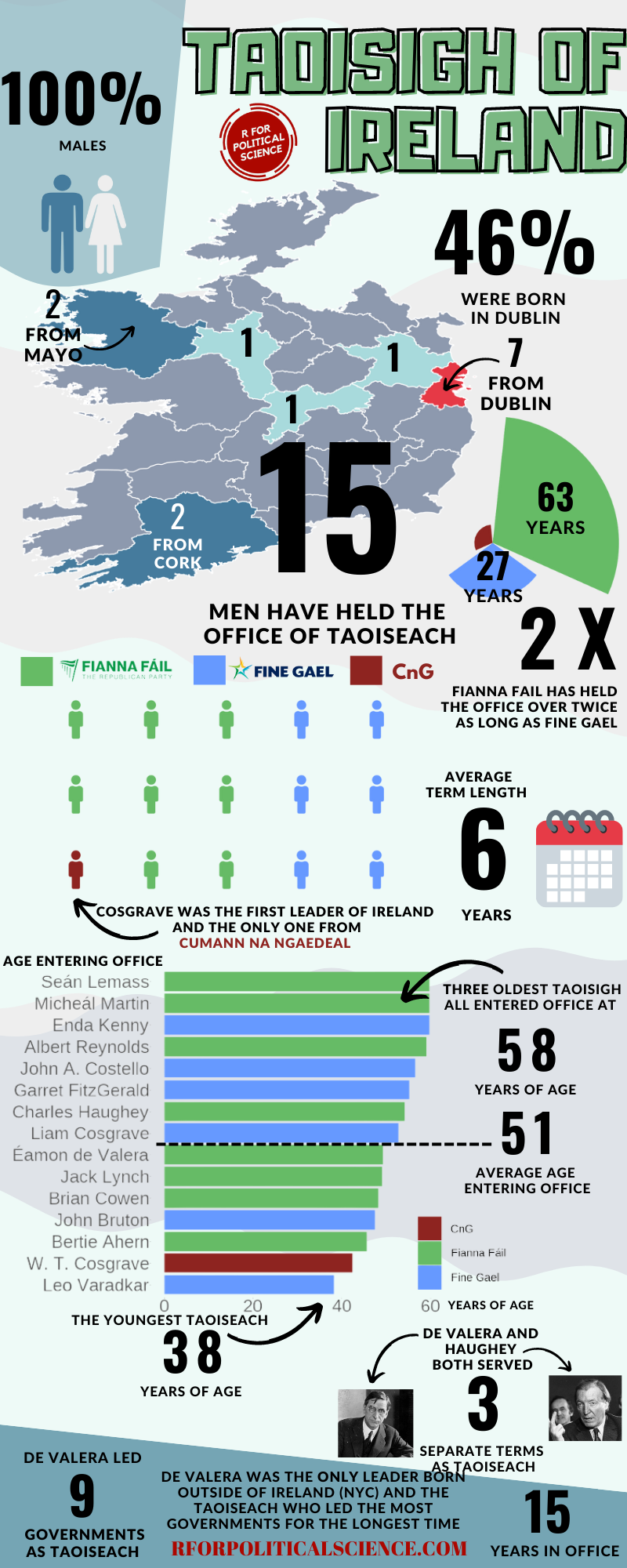
Create infographics with the Irish leader dataset in R and Canva

Click here to download the Irish leader datatset. This file details information on all Taoisigh since 1922.

Source: Wikipedia

Tentative Codebook

Variable NameVariable Description
noTaoiseach number
nameName
partyPolitical party
constituencyElectoral constituency
bornDate of birth
diedDate of death
first_electedDate first entered the Dail
entered_officeDate entering office of Taoiseach
left_officeDate leaving office of Taoiseach
left_dailDate left the Dail
cum_daysTotal number of days in Dail
cum_yearsTotal number of years in Dail
second_levelSecondary school Taoiseach attended
third_levelUniversity Taoiseach attended
periodNumber of times the person was Taoiseach
before_after_taoiseachTitle of cabinet positions held by the Taoiseach when he was not holding office of Taoiseach
while_taoiseachTitle of cabinet positions held by the Taoiseach when he was in office as Taoiseach
no_pos_before_afterNumber of cabinet positions the man held when he was not holding office of Taoiseach
no_pos_durNumber of cabinet positions the man held when he was Taoiseach
county_bornThe county the Taoiseach was born in
ageAge of Taoiseach
age_enterAge the man entered office of Taoiseach
genderGender

Packages we will need:

library(tidyverse)
library(ggthemes)
library(readr)
library(sf)
library(tmap)


With the dataset, we can add map data and plot the 26 counties of Ireland.

If you follow this link below, you can download county map data from the following website by Chris Brundson

https://rpubs.com/chrisbrunsdon/part1

Thank you to Chris for the tutorial and data access!

Read in the simple features data with the st_read() from the sf package.

setwd("C:/Users/my_name/Desktop")

county_geom <- sf::st_read("counties.json") %>% 
   clean_names() %>% 
   mutate(county = stringr::str_to_title(county))

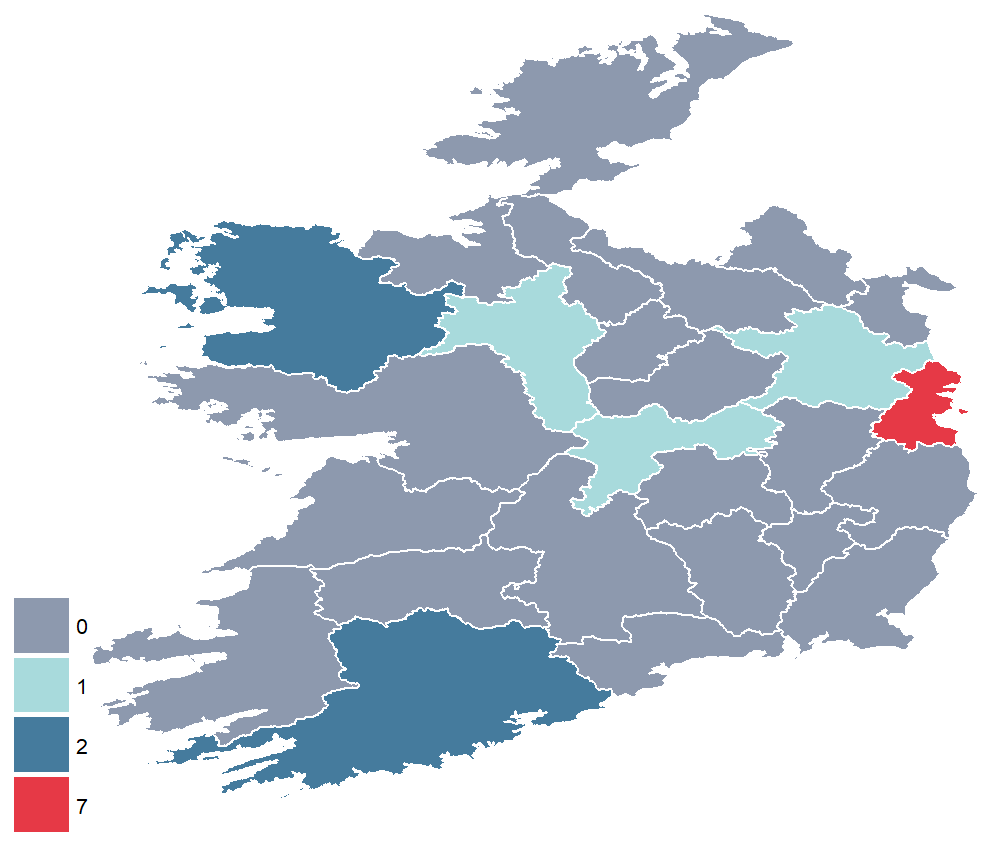
Next we count the number of counties that have given Ireland a Taoiseach with the group_by() and count() functions.

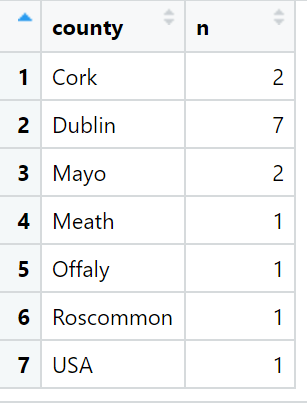
One Taoiseach, Eamon DeValera, was born in New York City, so he will not be counted in the graph.

Sorry Dev.

Sad Friends Tv GIF - Find & Share on GIPHY

We can join the Taoisech dataset to the county_geom dataframe by the county variable. The geometric data has the counties in capital letters, so we convert tolower() letters.

Add the geometry variable in the main ggplot() function.

We can play around with the themes arguments and add the theme_map() from the ggthemes package to get the look you want.

I added a few hex colors to indicate the different number of countries.

If you want a transparent background, we save it with the ggsave() function and set the bg argument to “transparent”

full_taois %>% 
  select(county = county_born, everything()) %>% 
  distinct(name, .keep_all = TRUE) %>% 
  group_by(county) %>% 
  count() %>% 
  ungroup() %>% 
  right_join(county_geom, by = c("county" = "county")) %>%
  replace(is.na(.), 0) %>% 
  ggplot(aes(geometry = geometry, fill = factor(n))) +  
  geom_sf(linewidth = 1, color = "white") +
  ggthemes::theme_map() + 
  theme(panel.background = element_rect(fill = 'transparent'),  
    legend.title = element_blank(),
    legend.text = element_text(size = 20) )  + 
scale_fill_manual(values = c("#8d99ae", "#a8dadc", "#457b9d", "#e63946", "#1d3557")) 

ggsave('county_map.png', county_map, bg = 'transparent')

Counties that have given us Taoisigh

Source: Wikipedia

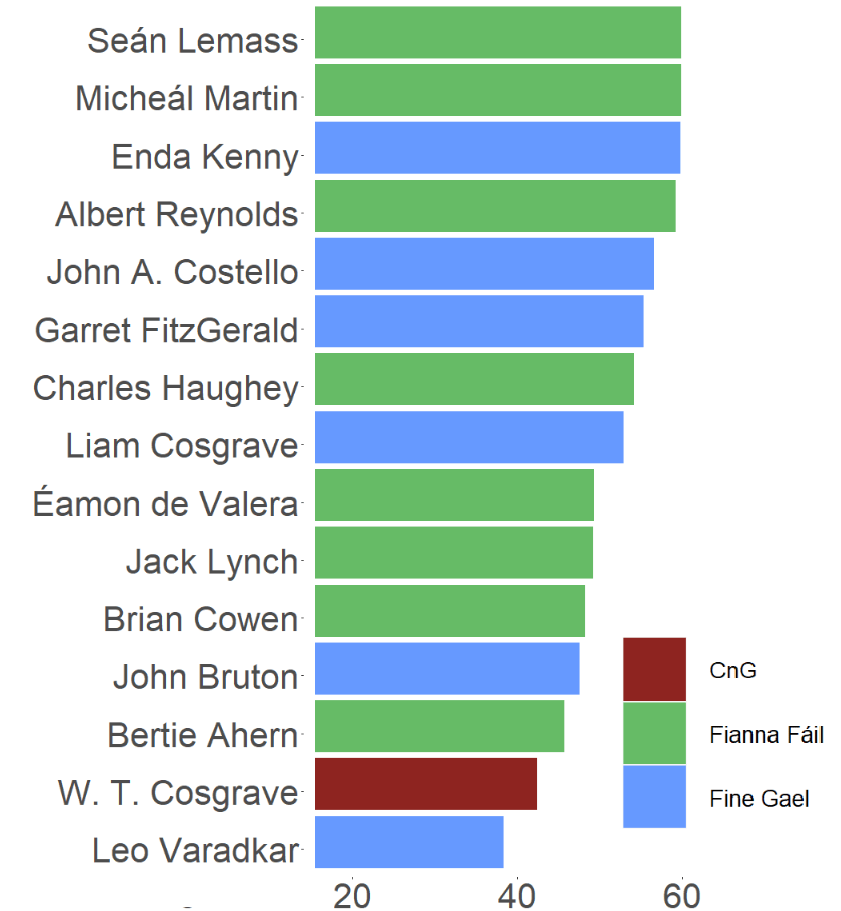
Next we can graph the ages of the Taoiseach when they first entered office. With the reorder() function, we can compare how old they were.

full_taois %>%
  mutate(party = case_when(party == "Cumann na nGaedheal" ~ "CnG",
                           TRUE ~ as.character(party))) %>% 
  distinct(name, .keep_all = TRUE) %>% 
  mutate(age_enter = round(age_enter, digits = 0)) %>% 
  ggplot(aes(x = reorder(name, age_enter),
             y = age_enter,
             fill = party)) + 
  geom_bar(stat = "identity") +
  coord_flip() + 
  scale_fill_manual(values = c( "#8e2420","#66bb66","#6699ff")) + 
  theme(text = element_text(size = 40),
    axis.title.x = element_blank(), 
    axis.title.y = element_blank(), 
    panel.background = element_rect(fill = 'transparent'),  
    plot.background = element_rect(fill = 'transparent', color = NA), 
    panel.grid.major = element_blank(), 
    panel.grid.minor = element_blank(),
    legend.background = element_rect(fill = 'transparent'), #transparent legend bg
    legend.key.size = unit(2, 'cm'),
    legend.key.height = unit(2, 'cm'),
    legend.key.width = unit(2, 'cm'), 
    legend.title = element_blank(),
    legend.text = element_text(size = 20) ) 

ggsave('age_chart.png', age_chart, bg = 'transparent')

Ages of the Taoiseach entering office for the first time

Source: Wikipedia

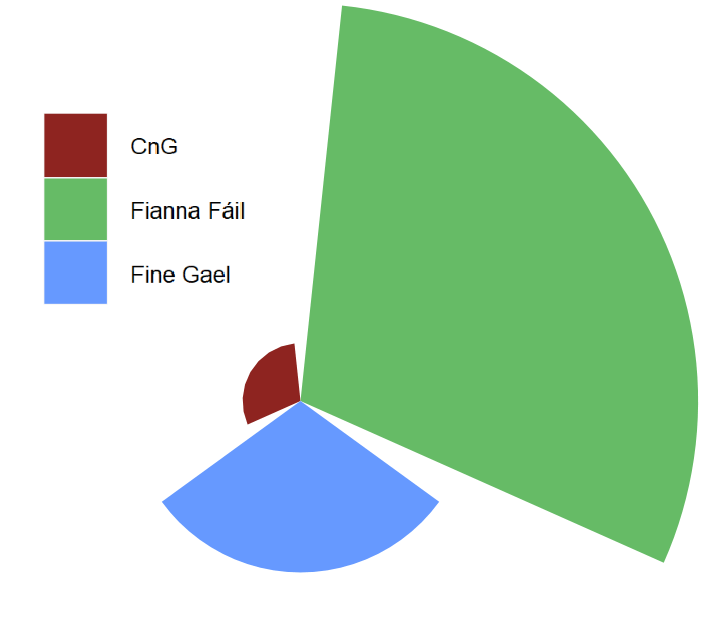
We can calculate to see which party has held the office of Taoiseach the longest with a special, but slightly mad-looking pie chart

Click here to learn more about creating these plots.

full_taois %>% 
  distinct(name, .keep_all = TRUE) %>% 
  group_by(party) %>% 
  summarise(total_cum = sum(cum_days)) %>% 
    ggplot(aes(reorder(total_cum, party), total_cum, fill = as.factor(party))) + 
  geom_bar(stat = "identity") + 
  coord_polar("x", start = 0, direction = - 1)  + 
  scale_fill_manual(values = c( "#8e2420","#66bb66","#6699ff")) + 
  ggthemes::theme_map()

Number of years each party held the office of Taoiseach

Source: Wikipedia

Fianna Fail has held the office over twice as long as Fine Fail and much more than the one term of W Cosgrove (the only CnG Taoiseach)

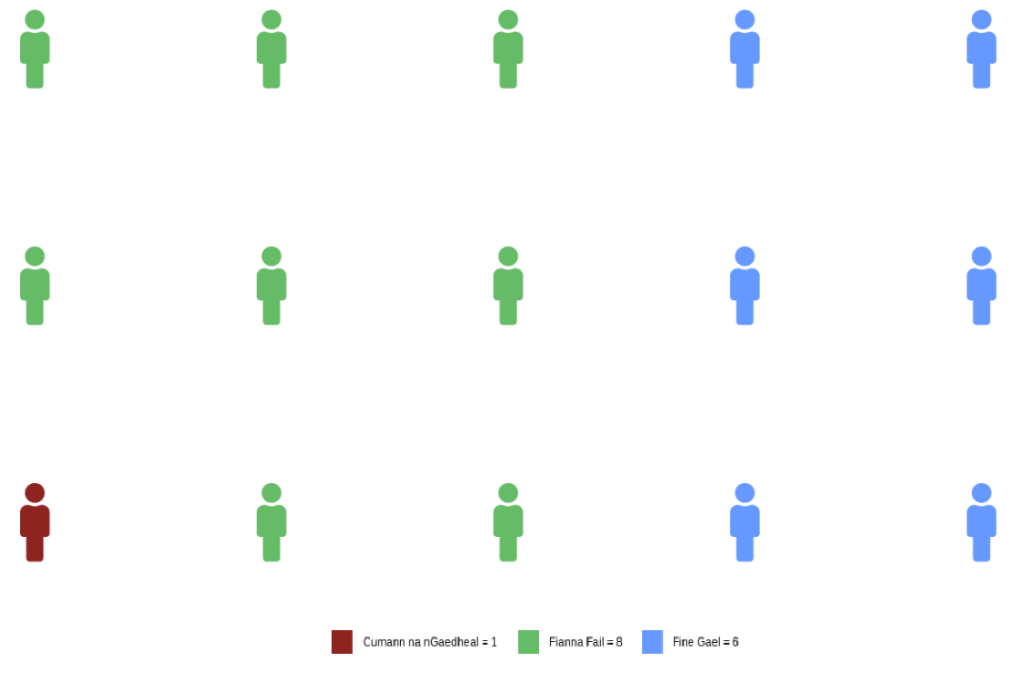
Last we can create an icon waffle plots. We can use little man icons to create a waffle plot of all the men (only men) in the office, colored by political party.

I got the code and tutorial for making these waffle plots from the following website:

https://www.listendata.com/2019/06/create-infographics-with-r.html

It was very helpful in walking step by step through how to download the FontAwesome icons into the correct font folder on the PC. I had a heap of issues with the wrong versions of the htmltools.

remotes::install_github("JohnCoene/echarts4r")

remotes::install_github("hrbrmstr/waffle")

devtools::install_github("JohnCoene/echarts4r.assets")

remotes::install_github("hrbrmstr/waffle")

library(echarts4r)
library(extrafont)
library(showtext)
library(magrittr)
library(echarts4r.assets)
library(htmltools)
library(waffle)

extrafont::font_import(path = "C:/Users/my_name/Desktop",  pattern = "fa-", prompt =  FALSE)

extrafont::loadfonts(device="win")

font_add(family = "FontAwesome5Free-Solid", regular = "C:/Users/my_name/Desktop/fa-solid-900.ttf")
font_add(family = "FontAwesome5Free-Regular", regular = "C:/Users/my_name/Desktop/fa-regular-400.ttf")
font_add(family = "FontAwesome5Brands-Regular", regular = "C:/Users/my_name/Desktop/fa-brands-400.ttf")

showtext_auto()

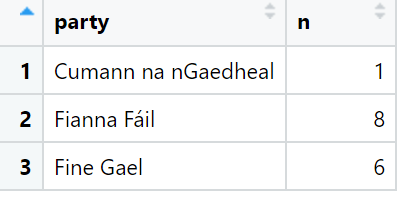
Next we will find out the number of Taoisigh from each party:

And we fill a vector of values into the waffle() function. We can play around with the number of rows. Three seems like a nice fit for the number of icons (glyphs).

Also, we choose the type of glyph image we want with the the use_glyph() argument.

The options are the glyphs that come with the Font Awesome package we downloaded with extrafonts.

waffle(
  c( Cumann na nGaedheal = 1      ` = 1,
      `Fianna Fail = 8    ` = 8, 
      `Fine Gael = 6    ` = 6), 
  rows = 3, 
  colors = c("#8e2420", "#66bb66",  "#6699ff"),
  use_glyph = "male", 
  glyph_size = 25, 
  legend_pos = "bottom")

Click below to download the infographic that was edited and altered with Canva.com.

Jimmy Fallon Dancing GIF by The Tonight Show Starring Jimmy Fallon - Find & Share on GIPHY

How to create semi-circle parliament graphs with the ggparliament package in R

Packages we will need:

library(tidyverse)
library(forcats)
library(ggparliament)

Check out part 1 of this blog where you can follow along how to scrape the data that we will use in this blog. It will create a dataset of the current MPs in the Irish Dail.

In this blog, we will use the ggparliament package, created by Zoe Meers.

The Best Yes GIF - Find & Share on GIPHY

With this dataset of the 33rd Dail, we will reduce it down to get the number of seats that each party holds.

If we don’t want to graph every party, we can lump most of the smaller parties into an “other” category. We can do this with the fct_lump_n() function from the forcats package. I want the top five biggest parties only in the graph. The rest will be colored as “Other”.

Click here to read more about the forcats pacakge and dealing with factors in R.

dail_33 %>% 
  mutate(party_groups  = fct_lump_n(party, n = 5,
         other_level = "Other"))-> dail_lump_count

Next we want to count the number of members per party.

dail_lump_count %>% 
  group_by(party_groups) %>% 
  count() %>%  
  arrange(desc(n)) -> dail_count
  <fct>        <int>
1 Fianna Fail     38
2 Sinn Fein       37
3 Fine Gael       35
4 Independent     19
5 Other           19
6 Green Party     12

Before we graph, I found the hex colors that represent each of the biggest Irish political party. We can create a new party color variables with the case_when() function and add each color.

dail_count %<>% 
  mutate(party_color = case_when(party_groups == "Fianna Fail" ~ "#66bb66",
                                 party_groups == "Fine Gael" ~ "#6699ff",
                                 party_groups == "Green Party" ~ "#44532a",
                                 party_groups == "Independent" ~ "#8e2420",
                                 party_groups == "Sinn Fein" ~ "#326760",
                                 party_groups == "Other" ~ "#ee9f27"))

Now we can dive into the ggparliament package.

We use the parliamenet_data() function to create coordinates for our graph: these are the x and y variables we will plot out.

We feed in the data.frame of all the seat counts into the election_data argument.

We specifiy the type as “semi-circle“. Other options are “horseshoe” and “opposing_benches“.

We can change how many circles we want stacked on top of each other.

I tried it with three and it looked quite strange. So play around with this parl_rows argument to see what suits your data best

And last we feed in the number of seats that each party has with the n we summarised above.

dail_33_coord <- parliament_data(election_data = dail_count,
                                 type = "semicircle", 
                                 parl_rows = 6,  
                                 party_seats = dail_count$n) 

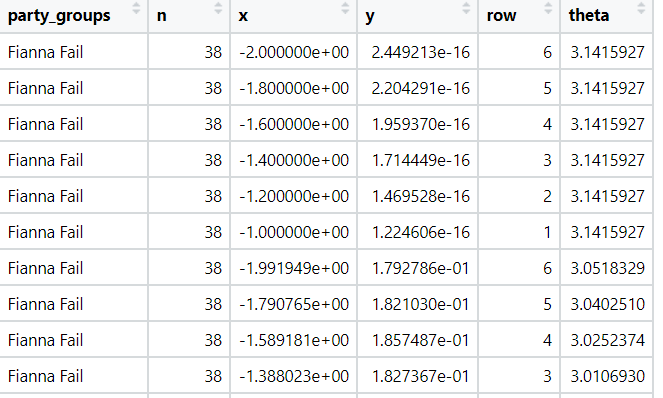
If we view the dail_33_coord data.frame we can see that the parliament_data() function calculated new x and y coordinate variables for the semi-circle graph.

I don’t know what the theta variables is for… But there it is also … maybe to make circular shapes?

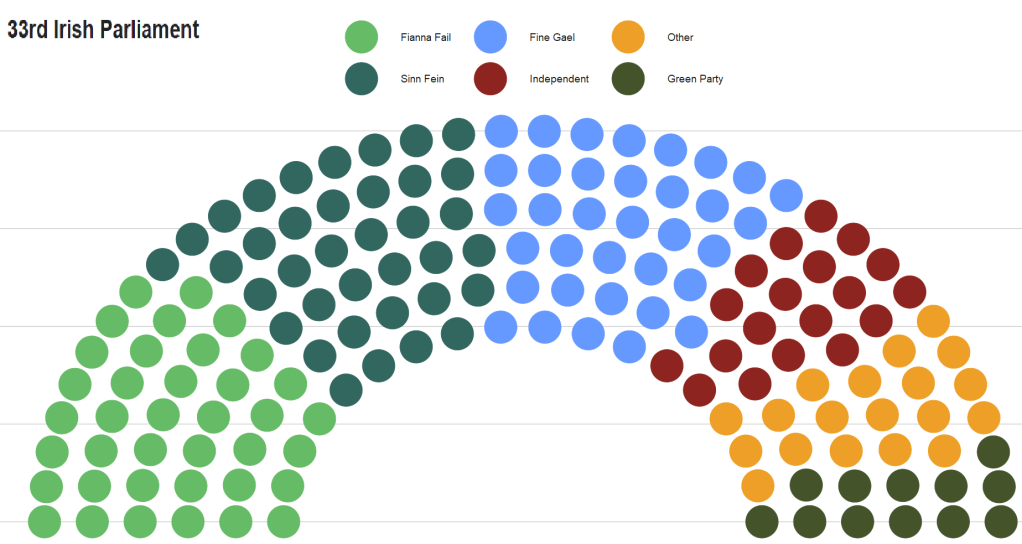
We feed the x and y coordinates into the ggplot() function and then add the geom_parliament_seat() layer to produce our graph!

Click here to check out the PDF for the ggparliament package

dail_33_coord %>% 
  ggplot(aes(x = x,
             y = y,
             colour = party_groups)) +
  geom_parliament_seats(size = 20) -> dail_33_plot

And we can make it look more pretty with bbc_style() plot and colors.

Click here to read more about the BBC style graphs.

dail_33_plot +  bbplot::bbc_style() + 
  ggtitle("33rd Irish Parliament") +
  theme(text = element_text(size = 50),
                      legend.title = element_blank(),
                      axis.text.x = element_blank(),
                      axis.text.y = element_blank()) +  
  scale_colour_manual(values = dail_33_coord$party_color,
                    limits = dail_33_coord$party_groups)
Clueless Movie Cherilyn Horowitz GIF - Find & Share on GIPHY

How to interpret linear models with the broom package in R

Packages you will need:

library(tidyverse)
library(magrittr)     # for pipes

library(broom)        # add model variables
library(easystats)    # diagnostic graphs

library(WDI)           # World Bank data
library(democracyData) # Freedom House data

library(countrycode)   # add ISO codes
library(bbplot)        # pretty themes
library(ggthemes)      # pretty colours
library(knitr)         # pretty tables
library(kableExtra)    # make pretty tables prettier

This blog will look at the augment() function from the broom package.

After we run a liner model, the augment() function gives us more information about how well our model can accurately preduct the model’s dependent variable.

It also gives us lots of information about how does each observation impact the model. With the augment() function, we can easily find observations with high leverage on the model and outlier observations.

For our model, we are going to use the “women in business and law” index as the dependent variable.

According to the World Bank, this index measures how laws and regulations affect women’s economic opportunity.

Overall scores are calculated by taking the average score of each index (Mobility, Workplace, Pay, Marriage, Parenthood, Entrepreneurship, Assets and Pension), with 100 representing the highest possible score.

Into the right-hand side of the model, our independent variables will be child mortality, military spending by the government as a percentage of GDP and Freedom House (democracy) Scores.

First we download the World Bank data and summarise the variables across the years.

Click here to read more about the WDI package and downloading variables from the World Bank website.

women_business = WDI(indicator = "SG.LAW.INDX")
mortality = WDI(indicator = "SP.DYN.IMRT.IN")
military_spend_gdp <- WDI(indicator = "MS.MIL.XPND.ZS")

We get the average across 60 ish years for three variables. I don’t want to run panel data regression, so I get a single score for each country. In total, there are 160 countries that have all observations. I use the countrycode() function to add Correlates of War codes. This helps us to filter out non-countries and regions that the World Bank provides. And later, we will use COW codes to merge the Freedom House scores.

women_business %>%
  filter(year > 1999) %>% 
  inner_join(mortality) %>% 
  inner_join(military_spend_gdp) %>% 
  select(country, year, iso2c, 
         fem_bus = SG.LAW.INDX, 
         mortality = SP.DYN.IMRT.IN,
         mil_gdp = MS.MIL.XPND.ZS)  %>% 
  mutate_all(~ifelse(is.nan(.), NA, .)) %>% 
  select(-year) %>% 
  group_by(country, iso2c) %>% 
  summarize(across(where(is.numeric), mean,  
   na.rm = TRUE, .names = "mean_{col}")) %>% 
  ungroup() %>% 
  mutate(cown = countrycode::countrycode(iso2c, "iso2c", "cown")) %>% 
  filter(!is.na(cown)) -> wdi_summary

Next we download the Freedom House data with the democracyData package.

Click here to read more about this package.

fh <- download_fh()

fh %>% 
  group_by(fh_country) %>% 
  filter(year > 1999) %>% 
  summarise(mean_fh = mean(fh_total, na.rm = TRUE)) %>% 
  mutate(cown = countrycode::countrycode(fh_country, "country.name", "cown")) %>% 
  mutate_all(~ifelse(is.nan(.), NA, .)) %>% 
  filter(!is.na(cown))  -> fh_summary

We join both the datasets together with the inner_join() functions:

fh_summary %>%
  inner_join(wdi_summary, by = "cown") %>% 
  select (-c(cown, iso2c, fh_country)) -> wdi_fh

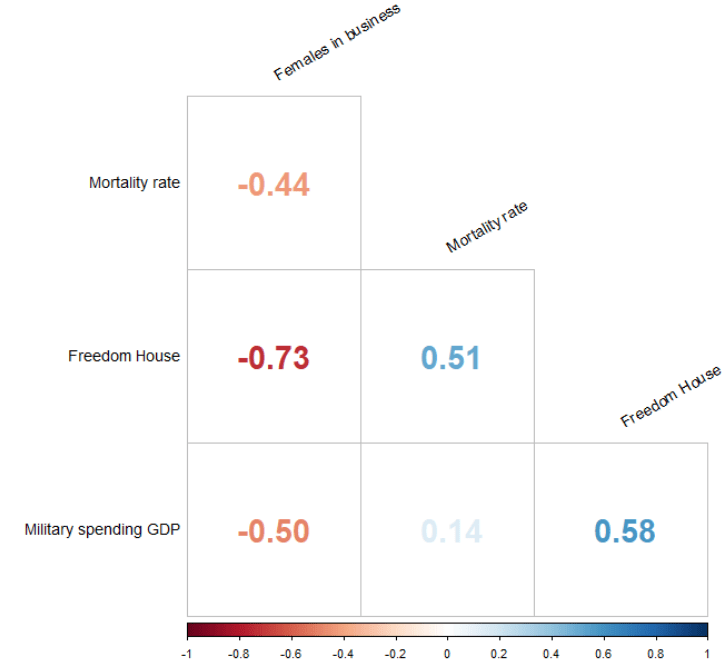
Before we model the data, we can look at the correlation matrix with the corrplot package:

wdi_fh %>% 
  drop_na() %>% 
  select(-country)  %>% 
  select(`Females in business` = mean_fem_bus,
        `Mortality rate` = mean_mortality,
        `Freedom House` = mean_fh,
        `Military spending GDP` = mean_mil_gdp)  %>% 
  cor() %>% 
  corrplot(method = 'number',
           type = 'lower',
           number.cex = 2, 
           tl.col = 'black',
           tl.srt = 30,
           diag = FALSE)

Next, we run a simple OLS linear regression. We don’t want the country variables so omit it from the list of independent variables.

fem_bus_lm <- lm(mean_fem_bus ~ . - country, data = wdi_fh)
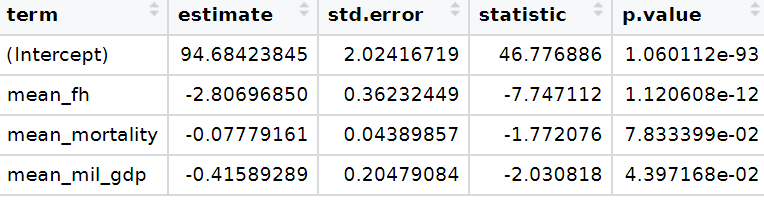
Dependent variable:
mean_fem_bus
mean_fh-2.807***
(0.362)
mean_mortality-0.078*
(0.044)
mean_mil_gdp-0.416**
(0.205)
Constant94.684***
(2.024)
Observations160
R20.557
Adjusted R20.549
Residual Std. Error11.964 (df = 156)
F Statistic65.408*** (df = 3; 156)
Note:*p<0.1; **p<0.05; ***p<0.01

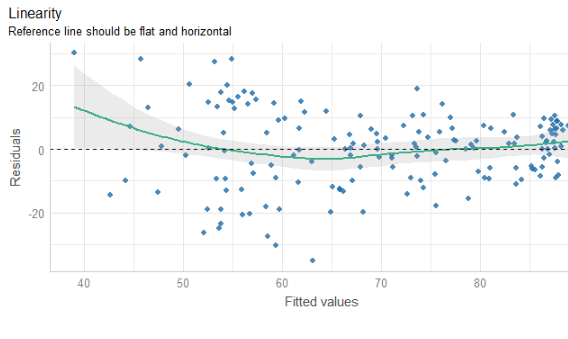
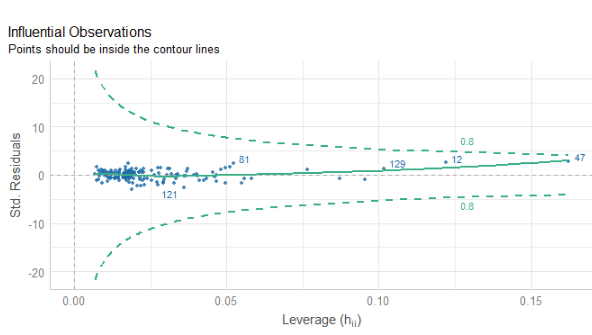
We can look at some preliminary diagnostic plots.

Click here to read more about the easystat package. I found it a bit tricky to download the first time.

performance::check_model(fem_bus_lm)

The line is not flat at the beginning so that is not ideal..

We will look more into this later with the variables we create with augment() a bit further down this blog post.

None of our variables have a VIF score above 5, so that is always nice to see!

From the broom package, we can use the augment() function to create a whole heap of new columns about the variables in the model.

fem_bus_pred <- broom::augment(fem_bus_lm)

  • .fitted = this is the model prediction value for each country’s dependent variable score. Ideally we want them to be as close to the actual scores as possible. If they are totally different, this means that our independent variables do not do a good job explaining the variance in our “women in business” index.

  • .resid = this is actual dependent variable value minus the .fitted value.

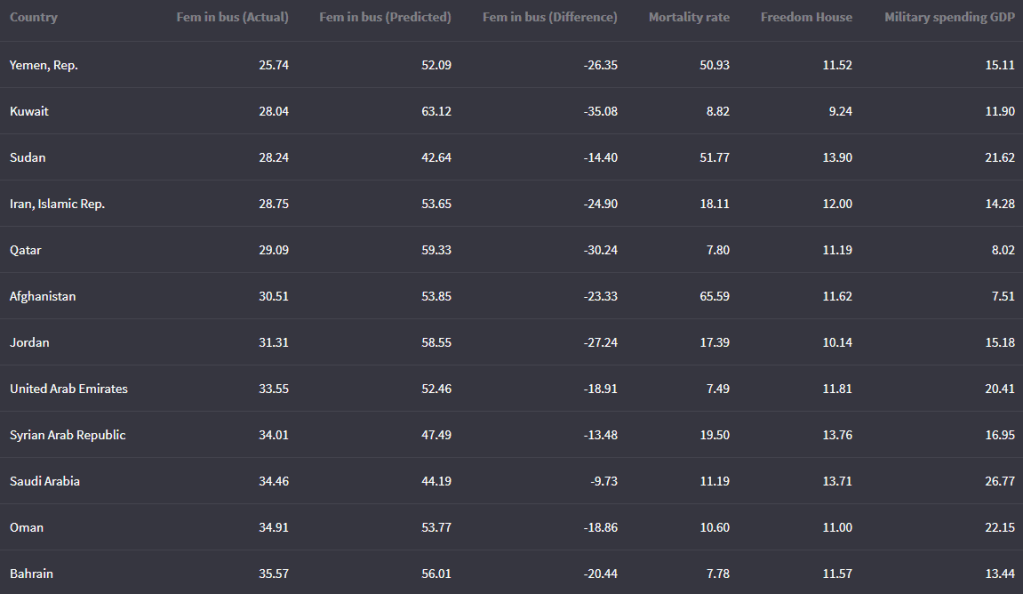
We can look at the fitted values that the model uses to predict the dependent variable – level of women in business – and compare them to the actual values.

The third column in the table is the difference between the predicted and actual values.

fem_bus_pred %>% 
  mutate(across(where(is.numeric), ~round(., 2))) %>%
  arrange(mean_fem_bus) %>% 
  select(Country = country,
    `Fem in bus (Actual)` = mean_fem_bus,
    `Fem in bus (Predicted)` = .fitted,
    `Fem in bus (Difference)` = .resid,
                  `Mortality rate` = mean_mortality,
                  `Freedom House` = mean_fh,
                  `Military spending GDP` = mean_mil_gdp)  %>% 
  kbl(full_width = F) 
Country Leverage of country Fem in bus (Actual) Fem in bus (Predicted)
Austria 0.02 88.92 88.13
Belgium 0.02 92.13 87.65
Costa Rica 0.02 79.80 87.84
Denmark 0.02 96.36 87.74
Finland 0.02 94.23 87.74
Iceland 0.02 96.36 88.90
Ireland 0.02 95.80 88.18
Luxembourg 0.02 94.32 88.33
Sweden 0.02 96.45 87.81
Switzerland 0.02 83.81 87.78

And we can graph them out:

fem_bus_pred %>%
  mutate(fh_category = cut(mean_fh, breaks =  5,
  labels = c("full demo ", "high", "middle", "low", "no demo"))) %>%         ggplot(aes(x = .fitted, y = mean_fem_bus)) + 
  geom_point(aes(color = fh_category), size = 4, alpha = 0.6) + 
  geom_smooth(method = "loess", alpha = 0.2, color = "#20948b") + 
  bbplot::bbc_style() + 
  labs(x = '', y = '', title = "Fitted values versus actual values")

In addition to the predicted values generated by the model, other new columns that the augment function adds include:

  • .hat = this is a measure of the leverage of each variable.

  • .cooksd = this is the Cook’s Distance. It shows how much actual influence the observation had on the model. Combines information from .residual and .hat.

  • .sigma = this is the estimate of residual standard deviation if that observation is dropped from model

  • .std.resid = standardised residuals

If we look at the .hat observations, we can examine the amount of leverage that each country has on the model.

fem_bus_pred %>% 
  mutate(dplyr::across(where(is.numeric), ~round(., 2))) %>%
  arrange(desc(.hat)) %>% 
  select(Country = country,
         `Leverage of country` = .hat,
         `Fem in bus (Actual)` = mean_fem_bus,
         `Fem in bus (Predicted)` = .fitted)  %>% 
  kbl(full_width = F) %>%
  kable_material_dark()

Next, we can look at Cook’s Distance. This is an estimate of the influence of a data point.  According to statisticshowto website, Cook’s D is a combination of each observation’s leverage and residual values; the higher the leverage and residuals, the higher the Cook’s distance.

  1. If a data point has a Cook’s distance of more than three times the mean, it is a possible outlier
  2. Any point over 4/n, where n is the number of observations, should be examined
  3. To find the potential outlier’s percentile value using the F-distribution. A percentile of over 50 indicates a highly influential point
fem_bus_pred %>% 
  mutate(fh_category = cut(mean_fh, 
breaks =  5,
  labels = c("full demo ", "high", "middle", "low", "no demo"))) %>%  
  mutate(outlier = ifelse(.cooksd > 4/length(fem_bus_pred), 1, 0)) %>% 
  ggplot(aes(x = .fitted, y = .resid)) +
  geom_point(aes(color = fh_category), size = 4, alpha = 0.6) + 
  ggrepel::geom_text_repel(aes(label = ifelse(outlier == 1, country, NA))) + 
  labs(x ='', y = '', title = 'Influential Outliers') + 
  bbplot::bbc_style() 

We can decrease from 4 to 0.5 to look at more outliers that are not as influential.

Also we can add a horizontal line at zero to see how the spread is.

fem_bus_pred %>% 
  mutate(fh_category = cut(mean_fh, breaks =  5,
labels = c("full demo ", "high", "middle", "low", "no demo"))) %>%  
  mutate(outlier = ifelse(.cooksd > 0.5/length(fem_bus_pred), 1, 0)) %>% 
  ggplot(aes(x = .fitted, y = .resid)) +
  geom_point(aes(color = fh_category), size = 4, alpha = 0.6) + 
  geom_hline(yintercept = 0, color = "#20948b", size = 2, alpha = 0.5) + 
  ggrepel::geom_text_repel(aes(label = ifelse(outlier == 1, country, NA)), size = 6) + 
  labs(x ='', y = '', title = 'Influential Outliers') + 
  bbplot::bbc_style() 

To look at the model-level data, we can use the tidy()function

fem_bus_tidy <- broom::tidy(fem_bus_lm)

And glance() to examine things such as the R-Squared value, the overall resudial standard deviation of the model (sigma) and the AIC scores.

broom::glance(fem_bus_lm)

An R squared of 0.55 is not that hot ~ so this model needs a fair bit more work.

We can also use the broom packge to graph out the assumptions of the linear model. First, we can check that the residuals are normally distributed!

fem_bus_pred %>% 
  ggplot(aes(x = .resid)) + 
  geom_histogram(bins = 15, fill = "#20948b") + 
  labs(x = '', y = '', title = 'Distribution of Residuals') +
  bbplot::bbc_style()

Next we can plot the predicted versus actual values from the model with and without the outliers.

First, all countries, like we did above:

fem_bus_pred %>%
  mutate(fh_category = cut(mean_fh, breaks =  5,
  labels = c("full demo ", "high", "middle", "low", "no demo"))) %>%         ggplot(aes(x = .fitted, y = mean_fem_bus)) + 
  geom_point(aes(color = fh_category), size = 4, alpha = 0.6) + 
  geom_smooth(method = "loess", alpha = 0.2, color = "#20948b") + 
  bbplot::bbc_style() + 
  labs(x = '', y = '', title = "Fitted values versus actual values")

And how to plot looks like if we drop the outliers that we spotted earlier,

fem_bus_pred %>%
  filter(country != "Eritrea") %>% 
   filter(country != "Belarus") %>% 
  mutate(fh_category = cut(mean_fh, breaks =  5,
                           labels = c("full demo ", "high", "middle", "low", "no demo"))) %>%         ggplot(aes(x = .fitted, y = mean_fem_bus)) + 
  geom_point(aes(color = fh_category), size = 4, alpha = 0.6) + 
  geom_smooth(method = "loess", alpha = 0.2, color = "#20948b") + 
  bbplot::bbc_style() + 
  labs(x = '', y = '', title = "Fitted values versus actual values")

How to recreate Pew opinion graphs with ggplot2 in R

Packages we will need

library(HH)
library(tidyverse)
library(bbplot)
library(haven)

In this blog post, we are going to recreate Pew Opinion poll graphs.

This is the plot we will try to recreate on gun control opinions of Americans:

To do this, we will download the data from the Pew website by following the link below:

atp <- read.csv(file.choose())

We then select the variables related to gun control opinions

atp %>% 
  select(GUNPRIORITY1_b_W87:GUNPRIORITY2_j_W87) -> gun_df

I want to rename the variables so I don’t forget what they are.

Then, we convert them all to factor variables because haven labelled class variables are sometimes difficult to wrangle…

gun_df %<>%
  select(mental_ill = GUNPRIORITY1_b_W87,
         assault_rifle = GUNPRIORITY1_c_W87, 
         gun_database = GUNPRIORITY1_d_W87,
         high_cap_mag = GUNPRIORITY1_e_W87,
         gunshow_bkgd_check = GUNPRIORITY1_f_W87,
         conceal_gun =GUNPRIORITY2_g_W87,
         conceal_gun_no_permit = GUNPRIORITY2_h_W87,
         teacher_gun = GUNPRIORITY2_i_W87,
         shorter_waiting = GUNPRIORITY2_j_W87) %>% 
  mutate(across(everything()), haven::as_factor(.))

Also we can convert the “Refused” to answer variables to NA if we want, so it’s easier to filter out.

gun_df %<>% 
  mutate(across(where(is.factor), ~na_if(., "Refused")))

Next we will pivot the variables to long format. The new names variable will be survey_question and the responses (Strongly agree, Somewhat agree etc) will go to the new response variable!

gun_df %>% 
  pivot_longer(everything(), names_to = "survey_question", values_to = "response") -> gun_long

And next we calculate counts and frequencies for each variable

gun_long %<>% 
  group_by(survey_question, response) %>% 
  summarise(n = n()) %>%
  mutate(freq = n / sum(n)) %>% 
  ungroup() 

Then we want to reorder the levels of the factors so that they are in the same order as the original Pew graph.

gun_long %>% 
  mutate(survey_question = as.factor(survey_question))   %>% 
   mutate(survey_question_reorder = factor(survey_question, 
          levels =  c( 
           "conceal_gun_no_permit",
           "shorter_waiting",
           "teacher_gun",
           "conceal_gun",
           "assault_rifle",
           "high_cap_mag",
           "gun_database",
           "gunshow_bkgd_check",
           "mental_ill"
           ))) -> gun_reordered

And we use the hex colours from the original graph … very brown… I used this hex color picker website to find the right hex numbers: https://imagecolorpicker.com/en

brown_palette <- c("Strongly oppose" = "#8c834b",
                   "Somewhat oppose" = "#beb88f",
                   "Somewhat favor" = "#dfc86c",
                   "Strongly favor" = "#caa31e")

And last, we use the geom_bar() – with position = "stack" and stat = "identity" arguments – to create the bar chart.

To add the numbers, write geom_text() function with label = frequency within aes() and then position = position_stack() with hjust and vjust to make sure you’re happy with where the numbers are

gun_reordered %>% 
  filter(!is.na(response)) %>% 
  mutate(frequency = round(freq * 100), 0) %>% 
  ggplot(aes(x = survey_question_reorder, 
             y = frequency, fill = response)) +
  geom_bar(position = "stack",
           stat = "identity") + 
  coord_flip() + 
  scale_fill_manual(values = brown_palette) +
  geom_text(aes(label = frequency), size = 10, 
            color = "black", 
            position = position_stack(vjust = 0.5)) +
  bbplot::bbc_style() + 
  labs(title = "Broad support for barring people with mental illnesses 
       \n from obtaining guns, expanded background checks",
       subtitle = "% who", 
       caption = "Note: No answer resposes not shown.\n Source: Survey of U.S. adults conducted April 5-11 2021.") + 
  scale_x_discrete(labels = c(
    "Allowing people to carry conealed \n guns without a person",
    "Shortening waiting periods for people \n who want to buy guns leagally",
    "Allowing reachers and school officials \n to carry guns in K-12 school",
    "Allowing people to carry \n concealed guns in more places",
    "Banning assault-style weapons",
    "Banning high capacity ammunition \n magazines that hold more than 10 rounds",
    "Creating a federal government \n database to track all gun sales",
    "Making private gun sales \n subject to background check",
    "Preventing people with mental \n illnesses from purchasing guns"
    ))
Stephen Colbert Waiting GIF - Find & Share on GIPHY

Unfortunately this does not have diverving stacks from the middle of the graph

We can make a diverging stacked bar chart using function likert() from the HH package.

For this we want to turn the dataset back to wider with a column for each of the responses (strongly agree, somewhat agree etc) and find the frequency of each response for each of the questions on different gun control measures.

Then with the likert() function, we take the survey question variable and with the ~tilda~ make it the product of each response. Because they are the every other variable in the dataset we can use the shorthand of the period / fullstop.

We use positive.order = TRUE because we want them in a nice descending order to response, not in alphabetical order or something like that

gun_reordered %<>%
    filter(!is.na(response)) %>%  
  select(survey_question, response, freq) %>%  
  pivot_wider(names_from = response, values_from = freq ) %>%
  ungroup() %>% 
  HH::likert(survey_question ~., positive.order = TRUE,
            main =  "Broad support for barring people with mental illnesses
            \n from obtaining guns, expanded background checks")

With this function, it is difficult to customise … but it is very quick to make a diverging stacked bar chart.

Angry Stephen Colbert GIF by The Late Show With Stephen Colbert - Find & Share on GIPHY

If we return to ggplot2, which is more easy to customise … I found a solution on Stack Overflow! Thanks to this answer! The solution is to put two categories on one side of the centre point and two categories on the other!

gun_reordered %>% 
filter(!is.na(response)) %>% 
  mutate(frequency = round(freq * 100), 0) -> gun_final

And graph out

ggplot(data = gun_final, aes(x = survey_question_reorder, 
            fill = response)) +
  geom_bar(data = subset(gun_final, response %in% c("Strongly favor",
           "Somewhat favor")),
           aes(y = -frequency), position="stack", stat="identity") +
  geom_bar(data = subset(gun_final, !response %in% c("Strongly favor",
            "Somewhat favor")), 
           aes(y = frequency), position="stack", stat="identity") +
  coord_flip() + 
  scale_fill_manual(values = brown_palette) +
  geom_text(data = gun_final, aes(y = frequency, label = frequency), size = 10, color = "black", position = position_stack(vjust = 0.5)) +
  bbplot::bbc_style() + 
  labs(title = "Broad support for barring people with mental illnesses 
       \n from obtaining guns, expanded background checks",
       subtitle = "% who", 
       caption = "Note: No answer resposes not shown.\n Source: Survey of U.S. adults conducted April 5-11 2021.") + 
  scale_x_discrete(labels = c(
    "Allowing people to carry conealed \n guns without a person",
    "Shortening waiting periods for people \n who want to buy guns leagally",
    "Allowing reachers and school officials \n to carry guns in K-12 school",
    "Allowing people to carry \n concealed guns in more places",
    "Banning assault-style weapons",
    "Banning high capacity ammunition \n magazines that hold more than 10 rounds",
    "Creating a federal government \n database to track all gun sales",
    "Making private gun sales \n subject to background check",
    "Preventing people with mental \n illnesses from purchasing guns"
  ))
High Five Stephen Colbert GIF - Find & Share on GIPHY

Next to complete in PART 2 of this graph, I need to figure out how to add lines to graphs and add the frequency in the correct place

Examining Ireland’s foreign policy in pictures with R

Packages we will need:

library(peacesciencer)  
library(forcats)
library(ggflags)
library(tidyverse)
library(magrittr)
library(waffle)
library(bbplot)
library(rvest)

In January 2015, the Irish government published a review of Ireland’s foreign policy. The document, The Global Island: Ireland’s Foreign Policy for a Changing World offers a perspective on Ireland’s place in the world.

In this blog, we will graph out some of the key features of Ireland’ foreign policy and so we can have a quick overview of the key relationships and trends.

Excited Season 4 GIF by The Office - Find & Share on GIPHY

First, we will look at the aid that Ireland gives to foreign countries. This read.csv(file.choose()) will open up the file window and you can navigate to the file and data that you can download from DAC OECD website: https://data.oecd.org/oda/net-oda.htm

dac <- read.csv(file.choose())

We will filter only Ireland and clean the names with the clean_names() function from the janitor package:

dac %<>% 
  filter(Donor == "Ireland") %>% 
  clean_names()

And change the variables, adding the Correlates of War codes and cleaning up some of the countries’ names.

dac %<>% 
  mutate(cown = countrycode(recipient_2, "country.name", "cown"),
         aid_amount = value*1000000) %>%  
  select(country = recipient_2, cown,
         year, time, aid_type, value, aid_amount) %>%
  mutate(cown = ifelse(country == "West Bank and Gaza Strip", 6666,
         ifelse(country == "Serbia", 345, 
         ifelse(country == "Micronesia", 987,cown))))%>%
  filter(!is.na(cown)) 

Next we can convert dataframe to wider format so we have a value column for each aid type

dac %>% 
  distinct(country, cown, year, time, aid_type, value, .keep_all = TRUE)  %>%  
  pivot_wider(names_from = "aid_type", values_from = "aid_amount") %>% 
  mutate(across(where(is.numeric), ~ replace_na(., 0))) %>% 
  clean_names() -> dac_wider

And we graph out the three main types of aid:

dac_wider %>%
  group_by(year) %>% 
  summarise(total_humanitarian = sum(humanitarian_aid, na.rm = TRUE),
  total_technical = sum(technical_cooperation, na.rm = TRUE),
  total_development_food_aid = sum(development_food_aid)) %>% 
  ungroup() %>% 
  pivot_longer(!year, names_to = "aid_type", values_to = "aid_value") %>% 
  ggplot(aes(x = year, y = aid_value, groups = aid_type)) + 
  geom_line(aes(color = aid_type), size = 2, show_guide  = FALSE) +
  geom_point(aes(color = aid_type), fill = "white", shape = 21, size = 3, stroke = 2) +
  bbplot::bbc_style()  +
  scale_y_continuous(labels = scales::comma) + 
  scale_x_discrete(limits = c(2010:2018)) +
  labs(title = "Irish foreign aid by aid type (2010 - 2018)",
       subtitle = ("Source: OECD DAC")) +
  scale_color_discrete(name = "Aid type", 
        labels = c("Development and Food", "Humanitarian", "Technical"))

We will look at total ODA aid:

dac %>% 
  count(aid_type) %>% 
  arrange(desc(n)) %>% 
  knitr::kable(format = "html")
aid_type n
Imputed Multilateral ODA 2298
Memo: ODA Total, excl. Debt 1292
Memo: ODA Total, Gross disbursements 1254
ODA: Total Net 1249
Grants, Total 1203
Technical Cooperation 541
ODA per Capita 532
Humanitarian Aid 518
ODA as % GNI (Recipient) 504
Development Food Aid 9

And get some pretty hex colours:

pal_10 <- c("#001219","#005f73","#0a9396","#94d2bd","#e9d8a6","#ee9b00","#ca6702","#bb3e03","#ae2012","#9b2226")

And download some regime, democracy, region and continent data from the PACL datase with the democracyData() package

pacl <- redownload_pacl() 

pacl %<>% 
  mutate(regime_name = ifelse(regime == 0, "Parliamentary democracies",
         ifelse(regime == 1, "Mixed democracies",
         ifelse(regime == 2, "Presidential democracies",
         ifelse(regime == 3, "Civilian autocracies",
         ifelse(regime == 4, "Military dictatorships",
         ifelse(regime ==  5,"Royal dictatorships", regime))))))) %>%
  mutate(regime = as.factor(regime)) 

pacl %<>% 
  select(year, country = pacl_country, 
         democracy, regime_name,
         region_name = un_region_name, 
         continent_name = un_continent_name)

pacl %<>% 
  mutate(cown = countrycode(country, "country.name", "cown")) %>% 
  select(!country)

Summarise the total aid for each country across the years and choose the top 20 countries

dac %>% 
  filter(aid_type == "Memo: ODA Total, Gross disbursements") %>% 
  group_by(country) %>% 
  summarise(total_country_aid = sum(aid_amount, na.rm = TRUE)) %>% 
  ungroup() %>% 
  top_n(n = 20) %>% 
  mutate(cown = countrycode::countrycode(country, "country.name", "cown")) %>% 
  inner_join(pacl, by = "cown") %>%  
  mutate(region_name = ifelse(country == "West Bank and Gaza Strip", "Western Asia", region_name)) %>% 
  mutate(region_name = ifelse(region_name == "Western Asia", "Middle East", region_name)) %>% 
  mutate(country = ifelse(country == "West Bank and Gaza Strip", "Palestine",
  ifelse(country == "Democratic Republic of the Congo", "DR Congo",
  ifelse(country == "Syrian Arab Republic", "Syria", country)))) %>% 
  mutate(iso2 = tolower(countrycode::countrycode(country, "country.name", "iso2c"))) %>% 
  ggplot(aes(x = forcats::fct_reorder(country, total_country_aid), y = total_country_aid)) + 
  geom_bar(aes(fill = region_name), stat = "identity", width = 0.7) + 
  coord_flip() + bbplot::bbc_style() + 
  geom_flag(aes(x = country, y = -100, country = iso2), size = 12) +
  scale_fill_manual(values = pal_10) +
  labs(title = "Ireland's largest ODA foreign aid recipients, 2010 - 2018",
       subtitle = ("Source: OECD DAC")) + 
  xlab("") + ylab("") + 
  scale_x_continuous(labels = scales::comma)

We can make a waffle plot to look at the different types of regimes to which the Irish government gave aid over the decades

 dac %>% 
  mutate(decade = substr(year, 1, 3)) %>% 
  mutate(decade = paste0(decade, "0s")) %>% 
  group_by(decade) %>% 
  count(regime_name) %>% 
  ggplot(aes(fill = regime_name, values = n)) +
  geom_waffle(color = "white", size = 0.3, n_rows = 10, flip = TRUE) +
  facet_wrap(~decade, nrow = 1, strip.position = "bottom") + 
  bbplot::bbc_style()  +
  scale_fill_manual(values = pal_10) +
   scale_x_discrete(breaks = round(seq(0, 1, by = 0.2),3)) +
  labs(title = "Ireland's ODA foreign aid recipient regime types since 1945",
       subtitle = ("Source: OECD DAC"))  

Next, we will download dyadic foreign policy similarity measures from peacesciencer.

Peacesciencer package has tools and data sets for the study of quantitative peace science. 

Click here to read more about the peacesciencer package by Steven Miller

fp_similar_df <- peacesciencer::create_dyadyears() %>% 
  add_gwcode_to_cow() %>% 
  add_fpsim()	

I am only looking at dyadic foreign policy similarity with Ireland, so filter by Ireland’s Correlates of War code, 205.

Click here to find out all countries’ COW code

fp_similar_df %<>% 
  filter(ccode1 == 205)

Data on alliance portfolios comes from the Correlates of War and is used to calculate similarity of foreign policy positions (see Altfeld & Mesquita, 1979).

The assumption is that similar alliance portfolios are the result of similar foreign policy positions.

With increasing in level of commitment, the strength of alliance commitments can be:

  1. no commitment
  2. entente
  3. neutrality or nonaggression pact
  4. defense pact

We will map out alliance similarity. This will use the measurement calculated with Cohen’s Kappa. Check out Hage’s (2011) article to read more about the different ways to measure alliance similarity.

Next we can look at UN similarity.

The UN voting variable calculates three values:

1 = Yes

2 = Abstain

3 = No

Based on these data, if two countries in a similar way on the same UN resolutions, this is a measure of the degree to which dyad members’ foreign policy positions are similar.

fp_similarity_df %>% 
  mutate(country = countrycode::countrycode(ccode2, "cown", "country.name")) %>% 
  select(country, ccode2, year,
         un_similar = kappavv) %>% 
  filter(year > 1989) %>% 
  filter(!is.na(country)) %>%
  mutate(iso2 = tolower(countrycode::countrycode(country, "country.name", "iso2c"))) %>% 
  group_by(country) %>% 
  mutate(avg_un = mean(un_similar, na.rm = TRUE)) %>%
  distinct(country, avg_un, iso2, .keep_all = FALSE) %>% 
  ungroup() %>% 
  top_n(n = 10)  -> top_un_similar

And graph out the top ten

  top_un_similar %>%
  ggplot(aes(x = forcats::fct_reorder(country, avg_un), 
             y = avg_un)) + 
  geom_bar(stat = "identity",
           width = 0.7, 
           color = "#0a85e5", 
           fill = "#0a85e5") +
  ggflags::geom_flag(aes(x = country, y = 0, country = iso2), size = 15) +
  coord_flip() + bbplot::bbc_style()  +
  ggtitle("UN voting similarity with Ireland since 1990")

If we change the top_n() to negative, we can get the bottom 10

top_n(n = -10)

We can quickly scrape data about the EU countries with the rvest package


eu_members_html <- read_html("https://en.wikipedia.org/wiki/European_Union")
eu_members_tables <- eu_members_html %>% html_table(header = TRUE, fill = TRUE)

eu_member <- eu_members_tables[[6]]

eu_member %<>% 
  janitor::clean_names()

eu_member %>% distinct(state) %>%  pull(state) -> eu_state

Last we are going to look at globalization scores. The data comes from the the KOF Globalisation Index. This measures the economic, social and political dimensions of globalisation. Globalisation in the economic, social and political fields has been on the rise since the 1970s, receiving a particular boost after the end of the Cold War.

Click here for data that you can download comes from the KOF website

kof %>%
  filter(country %in% eu_state) -> kof_eu

And compare Ireland to other EU countries on financial KOF index scores. We will put Ireland in green and the rest of the countries as grey to make it pop.

Ireland appears to follow the general EU trends and is not an outlier for financial globalisation scores.

kof_eu %>% 
  ggplot(aes(x = year,  y = finance, groups = country)) + 
  geom_line(color = ifelse(kof_eu$country == "Ireland",     "#2a9d8f", "#8d99ae"),
  size = ifelse(kof_eu$country == "Ireland", 3, 2), 
  alpha = ifelse(kof_eu$country == "Ireland", 0.9, 0.3)) +
  bbplot::bbc_style() + 
  ggtitle("Financial Globalization in Ireland, 1970 to 2020", 
          subtitle = "Source: KOF")

References

Häge, F. M. (2011). Choice or circumstance? Adjusting measures of foreign policy similarity for chance agreement. Political Analysis19(3), 287-305.

Dreher, Axel (2006): Does Globalization Affect Growth? Evidence from a new Index of Globalizationcall_made, Applied Economics 38, 10: 1091-​1110.

Scraping and wrangling UN peacekeeping data with tidyr package in R

Packages we will need:

library(tidyverse)
library(rvest)
library(magrittr)
library(tidyr)
library(countrycode)
library(democracyData)
library(janitor)
library(waffle)

For this blog post, we will look at UN peacekeeping missions and compare across regions.

Despite the criticisms about some operations, the empirical record for UN peacekeeping records has been robust in the academic literature

“In short, peacekeeping intervenes in the most difficult
cases, dramatically increases the chances that peace will
last, and does so by altering the incentives of the peacekept,
by alleviating their fear and mistrust of each other, by
preventing and controlling accidents and misbehavior by
hard-line factions, and by encouraging political inclusion”
(Goldstone, 2008: 178).

The data on the current and previous PKOs (peacekeeping operations) will come from the Wikipedia page. But the variables do not really lend themselves to analysis as they are.

Amy Coney Barrett Snl GIF by Saturday Night Live - Find & Share on GIPHY

Once we have the url, we scrape all the tables on the Wikipedia page in a few lines

pko_members <- read_html("https://en.wikipedia.org/wiki/List_of_United_Nations_peacekeeping_missions")
pko_tables <- pko_members %>% html_table(header = TRUE, fill = TRUE)

Click here to read more about the rvest package for scraping data from websites.

pko_complete_africa <- pko_tables[[1]]
pko_complete_americas <- pko_tables[[2]]
pko_complete_asia <- pko_tables[[3]]
pko_complete_europe <- pko_tables[[4]]
pko_complete_mena <- pko_tables[[5]]

And then we bind them together! It’s very handy that they all have the same variable names in each table.

rbind(pko_complete_africa, pko_complete_americas, pko_complete_asia, pko_complete_europe, pko_complete_mena) -> pko_complete

Next, we will add a variable to indicate that all the tables of these missions are completed.

pko_complete %<>% 
  mutate(complete = ifelse(!is.na(pko_complete$Location), "Complete", "Current"))

We do the same with the current missions that are ongoing:

pko_current_africa <- pko_tables[[6]]
pko_current_asia <- pko_tables[[7]]
pko_current_europe <- pko_tables[[8]]
pko_current_mena <- pko_tables[[9]]

rbind(pko_current_europe, pko_current_mena, pko_current_asia, pko_current_africa) -> pko_current

pko_current %<>% 
  mutate(complete = ifelse(!is.na(pko_current$Location), "Current", "Complete"))

We then bind the completed and current mission data.frames

rbind(pko_complete, pko_current) -> pko

Then we clean the variable names with the function from the janitor package.

pko_df <-  pko %>% 
  janitor::clean_names()

Next we’ll want to create some new variables.

We can make a new row for each country that is receiving a peacekeeping mission. We can paste all the countries together and then use the separate function from the tidyr package to create new variables.

 pko_df %>%
  group_by(conflict) %>%
  mutate(location = paste(location, collapse = ', ')) %>% 
  separate(location,  into = c("country_1", "country_2", "country_3", "country_4", "country_5"), sep = ", ")  %>% 
  ungroup() %>% 
  distinct(conflict, .keep_all = TRUE) %>% 

Next we can create a new variable that only keeps the acroynm for the operation name. I took these regex codes from the following stack overflow link

pko_df %<>% 
  mutate(acronym = str_extract_all(name_of_operation, "\\([^()]+\\)")) %>% 
  mutate(acronym = substring(acronym, 2, nchar(acronym)-1)) %>% 
  separate(dates_of_operation, c("start_date", "end_date"), "–")

I will fill in the end data for the current missions that are still ongoing in 2022

pko_df %<>% 
  mutate(end_date = ifelse(complete == "Current", 2022, end_date)) 

And next we can calculate the duration for each operation

pko_df %<>% 
  mutate(end_date = as.integer(end_date)) %>% 
  mutate(start_date = as.integer(start_date)) %>% 
  mutate(duration = ifelse(!is.na(end_date), end_date - start_date, 1)) 

I want to compare regions and graph out the different operations around the world.

We can download region data with democracyData package (best package ever!)

Snl Season 47 GIF by Saturday Night Live - Find & Share on GIPHY
pacl <- redownload_pacl()

pacl %>% 
  select(cown = pacl_cowcode,
        un_region_name, un_continent_name) %>% 
  distinct(cown, .keep_all = TRUE) -> pacl_region

We join the datasets together with the inner_join() and add Correlates of War country codes.

pko_df %<>% 
  mutate(cown = countrycode(country_1, "country.name", "cown")) %>%   mutate(cown = ifelse(country_1 == "Western Sahara", 605, 
                       ifelse(country_1 == "Serbia", 345, cown))) %>% 
  inner_join(pacl_region, by = "cown")

Now we can start graphing our duration data:

pko_df %>% 
  ggplot(mapping = aes(x = forcats::fct_reorder(un_region_name, duration), 
                       y = duration, 
                       fill = un_region_name)) +
  geom_boxplot(alpha = 0.4) +
  geom_jitter(aes(color = un_region_name),
              size = 6, alpha = 0.8, width = 0.15) +
  coord_flip() + 
  bbplot::bbc_style() + ggtitle("Duration of Peacekeeping Missions")
Years

We can see that Asian and “Western Asian” – i.e. Middle East – countries have the longest peacekeeping missions in terns of years.

pko_countries %>% 
  filter(un_continent_name == "Asia") %>%
  unite("country_names", country_1:country_5, remove = TRUE,  na.rm = TRUE, sep = ", ") %>% 
  arrange(desc(duration)) %>% 
  knitr::kable("html")
Start End Duration Region Country
1949 2022 73 Southern Asia India, Pakistan
1964 2022 58 Western Asia Cyprus, Northern Cyprus
1974 2022 48 Western Asia Israel, Syria, Lebanon
1978 2022 44 Western Asia Lebanon
1993 2009 16 Western Asia Georgia
1991 2003 12 Western Asia Iraq, Kuwait
1994 2000 6 Central Asia Tajikistan
2006 2012 6 South-Eastern Asia East Timor
1988 1991 3 Southern Asia Iran, Iraq
1988 1990 2 Southern Asia Afghanistan, Pakistan
1965 1966 1 Southern Asia Pakistan, India
1991 1992 1 South-Eastern Asia Cambodia, Cambodia
1999 NA 1 South-Eastern Asia East Timor, Indonesia, East Timor, Indonesia, East Timor
1958 NA 1 Western Asia Lebanon
1963 1964 1 Western Asia North Yemen
2012 NA 1 Western Asia Syria

Next we can compare the decades

pko_countries %<>% 
  mutate(decade = substr(start_date, 1, 3)) %>% 
  mutate(decade = paste0(decade, "0s")) 

And graph it out:

pko_countries %>% 
  ggplot(mapping = aes(x = decade, 
                       y = duration, 
                       fill = decade)) +
  geom_boxplot(alpha = 0.4) +
  geom_jitter(aes(color = decade),
              size = 6, alpha = 0.8, width = 0.15) +
   coord_flip() + 
  geom_curve(aes(x = "1950s", y = 60, xend = "1940s", yend = 72),
  arrow = arrow(length = unit(0.1, "inch")), size = 0.8, color = "black",
   curvature = -0.4) +
  annotate("text", label = "First Mission to Kashmir",
           x = "1950s", y = 49, size = 8, color = "black") +
  geom_curve(aes(x = "1990s", y = 46, xend = "1990s", yend = 32),
             arrow = arrow(length = unit(0.1, "inch")), size = 0.8, color = "black",curvature = 0.3) +
  annotate("text", label = "Most Missions after the Cold War",
           x = "1990s", y = 60, size = 8, color = "black") +

  bbplot::bbc_style() + ggtitle("Duration of Peacekeeping Missions")
Years

Following the end of the Cold War, there were renewed calls for the UN to become the agency for achieving world peace, and the agency’s peacekeeping dramatically increased, authorizing more missions between 1991 and 1994 than in the previous 45 years combined.

We can use a waffle plot to see which decade had the most operation missions. Waffle plots are often seen as more clear than pie charts.

Click here to read more about waffle charts in R

To get the data ready for a waffle chart, we just need to count the number of peacekeeping missions (i.e. the number of rows) in each decade. Then we fill the groups (i.e. decade) and enter the n variable we created as the value.

pko_countries %>% 
  group_by(decade) %>% 
  count() %>%  
  ggplot(aes(fill = decade, values = n)) + 
  waffle::geom_waffle(color = "white", size= 3, n_rows = 8) +
  scale_x_discrete(expand=c(0,0)) +
  scale_y_discrete(expand=c(0,0)) +
  coord_equal() +
  labs(title = "Number of Peacekeeper Missions") + bbplot::bbc_style() 
Cecily Strong Snl GIF by Saturday Night Live - Find & Share on GIPHY

If we want to add more information, we can go to the UN Peacekeeping website and download more data on peacekeeping troops and operations.

We can graph the number of peacekeepers per country

Click here to learn more about adding flags to graphs!

le_palette <- c("#5f0f40", "#9a031e", "#94d2bd", "#e36414", "#0f4c5c")

pkt %>%
  mutate(contributing_country = ifelse(contributing_country == "United Republic of Tanzania", "Tanzania",ifelse(contributing_country == "Côte d’Ivoire", "Cote d'Ivoire", contributing_country))) %>% 
  mutate(iso2 = tolower(countrycode::countrycode(contributing_country, "country.name", "iso2c"))) %>% 
  mutate(cown = countrycode::countrycode(contributing_country, "country.name", "cown")) %>% 
  inner_join(pacl_region, by = "cown") %>% 
  mutate(un_region_name = case_when(grepl("Africa", un_region_name) ~ "Africa",grepl("Eastern Asia", un_region_name) ~ "South-East Asia",
 un_region_name == "Western Africa" ~ "Middle East",TRUE ~ as.character(un_region_name))) %>% 
  filter(total_uniformed_personnel > 700) %>% 
  ggplot(aes(x = reorder(contributing_country, total_uniformed_personnel),
             y = total_uniformed_personnel)) + 
  geom_bar(stat = "identity", width = 0.7, aes(fill = un_region_name), color = "white") +
  coord_flip() +
  ggflags::geom_flag(aes(x = contributing_country, y = -1, country = iso2), size = 8) +
  # geom_text(aes(label= values), position = position_dodge(width = 0.9), hjust = -0.5, size = 5, color = "#000500") + 
  scale_fill_manual(values = le_palette) +
  labs(title = "Total troops serving as peacekeepers",
       subtitle = ("Across countries"),
       caption = "         Source: UN ") +
  xlab("") + 
  ylab("") + bbplot::bbc_style()

We can see that Bangladesh, Nepal and India have the most peacekeeper troops!

Download democracy data with democracyData package in R

Packages we will need:

library(democracyData)
library(tidyverse)
library(magrittr)       # for pipes
library(ggstream)       # proportion plots
library(ggthemes)       # nice ggplot themes
library(forcats)        # reorder factor variables
library(ggflags)        # add flags
library(peacesciencer)  # more great polisci data
library(countrycode)    # add ISO codes to countries

This blog will highlight some quick datasets that we can download with this nifty package.

To install the democracyData package, it is best to do this via the github of Xavier Marquez:

remotes::install_github("xmarquez/democracyData", force = TRUE)
library(democracyData)

We can download the dataset from the Democracy and Dictatorship Revisited paper by Cheibub Gandhi and Vreeland (2010) with the redownload_pacl() function. It’s all very simple!

pacl <- redownload_pacl()
Happy Maya Rudolph GIF by PeacockTV - Find & Share on GIPHY

This gives us over 80 variables, with information on things such as regime type, geographical data, the name and age of the leaders, and various democracy variables.

We are going to focus on the different regimes across the years.

The six-fold regime classification Cheibub et al (2010) present is rooted in the dichotomous classification of regimes as democracy and dictatorship introduced in Przeworski et al. (2000). They classify according to various metrics, primarily by examining the way in which governments are removed from power and what constitutes the “inner sanctum” of power for a given regime. Dictatorships can be distinguished according to the characteristics of these inner sanctums. Monarchs rely on family and kin networks along with consultative councils; military rulers confine key potential rivals from the armed forces within juntas; and, civilian dictators usually create a smaller body within a regime party—a political bureau—to coopt potential rivals. Democracies highlight their category, depending on how the power of a given leadership ends

We can change the regime variable from numbers to a factor variables, describing the type of regime that the codebook indicates:

pacl %<>% 
  mutate(regime_name = ifelse(regime == 0, "Parliamentary democracies",
       ifelse(regime == 1, "Mixed democracies",
       ifelse(regime == 2, "Presidential democracies",
       ifelse(regime == 3, "Civilian autocracies",
       ifelse(regime == 4, "Military dictatorships",
       ifelse(regime ==  5,"Royal dictatorships", regime))))))) %>%
  mutate(regime = as.factor(regime)) 

Before we make the graph, we can give traffic light hex colours to the types of democracy. This goes from green (full democracy) to more oranges / reds (autocracies):

regime_palette <- c("Military dictatorships" = "#f94144", 
                    "Civilian autocracies" = "#f3722c", 
                    "Royal dictatorships" =  "#f8961e", 
                    "Mixed democracies" = "#f9c74f", 
                    "Presidential democracies" = "#90be6d", 
                    "Parliamentary democracies" = "#43aa8b")

We will use count() to count the number of countries in each regime type and create a variable n

pacl %>% 
  mutate(regime_name = as.factor(regime_name)) %>% 
  mutate(regime_name = fct_relevel(regime_name, 
 levels = c("Parliamentary democracies", 
           "Presidential democracies",
           "Mixed democracies",
           "Royal dictatorships",
           "Civilian autocracies",
           "Military dictatorships"))) %>% 
  group_by(year, un_continent_name) %>% 
  filter(!is.na(regime_name)) %>% 
  count(regime_name) %>% 
  ungroup() %>%  
  filter(un_continent_name != "") %>%
  filter(un_continent_name != "Oceania") -> pacl_count
Cant Handle It Kristen Wiig GIF by Saturday Night Live - Find & Share on GIPHY

We have all the variables we need.

We can now graph the count variables across different regions.

pacl_count %>% 
  ggplot(aes(x = year, y = n, 
             groups = regime_name, 
             fill = regime_name)) +
  ggstream::geom_stream(type = "proportion") + 
  facet_wrap(~un_continent_name) + 
  scale_fill_manual(values = regime_palette) + 
  ggthemes::theme_fivethirtyeight() + 
  theme(legend.title = element_blank(),
        text = element_text(size = 30)) 

I added the title and source header / footer section on canva.com to finish the graph.

Of course, the Cheibub et al (2010) dataset is not the only one that covers types of regimes.

Curtis Bell in 2016 developed the Rulers, Elections, and Irregular Governance Dataset (REIGN) dataset.

This describes political conditions in every country (including tenures and personal characteristics of world leaders, the types of political institutions and political regimes in effect, election outcomes and election announcements, and irregular events like coups)

Again, to download this dataset with the democracyData package, it is very simple:

reign <- download_reign()
Saturday Night Live Happy Dance GIF - Find & Share on GIPHY

I want to compare North and South Korea since their independence from Japan and see the changes in regimes and democracy scores over the years.

Next, we can easily download Freedom House or Polity 5 scores.

The Freedom House Scores default dataset ranges from 1972 to 2020, covering around 195 countries (depending on the year)

fh <- download_fh()

Alternatively, we can look at Polity Scores. This default dataset countains around 190 ish countries (again depending on the year and the number of countries in existance at that time) and covers a far longer range of years; from 1880 to 2018.

polityiv <- redownload_polityIV()

Alternatively, to download democracy scores, we can also use the peacesciencer dataset. Click here to read more about this package:

democracy_scores <- peacesciencer::create_stateyears() %>% 
  add_gwcode_to_cow() %>%
  add_democracy() 

With inner_join() we can merge these two datasets together:

reign %>% 
  select(ccode = cown, everything()) %>% 
  inner_join(democracy_scores, by = c("year", "ccode")) -> reign_demo

We next choose the years and countries for our plot.

Also, for the geom_flag() we will need the country name to be lower case ISO code. Click here to read more about the ggflags package.

reign_demo %>% 
    filter(year > 1945) %>% 
    mutate(gwf_regimetype = str_to_title(gwf_regimetype)) %>% 
    mutate(iso2c_lower = tolower(countrycode::countrycode(reign_country, "country.name", "iso2c"))) %>% 
filter(reign_country == "Korea North" | reign_country == "Korea South") -> korea_reign

We may to use specific hex colours for our graphs. I always prefer these deeper colours, rather than the pastel defaults that ggplot uses. I take them from coolors.co website!

korea_palette <- c("Military" = "#5f0f40",
                   "Party-Personal" = "#9a031e",
                   "Personal" = "#fb8b24",
                   "Presidential" = "#2a9d8f",
                   "Parliamentary" = "#1e6091")

We will add a flag to the start of the graph, so we create a mini dataset that only has the democracy scores for the first year in the dataset.

  korea_start <- korea_reign %>%
    group_by(reign_country) %>% 
    slice(which.min(year)) %>% 
    ungroup() 

Next we plot the graph

korea_reign %>% 
 ggplot(aes(x = year, y = v2x_polyarchy, groups = reign_country))  +
    geom_line(aes(color = gwf_regimetype), 
         size = 7, alpha = 0.7, show.legend = FALSE) +
    geom_point(aes(color = gwf_regimetype), size = 7, alpha = 0.7) +
    ggflags::geom_flag(data = korea_start, 
       aes(y = v2x_polyarchy, x = 1945, country = iso2c_lower), 
           size = 20) -> korea_plot

And then work on the aesthetics of the plot:

korea_plot + ggthemes::theme_fivethirtyeight() + 
    ggtitle("Electoral democracy on Korean Peninsula") +
    labs(subtitle = "Sources: Teorell et al. (2019) and Curtis (2016)") +
    xlab("Year") + 
    ylab("Democracy Scores") + 
    theme(plot.title = element_text(face = "bold"),
      axis.ticks = element_blank(),
      legend.box.background = element_blank(),
      legend.title = element_blank(),
      legend.text = element_text(size = 40),
      text = element_text(size = 30)) +
    scale_color_manual(values = korea_palette) + 
    scale_x_continuous(breaks = round(seq(min(korea_reign$year), max(korea_reign$year), by = 5),1))

While North Korea has been consistently ruled by the Kim dynasty, South Korea has gone through various types of government and varying levels of democracy!

References

Cheibub, J. A., Gandhi, J., & Vreeland, J. R. (2010). . Public choice143(1), 67-101.

Przeworski, A., Alvarez, R. M., Alvarez, M. E., Cheibub, J. A., Limongi, F., & Neto, F. P. L. (2000). Democracy and development: Political institutions and well-being in the world, 1950-1990 (No. 3). Cambridge University Press.

Scrape and graph election polling data from Wikipedia

Packages we will need:

library(rvest)
library(tidyverse)
library(magrittr)
library(forcats)
library(janitor)

With the Korean Presidential elections coming up, I wanted to graph the polling data since the beginning of this year.

Happy Paul Rudd GIF by Saturday Night Live - Find & Share on GIPHY

The data we can use is all collated together on Wikipedia.

Click here to read more about using the rvest package for scraping data from websites and click here to read the CRAN PDF for the package.

poll_html <- read_html("https://en.wikipedia.org/wiki/2022_South_Korean_presidential_election")

poll_tables <- poll_html %>% html_table(header = TRUE, fill = TRUE)

There are 22 tables on the page in total.

I count on the page that the polling data is the 16th table on the page, so extract index [[16]] from the list

feb_poll <- poll_tables[[16]]
View(feb_poll)

It is a bit messy, so we will need to do a bit of data cleaning before we can graph.

John Mulaney Snl GIF by Saturday Night Live - Find & Share on GIPHY

First the names of many variables are missing or on row 2 / 3 of the table, due to pictures and split cells in Wikipedia.

 [1] "Polling firm / Client" "Polling firm / Client" "Fieldwork  date"       "Sample  size" "Margin of  error"     
 [6] ""       ""      ""     ""      ""                     
[11] ""  "Others/Undecided"   "Lead"   

The clean_names() function from the janitor package does a lot of the brute force variable name cleaning!

feb_poll %<>% clean_names()

We now have variable names rather than empty column names, at least.

 [1] "polling_firm_client" "polling_firm_client_2" "fieldwork_date"        "sample_size"  "margin_of_error"      
 [6] "x"  "x_2"  "x_3"  "x_4"  "x_5"                  
[11] "x_6"  "others_undecided"   "lead"

We can choose the variables we want and rename the x variables with the names of each candidate, according to Wikipedia.

feb_poll %<>% 
  select(fieldwork_date, 
         Lee = x, 
         Yoon = x_2,
         Shim = x_3,
         Ahn = x_4, 
         Kim = x_5, 
         Heo = x_6,
         others_undecided)

We then delete the rows that contain text not related to the poll number values.

feb_poll = feb_poll[-25,]
feb_poll = feb_poll[-81,]
feb_poll = feb_poll[-1,]

I want to clean up the fieldwork_date variable and convert it from character to Date class.

First I found that very handy function on Stack Overflow that extracts the last n characters from a string variable.

substrRight <- function(x, n){
  substr(x, nchar(x)-n+1, nchar(x))
}

If we look at the table, some of the surveys started in Feb but ended in March. We want to extract the final section (i.e. the March section) and use that.

So we use grepl() to find rows that have both Feb AND March, and just extract the March section. If it only has one of those months, we leave it as it is.

feb_poll %<>% 
  mutate(clean_date = ifelse(grepl("Feb", fieldwork_date) & grepl("Mar", fieldwork_date), substrRight(fieldwork_date, 5), fieldwork_date))

Next want to extract the three letter date from this variables and create a new month variable

feb_poll %<>%
  mutate(month = substrRight(clean_date, 3)) 

Following that, we use the parse_number() function from tidyr package to extract the first number found in the string and create a day_number varible (with integer class now)

 feb_poll %<>%
   mutate(day_number = parse_number(clean_date))   

We want to take these two variables we created and combine them together with the unite() function from tidyr again! We want to delete the variables after we unite them. But often I want to keep the original variables, so usually I change the argument remove to FALSE.

We indicate we want to have nothing separating the vales with the sep = "" argument

 feb_poll %<>%
     unite("date", day_number:month, sep = "", remove = TRUE)

And we convert this new date into Date class with as.Date() function.

Here is a handy cheat sheet to help choose the appropriate % key so the format recognises the dates. I will never memorise these values, so I always need to refer to this site.

We have days as numbers (1, 2, 3) and abbreviated 3 character month (Jan, Feb, Mar), so we choose %d and %b

feb_poll %<>%
  mutate(dates_format = as.Date(date, "%d%b")) %>% 
  select(dates_format, Lee:others_undecided) 

Next, we will use the pivot_longer() function to combine all the poll number values into one column. This will make it far easier to plot later.

feb_poll %<>%
  pivot_longer(!dates_format, names_to = "candidate", values_to = "favour") 

After than, we need to clean the actual numbers, remove the percentage signs and convert from character to number class. We use the str_extract() and the regex code to extract the number and not keep the percentage sign.

feb_poll %<>%
    mutate(candidate = as.factor(candidate),
 favour_percent = str_extract(favour, "\\d+\\.*\\d*")) %>% 
   mutate(favour_percent = as.integer(favour_percent)) 

Some of the different polls took place on the same day. So we will take the average poll favourability value for each candidate on each day with the group_by() function

feb_poll %<>%
  group_by(dates_format, candidate) %>% 
  mutate(favour_percent_mean = mean(favour_percent, na.rm = TRUE)) %>% 
  ungroup() %>% 
  select(candidate, dates_format, favour_percent_mean) 

And this is how the cleaned up data should look!

We repeat for the 17th and 16th tables, which contain data going back to the beginning of January 2022

early_feb_poll <- poll_tables[[17]]
early_feb_poll = early_feb_poll[-37,]
early_feb_poll = early_feb_poll[-1,]

We repeat the steps from above with early Feb in one chunk

early_feb_poll %<>%
  clean_names() %>% 
  mutate(month = substrRight(fieldwork_date, 3))  %>% 
  mutate(day_number = parse_number(fieldwork_date)) %>%
  unite("date", day_number:month, sep = "", remove = FALSE) %>% 
  mutate(dates_format = as.Date(date, "%d%b")) %>% 
  select(dates_format, 
         Lee = lee_jae_myung, 
         Yoon = yoon_seok_youl,
         Shim = sim_sang_jung,
         Ahn = ahn_cheol_soo, 
         Kim = kim_dong_yeon, 
         Heo = huh_kyung_young,
         others_undecided) %>% 
  pivot_longer(!dates_format, names_to = "candidate", values_to = "favour") %>% 
  mutate(candidate = as.factor(candidate),
         favour_percent = str_extract(favour, "\\d+\\.*\\d*")) %>% 
  mutate(favour_percent = as.integer(favour_percent)) %>% 
  group_by(dates_format, candidate) %>% 
  mutate(favour_percent_mean = mean(favour_percent, na.rm = TRUE)) %>% 
  ungroup() %>% 
  select(candidate, dates_format, favour_percent_mean)

And we use rbind() to combine the two data.frames

polls <- rbind(feb_poll, early_feb_poll)

Next we repeat with January data:

jan_poll <- poll_tables[[18]]

jan_poll = jan_poll[-34,]
jan_poll = jan_poll[-1,]

jan_poll %<>% 
  clean_names() %>% 
  mutate(month = substrRight(fieldwork_date, 3))  %>% 
  mutate(day_number = parse_number(fieldwork_date)) %>%   # drops any non-numeric characters before or after the first number. 
  unite("date", day_number:month, sep = "", remove = FALSE) %>% 
  mutate(dates_format = as.Date(date, "%d%b")) %>% 
  select(dates_format, 
         Lee = lee_jae_myung, 
         Yoon = yoon_seok_youl,
         Shim = sim_sang_jung,
         Ahn = ahn_cheol_soo, 
         Kim = kim_dong_yeon, 
         Heo = huh_kyung_young,
         others_undecided) %>% 
  pivot_longer(!dates_format, names_to = "candidate", values_to = "favour") %>% 
  mutate(candidate = as.factor(candidate),
         favour_percent = str_extract(favour, "\\d+\\.*\\d*")) %>% 
  mutate(favour_percent = as.integer(favour_percent)) %>% 
  group_by(dates_format, candidate) %>% 
  mutate(favour_percent_mean = mean(favour_percent, na.rm = TRUE)) %>% 
  ungroup() %>% 
  select(candidate, dates_format, favour_percent_mean)

And bind to our combined data.frame:

polls <- rbind(polls, jan_poll)

We can create variables to help us filter different groups of candidates. If we want to only look at the largest candidates, we can makes an important variable and then filter

We can lump the candidates that do not have data from every poll (i.e. the smaller candidate) and add them into the “other_undecided” category with the fct_lump_min() function from the forcats package

polls %>% 
  mutate(important = ifelse(candidate %in% c("Ahn", "Yoon", "Lee", "Shim"), 1, 0)) %>% 
  mutate(few_candidate = fct_lump_min(candidate, min = 110, other_level = "others_undecided")) %>% 
  group_by(few_candidate, dates_format) %>% 
  filter(important == 1) -> poll_data

I want to only look at the main two candidates from the main parties that have been polling in the 40% range – Lee and Yoon – as well as the data for Ahn (who recently dropped out and endorsed Yoon).

poll_data %>% 
  filter(candidate %in% c("Lee", "Yoon", "Ahn")) -> lee_yoon_data

We take the official party hex colors for the graph and create a vector to use later with the scale_color_manual() function below:

party_palette <- c(
  "Ahn" = "#df550a",
  "Lee" = "#00a0e2",
  "Yoon" = "#e7001f")

And we plot the variables.

lee_yoon_data %>% 
  ggplot(aes(x = dates_format, y = favour_percent_mean,
             groups = candidate, color = candidate)) + 
  geom_line( size = 2, alpha = 0.8) +
  geom_point(fill = "#5e6472", shape = 21, size = 4, stroke = 3) + 
  labs(title = "Polling data for Korean Presidential Election", subtitle = "Source: various polling companies, via Wikipedia") -> poll_graph

The bulk of aesthetics for changing the graph appearance in the theme()

poll_graph + theme(panel.border = element_blank(),
        legend.position = "bottom",        
        text = element_text(size = 15, color = "white"),
        plot.title = element_text(size = 40),
        legend.title = element_blank(),
        legend.text = element_text(size = 50, color = "white"),
        axis.text.y = element_text(size = 20), 
        axis.text.x = element_text(size = 20),
        legend.background = element_rect(fill = "#5e6472"),
        axis.title = element_blank(),
        axis.text = element_text(color = "white", size = 20),
        panel.grid.major.y = element_blank(),
        panel.grid.minor.y = element_blank(),
        panel.grid.major.x = element_blank(),
        panel.grid.minor.x = element_blank(),
        legend.key = element_rect(fill = "#5e6472"),
        plot.background = element_rect(fill = "#5e6472"),
        panel.background = element_rect(fill = "#5e6472")) +
  scale_color_manual(values = party_palette) 

Last, with the annotate() functions, we can also add an annotation arrow and text to add some more information about Ahn Cheol-su the candidate dropping out.

  annotate("text", x = as.Date("2022-02-11"), y = 13, label = "Ahn dropped out just as the polling blackout began", size = 10, color = "white") +
  annotate(geom = "curve", x = as.Date("2022-02-25"), y = 13, xend = as.Date("2022-03-01"), yend = 10, 
    curvature = -.3, arrow = arrow(length = unit(2, "mm")), size = 1, color = "white")

We will just have to wait until next Wednesday / Thursday to see who is the winner ~

Over It Reaction GIF by Saturday Night Live - Find & Share on GIPHY

Exploratory Data Analysis and Descriptive Statistics for Political Science Research in R

Packages we will use:

library(tidyverse)      # of course
library(ggridges)       # density plots
library(GGally)         # correlation matrics
library(stargazer)      # tables
library(knitr)          # more tables stuff
library(kableExtra)     # more and more tables
library(ggrepel)        # spread out labels
library(ggstream)       # streamplots
library(bbplot)         # pretty themes
library(ggthemes)       # more pretty themes
library(ggside)         # stack plots side by side
library(forcats)        # reorder factor levels

Before jumping into any inferentional statistical analysis, it is helpful for us to get to know our data.

That always means plotting and visualising the data and looking at the spread, the mean, distribution and outliers in the dataset.

Before we plot anything, a simple package that creates tables in the stargazer package. We can examine descriptive statistics of the variables in one table.

Click here to read this practically exhaustive cheat sheet for the stargazer package by Jake Russ. I refer to it at least once a week. Thank you, Jack.

https://www.jakeruss.com/cheatsheets/stargazer/

I want to summarise a few of the stats, so I write into the summary.stat() argument the number of observations, the mean, median and standard deviation.

The kbl() and kable_classic() will change the look of the table in R (or if you want to copy and paste the code into latex with the type = "latex" argument).

In HTML, they do not appear.

Seth Meyers Ok GIF by Late Night with Seth Meyers - Find & Share on GIPHY

To find out more about the knitr kable tables, click here to read the cheatsheet by Hao Zhu.

Choose the variables you want, put them into a data.frame and feed them into the stargazer() function

stargazer(my_df_summary, 
          covariate.labels = c("Corruption index",
                               "Civil society strength", 
                               'Rule of Law score',
                               "Physical Integerity Score",
                               "GDP growth"),
          summary.stat = c("n", "mean", "median", "sd"), 
          type = "html") %>% 
  kbl() %>% 
  kable_classic(full_width = F, html_font = "Times", font_size = 25)
StatisticNMeanMedianSt. Dev.
Corruption index1790.4770.5190.304
Civil society strength1790.6700.8050.287
Rule of Law score1737.4517.0004.745
Physical Integerity Score1790.6960.8070.284
GDP growth1630.0190.0200.032

Next, we can create a barchart to look at the different levels of variables across categories. We can look at the different regime types (from complete autocracy to liberal democracy) across the six geographical regions in 2018 with the geom_bar().

my_df %>% 
  filter(year == 2018) %>%
  ggplot() +
  geom_bar(aes(as.factor(region),
               fill = as.factor(regime)),
           color = "white", size = 2.5) -> my_barplot

And we can add more theme changes

my_barplot + bbplot::bbc_style() + 
  theme(legend.key.size = unit(2.5, 'cm'),
        legend.text = element_text(size = 15),
        text = element_text(size = 15)) +
  scale_fill_manual(values = c("#9a031e","#00a896","#e36414","#0f4c5c")) + 
  scale_color_manual(values = c("#9a031e","#00a896","#e36414","#0f4c5c")) 

This type of graph also tells us that Sub-Saharan Africa has the highest number of countries and the Middle East and North African (MENA) has the fewest countries.

However, if we want to look at each group and their absolute percentages, we change one line: we add geom_bar(position = "fill"). For example we can see more clearly that over 50% of Post-Soviet countries are democracies ( orange = electoral and blue = liberal democracy) as of 2018.

We can also check out the density plot of democracy levels (as a numeric level) across the six regions in 2018.

With these types of graphs, we can examine characteristics of the variables, such as whether there is a large spread or normal distribution of democracy across each region.

my_df %>% 
  filter(year == 2018) %>%
  ggplot(aes(x = democracy_score, y = region, fill = regime)) +
  geom_density_ridges(color = "white", size = 2, alpha = 0.9, scale = 2) -> my_density_plot

And change the graph theme:

my_density_plot + bbplot::bbc_style() + 
  theme(legend.key.size = unit(2.5, 'cm')) +
  scale_fill_manual(values = c("#9a031e","#00a896","#e36414","#0f4c5c")) + 
  scale_color_manual(values = c("#9a031e","#00a896","#e36414","#0f4c5c")) 

Click here to read more about the ggridges package and click here to read their CRAN PDF.

Next, we can also check out Pearson’s correlations of some of the variables in our dataset. We can make these plots with the GGally package.

The ggpairs() argument shows a scatterplot, a density plot and correlation matrix.

my_df %>%
  filter(year == 2018) %>%
  select(regime, 
         corruption, 
         civ_soc, 
         rule_law, 
         physical, 
         gdp_growth) %>% 
  ggpairs(columns = 2:5, 
          ggplot2::aes(colour = as.factor(regime), 
          alpha = 0.9)) + 
  bbplot::bbc_style() +
  scale_fill_manual(values = c("#9a031e","#00a896","#e36414","#0f4c5c")) + 
  scale_color_manual(values = c("#9a031e","#00a896","#e36414","#0f4c5c"))

Click here to read more about the GGally package and click here to read their CRAN PDF.

We can use the ggside package to stack graphs together into one plot.

There are a few arguments to add when we choose where we want to place each graph.

For example, geom_xsideboxplot(aes(y = freedom_house), orientation = "y") places a boxplot for the three Freedom House democracy levels on the top of the graph, running across the x axis. If we wanted the boxplot along the y axis we would write geom_ysideboxplot(). We add orientation = "y" to indicate the direction of the boxplots.

Next we indiciate how big we want each graph to be in the panel with theme(ggside.panel.scale = .5) argument. This makes the scatterplot take up half and the boxplot the other half. If we write .3, the scatterplot takes up 70% and the boxplot takes up the remainning 30%. Last we indicade scale_xsidey_discrete() so the graph doesn’t think it is a continuous variable.

We add Darjeeling Limited color palette from the Wes Anderson movie.

Click here to learn about adding Wes Anderson theme colour palettes to graphs and plots.

my_df %>%
 filter(year == 2018) %>% 
 filter(!is.na(fh_number)) %>% 
  mutate(freedom_house = ifelse(fh_number == 1, "Free", 
         ifelse(fh_number == 2, "Partly Free", "Not Free"))) %>%
  mutate(freedom_house = forcats::fct_relevel(freedom_house, "Not Free", "Partly Free", "Free")) %>% 
ggplot(aes(x = freedom_from_torture, y = corruption_level, colour = as.factor(freedom_house))) + 
  geom_point(size = 4.5, alpha = 0.9) +
  geom_smooth(method = "lm", color ="#1d3557", alpha = 0.4) +  
  geom_xsideboxplot(aes(y = freedom_house), orientation = "y", size = 2) +
  theme(ggside.panel.scale = .3) +
  scale_xsidey_discrete() +
  bbplot::bbc_style() + 
  facet_wrap(~region) + 
  scale_color_manual(values= wes_palette("Darjeeling1", n = 3))

The next plot will look how variables change over time.

We can check out if there are changes in the volume and proportion of a variable across time with the geom_stream(type = "ridge") from the ggstream package.

In this instance, we will compare urban populations across regions from 1800s to today.

my_df %>% 
  group_by(region, year) %>% 
  summarise(mean_urbanization = mean(urban_population_percentage, na.rm = TRUE)) %>% 
  ggplot(aes(x = year, y = mean_urbanization, fill = region)) +
  geom_stream(type = "ridge") -> my_streamplot

And add the theme changes

  my_streamplot + ggthemes::theme_pander() + 
  theme(
legend.title = element_blank(),
        legend.position = "bottom",
        legend.text = element_text(size = 25),
        axis.text.x = element_text(size = 25),
        axis.title.y = element_blank(),
        axis.title.x = element_blank()) +
  scale_fill_manual(values = c("#001219",
                               "#0a9396",
                               "#e9d8a6",
                               "#ee9b00", 
                               "#ca6702",
                               "#ae2012")) 

Click here to read more about the ggstream package and click here to read their CRAN PDF.

We can also look at interquartile ranges and spread across variables.

We will look at the urbanization rate across the different regions. The variable is calculated as the ratio of urban population to total country population.

Before, we will create a hex color vector so we are not copying and pasting the colours too many times.

my_palette <- c("#1d3557",
                "#0a9396",
                "#e9d8a6",
                "#ee9b00", 
                "#ca6702",
                "#ae2012")

We use the facet_wrap(~year) so we can separate the three years and compare them.

my_df %>% 
  filter(year == 1980 | year == 1990 | year == 2000)  %>% 
  ggplot(mapping = aes(x = region, 
                       y = urban_population_percentage, 
                       fill = region)) +
  geom_jitter(aes(color = region),
              size = 3, alpha = 0.5, width = 0.15) +
  geom_boxplot(alpha = 0.5) + facet_wrap(~year) + 
  scale_fill_manual(values = my_palette) +
  scale_color_manual(values = my_palette) + 
  coord_flip() + 
  bbplot::bbc_style()

If we want to look more closely at one year and print out the country names for the countries that are outliers in the graph, we can run the following function and find the outliers int he dataset for the year 1990:

is_outlier <- function(x) {
  return(x < quantile(x, 0.25) - 1.5 * IQR(x) | x > quantile(x, 0.75) + 1.5 * IQR(x))
}

We can then choose one year and create a binary variable with the function

my_df_90 <- my_df %>% 
  filter(year == 1990) %>% 
  filter(!is.na(urban_population_percentage))

my_df_90$my_outliers <- is_outlier(my_df_90$urban_population_percentage)

And we plot the graph:

my_df_90 %>% 
  ggplot(mapping = aes(x = region, y = urban_population_percentage, fill = region)) +
  geom_jitter(aes(color = region), size = 3, alpha = 0.5, width = 0.15) +
  geom_boxplot(alpha = 0.5) +
  geom_text_repel(data = my_df_90[which(my_df_90$my_outliers == TRUE),],
            aes(label = country_name), size = 5) + 
  scale_fill_manual(values = my_palette) +
  scale_color_manual(values = my_palette) + 
  coord_flip() + 
  bbplot::bbc_style() 

In the next blog post, we will look at t-tests, ANOVAs (and their non-parametric alternatives) to see if the difference in means / medians is statistically significant and meaningful for the underlying population.

Bo Burnham What GIF - Find & Share on GIPHY

Comparing proportions across time with ggstream in R

Packages we need:

library(tidyverse)
library(ggstream)
library(magrittr)
library(bbplot)
library(janitor)

We can look at proportions of energy sources across 10 years in Ireland. Data source comes from: https://www.seai.ie/data-and-insights/seai-statistics/monthly-energy-data/electricity/

Before we graph the energy sources, we can tidy up the variable names with the janitor package. We next select column 2 to 12 which looks at the sources for electricity generation. Other rows are aggregates and not the energy-related categories we want to look at.

Next we pivot the dataset longer to make it more suitable for graphing.

We can extract the last two digits from the month dataset to add the year variable.

elec %<>% 
  janitor::clean_names()

elec[2:12,] -> elec

el <- elec %>% 
  pivot_longer(!electricity_generation_g_wh, 
               names_to = "month", values_to = "value") %>% 

substrRight <- function(x, n){
  substr(x, nchar(x) - n + 1, nchar(x))}

el$year <- substrRight(el$month, 2)

el %<>% select(year, month, elec_type = electricity_generation_g_wh, elec_value = value) 

First we can use the geom_stream from the ggstream package. There are three types of plots: mirror, ridge and proportion.

First we will plot the proportion graph.

Select the different types of energy we want to compare, we can take the annual values, rather than monthly with the tried and trusted group_by() and summarise().

Optionally, we can add the bbc_style() theme for the plot and different hex colors with scale_fill_manual() and feed a vector of hex values into the values argument.

el %>% 
  filter(elec_type == "Oil" | 
           elec_type == "Coal" |
           elec_type == "Peat" | 
           elec_type == "Hydro" |
           elec_type == "Wind" |
           elec_type == "Natural Gas") %>% 
  group_by(year, elec_type) %>%
  summarise(annual_value = sum(elec_value, na.rm = TRUE)) %>% 
  ggplot(aes(x = year, 
             y = annual_value,
             group = elec_type,
             fill = elec_type)) +
  ggstream::geom_stream(type = "proportion") + 
  bbplot::bbc_style() +
  labs(title = "Comparing energy proportions in Ireland") +
  scale_fill_manual(values = c("#f94144",
                               "#277da1",
                               "#f9c74f",
                               "#f9844a",
                               "#90be6d",
                               "#577590"))

With ggstream::geom_stream(type = "mirror")

With ggstream::geom_stream(type = "ridge")

Without the ggstream package, we can recreate the proportion graph with slightly different looks

https://giphy.com/gifs/filmeditor-clueless-movie-l0ErMA0xAS1Urd4e4

el %>% 
  filter(elec_type == "Oil" | 
           elec_type == "Coal" |
           elec_type == "Peat" | 
           elec_type == "Hydro" |
           elec_type == "Wind" |
           elec_type == "Natural Gas") %>% 
  group_by(year, elec_type) %>%
  summarise(annual_value = sum(elec_value, na.rm = TRUE)) %>% 
  ggplot(aes(x = year, 
             y = annual_value,
             group = elec_type,
             fill = elec_type)) +
  geom_area(alpha=0.8 , size=1.5, colour="white") +
  bbplot::bbc_style() +
  labs(title = "Comparing energy proportions in Ireland") +
  theme(legend.key.size = unit(2, "cm")) + 
  scale_fill_manual(values = c("#f94144",
                               "#277da1",
                               "#f9c74f",
                               "#f9844a",
                               "#90be6d",
                               "#577590"))

Love You Hug GIF by Filmin - Find & Share on GIPHY

Create density plots with ggridges package in R

Packages we will need:

library(tidyverse)
library(ggridges)
library(ggimage)  # to add png images
library(bbplot)   # for pretty graph themes

We will plot out the favourability opinion polls for the three main political parties in Ireland from 2016 to 2020. Data comes from Louwerse and Müller (2020)

Happy Danny Devito GIF by It's Always Sunny in Philadelphia - Find & Share on GIPHY

Before we dive into the ggridges plotting, we have a little data cleaning to do. First, we extract the last four “characters” from the date string to create a year variable.

I took this quick function from a StackOverflow response:

substrRight <- function(x, n){
  substr(x, nchar(x)-n+1, nchar(x))}

polls_csv$year <- substrRight(polls_csv$Date, 4)

Next, pivot the data from wide to long format.

More information of pivoting data with dplyr can be found here. I tend to check it at least once a month as the arguments refuse to stay in my head.

I only want to take the main parties in Ireland to compare in the plot.

polls <- polls_csv %>%
  select(year, FG:SF) %>% 
  pivot_longer(!year, names_to = "party", values_to = "opinion_poll")

I went online and found the logos for the three main parties (sorry, Labour) and saved them in the working directory I have for my RStudio. That way I can call the file with the prefix “~/**.png” rather than find the exact location they are saved on the computer.

polls %>% 
  filter(party == "FF" | party == "FG" | party == "SF" ) %>% 
  mutate(image = ifelse(party=="FF","~/ff.png",
 ifelse(party=="FG","~/fg.png", "~/sf.png"))) -> polls_three

Now we are ready to plot out the density plots for each party with the geom_density_ridges() function from the ggridges package.

We will add a few arguments into this function.

We add an alpha = 0.8 to make each density plot a little transparent and we can see the plots behind.

The scale = 2 argument pushes all three plots togheter so they are slightly overlapping. If scale =1, they would be totally separate and 3 would have them overlapping far more.

The rel_min_height = 0.01 argument removes the trailing tails from the plots that are under 0.01 density. This is again for aesthetics and just makes the plot look slightly less busy for relatively normally distributed densities

The geom_image takes the images and we place them at the beginning of the x axis beside the labels for each party.

Last, we use the bbplot package BBC style ggplot theme, which I really like as it makes the overall graph look streamlined with large font defaults.

polls_three %>% 
  ggplot(aes(x = opinion_poll, y = as.factor(party))) +  
  geom_density_ridges(aes(fill = party), 
                      alpha = 0.8, 
                      scale = 2,
                      rel_min_height = 0.01) + 
  ggimage::geom_image(aes(y = party, x= 1, image = image), asp = 0.9, size = 0.12) + 
  facet_wrap(~year) + 
  bbplot::bbc_style() +
  scale_fill_manual(values = c("#f2542d", "#edf6f9", "#0e9594")) +
  theme(legend.position = "none") + 
  labs(title = "Favourability Polls for the Three Main Parties in Ireland", subtitle = "Data from Irish Polling Indicator (Louwerse & Müller, 2020)")
Its Always Sunny In Philadelphia Thumbs Up GIF by HULU - Find & Share on GIPHY

Comparing mean values across OECD countries with ggplot

Packages we will need:

library(tidyverse)
library(magrittr) # for pipes
library(ggrepel) # to stop overlapping labels
library(ggflags)
library(countrycode) # if you want create the ISO2C variable

I came across code for this graph by Tanya Shapiro on her github for #TidyTuesday.

Her graph compares Dr. Who actors and their average audience rating across their run as the Doctor on the show. So I have very liberally copied her code for my plot on OECD countries.

That is the beauty of TidyTuesday and the ability to be inspired and taught by other people’s code.

I originally was going to write a blog about how to download data from the OECD R package. However, my attempts to download the data leads to an unpleasant looking error and ends the donwload request.

I will try to work again on that blog in the future when the package is more established.

So, instead, I went to the OECD data website and just directly downloaded data on level of trust that citizens in each of the OECD countries feel about their governments.

Then I cleaned up the data in excel and used countrycode() to add ISO2 and country name data.

Click here to read more about the countrycode() package.

First I will only look at EU countries. I tried with all the countries from the OECD but it was quite crowded and hard to read.

I add region data from another dataset I have. This step is not necessary but I like to colour my graphs according to categories. This time I am choosing geographic regions.

my_df %<>%
  mutate(region = case_when(
    e_regiongeo == 1 ~ "Western",
    e_regiongeo == 2  ~ "Northern",
    e_regiongeo == 3  ~ "Southern", 
    e_regiongeo == 4  ~ "Eastern"))

To make the graph, we need two averages:

  1. The overall average trust level for all countries (avg_trust) and
  2. The average for each country across the years (country_avg_trust),
my_df %<>% 
  mutate(avg_trust = mean(trust, na.rm = TRUE)) %>% 
  group_by(country_name) %>% 
  mutate(country_avg_trust = mean(trust, na.rm = TRUE)) %>%
  ungroup()

When we plot the graph, we need a few geom arguments.

Along the x axis we have all the countries, and reorder them from most trusting of their goverments to least trusting.

We will color the points with one of the four geographic regions.

We use geom_jitter() rather than geom_point() for the different yearly trust values to make the graph a little more interesting.

I also make the sizes scaled to the year in the aes() argument. Again, I did this more to look interesting, rather than to convey too much information about the different values for trust across each country. But smaller circles are earlier years and grow larger for each susequent year.

The geom_hline() plots a vertical line to indicate the average trust level for all countries.

We then use the geom_segment() to horizontally connect the country’s individual average (the yend argument) to the total average (the y arguement). We can then easily see which countries are above or below the total average. The x and xend argument, we supply the country_name variable twice.

Next we use the geom_flag(), which comes from the ggflags package. In order to use this package, we need the ISO 2 character code for each country in lower case!

Click here to read more about the ggflags package.

my_df %>%
ggplot(aes(x = reorder(country_name, trust_score), y = trust_score, color = as.factor(region))) +
geom_jitter(aes(color = as.factor(region), size = year), alpha = 0.7, width = 0.15) +
geom_hline(aes(yintercept = avg_trust), color = "white", size = 2)+
geom_segment(aes(x = country_name, xend = country_name, y = country_avg_trust, yend = avg_trust), size = 2, color = "white") +
ggflags::geom_flag(aes(x = country_name, y = country_avg_trust, country = iso2), size = 10) + 
  coord_flip() + 
  scale_color_manual(values = c("#9a031e","#fb8b24","#5f0f40","#0f4c5c")) -> my_plot

Last we change the aesthetics of the graph with all the theme arguments!

my_plot +
 theme(panel.border = element_blank(),
        legend.position = "right",
        legend.title = element_blank(),
        legend.text = element_text(size = 20),
        legend.background = element_rect(fill = "#5e6472"),
        axis.title = element_blank(),
        axis.text = element_text(color = "white", size = 20),
        text= element_text(size = 15, color = "white"),
        panel.grid.major.y = element_blank(),
        panel.grid.minor.y = element_blank(),
        panel.grid.major.x = element_blank(),
        panel.grid.minor.x = element_blank(),
        legend.key = element_rect(fill = "#5e6472"),
        plot.background = element_rect(fill = "#5e6472"),
        panel.background = element_rect(fill = "#5e6472")) +
  guides(colour = guide_legend(override.aes = list(size=10))) 

And that is the graph.

We can see that countries in southern Europe are less trusting of their governments than in other regions. Western countries seem to occupy the higher parts of the graph, with France being the least trusting of their government in the West.

There is a large variation in Northern countries. However, if we look at the countries, we can see that the Scandinavian countries are more trusting and the Baltic countries are among the least trusting. This shows they are more similar in their trust levels to other Post-Soviet countries.

Next we can look into see if there is a relationship between democracy scores and level of trust in the goverment with a geom_point() scatterplot

The geom_smooth() argument plots a linear regression OLS line, with a standard error bar around.

We want the labels for the country to not overlap so we use the geom_label_repel() from the ggrepel package. We don’t want an a in the legend, so we add show.legend = FALSE to the arguments


my_df %>% 
  filter(!is.na(trust_score)) %>% 
  ggplot(aes(x = democracy_score, y = trust_score)) +
  geom_smooth(method = "lm", color = "#a0001c", size = 3) +
  geom_point(aes(color = as.factor(region)), size = 20, alpha = 0.6) +
 geom_label_repel(aes(label = country_name, color = as.factor(region)), show.legend = FALSE, size = 5) + 
scale_color_manual(values = c("#9a031e","#fb8b24","#5f0f40","#0f4c5c")) -> scatter_plot

And we change the theme and add labels to the plot.

scatter_plot + theme(panel.border = element_blank(),
        legend.position = "bottom",
        legend.title = element_blank(),
        legend.text = element_text(size = 20),
        legend.background = element_rect(fill = "#5e6472"),
        text= element_text(size = 15, color = "white"),

        legend.key = element_rect(fill = "#5e6472"),
        plot.background = element_rect(fill = "#5e6472"),
        panel.background = element_rect(fill = "#5e6472")) +
  guides(colour = guide_legend(override.aes = list(size=10)))  +
  labs(title = "Democracy and trust levels", 
       y = "Democracy score",
       x = "Trust level of respondents",
       caption="Data from OECD") 

We can filter out the two countries with low democracy and examining the consolidated democracies.

Thank you for reading!

Pop Tv Comedy GIF by Schitt's Creek - Find & Share on GIPHY

Graphing Pew survey responses with ggplot in R

Packages we will need:

library(tidyverse)
library(forcats)
library(ggthemes)

We are going to look at a few questions from the 2019 US Pew survey on relations with foreign countries.

Data can be found by following this link:

We are going to make bar charts to plot out responses to the question asked to American participaints: Should the US cooperate more or less with some key countries? The countries asked were China, Russia, Germany, France, Japan and the UK.

Before we dive in, we can find some nice hex colors for the bar chart. There are four possible responses that the participants could give: cooperate more, cooperate less, cooperate the same as before and refuse to answer / don’t know.

pal <- c("Cooperate more" = "#0a9396",
         "Same as before" = "#ee9b00",
         "Don't know" = "#005f73",
         "Cooperate less" ="#ae2012")

We first select the questions we want from the full survey and pivot the dataframe to long form with pivot_longer(). This way we have a single column with all the different survey responses. that we can manipulate more easily with dplyr functions.

Then we summarise the data to count all the survey reponses for each of the four countries and then calculate the frequency of each response as a percentage of all answers.

Then we mutate the variables so that we can add flags. The geom_flag() function from the ggflags packages only recognises ISO2 country codes in lower cases.

After that we change the factors level for the four responses so they from positive to negative views of cooperation

pew %>% 
  select(id = case_id, Q2a:Q2f) %>% 
  pivot_longer(!id, names_to = "survey_question", values_to = "response")  %>% 
  group_by(survey_question, response) %>% 
  summarise(n = n()) %>%
  mutate(freq = n / sum(n)) %>% 
  ungroup() %>% 
  mutate(response_factor = as.factor(response)) %>% 
  mutate(country_question = ifelse(survey_question == "Q2a", "fr",
ifelse(survey_question == "Q2b", "gb",
ifelse(survey_question == "Q2c", "ru",
ifelse(survey_question == "Q2d", "cn",
ifelse(survey_question == "Q2e", "de",
ifelse(survey_question == "Q2f", "jp", survey_question))))))) %>% 
  mutate(response_string = ifelse(response_factor == 1, "Cooperate more",
ifelse(response_factor == 2, "Cooperate less",
ifelse(response_factor == 3, "Same as before",
ifelse(response_factor == 9, "Don't know", response_factor))))) %>% 
  mutate(response_string = fct_relevel(response_string, c("Cooperate less","Same as before","Cooperate more", "Don't know"))) -> pew_clean

We next use ggplot to plot out the responses.

We use the position = "stack" to make all the responses “stack” onto each other for each country. We use stat = "identity" because we are not counting each reponses. Rather we are using the freq variable we calculated above.

pew_clean %>%
  ggplot() +
  geom_bar(aes(x = forcats::fct_reorder(country_question, freq), y = freq, fill = response_string), color = "#e5e5e5", size = 3, position = "stack", stat = "identity") +
  geom_flag(aes(x = country_question, y = -0.05 , country = country_question), color = "black", size = 20) -> pew_graph

And last we change the appearance of the plot with the theme function

pew_graph + 
coord_flip() + 
  scale_fill_manual(values = pal) +
  ggthemes::theme_fivethirtyeight() + 
  ggtitle("Should the US cooperate more or less with the following country?") +
  theme(legend.title = element_blank(),
        legend.position = "top",
        legend.key.size = unit(2, "cm"),
        text = element_text(size = 25),
        legend.text = element_text(size = 20),
        axis.text = element_blank())

Lollipop plots with ggplot2 in R

Packages we will need:

library(tidyverse)
library(rvest)
library(ggflags)
library(countrycode)
library(ggpubr)

We will plot out a lollipop plot to compare EU countries on their level of income inequality, measured by the Gini coefficient.

A Gini coefficient of zero expresses perfect equality, where all values are the same (e.g. where everyone has the same income). A Gini coefficient of one (or 100%) expresses maximal inequality among values (e.g. for a large number of people where only one person has all the income or consumption and all others have none, the Gini coefficient will be nearly one).

To start, we will take data on the EU from Wikipedia. With rvest package, scrape the table about the EU countries from this Wikipedia page.

Click here to read more about the rvest pacakge

With the gsub() function, we can clean up the different variables with some regex. Namely delete the footnotes / square brackets and change the variable classes.

eu_site <- read_html("https://en.wikipedia.org/wiki/Member_state_of_the_European_Union")

eu_tables <- eu_site %>% html_table(header = TRUE, fill = TRUE)

eu_members <- eu_tables[[3]]

eu_members %<>% janitor::clean_names()  %>% 
  filter(!is.na(accession))

eu_members$iso3 <- countrycode::countrycode(eu_members$geo, "country.name", "iso3c")

eu_members$accession <- as.numeric(gsub("([0-9]+).*$", "\\1",eu_members$accession))

eu_members$name_clean <- gsub("\\[.*?\\]", "", eu_members$name)

eu_members$gini_clean <- gsub("\\[.*?\\]", "", eu_members$gini)

Next some data cleaning and grouping the year member groups into different decades. This indicates what year each country joined the EU. If we see clustering of colours on any particular end of the Gini scale, this may indicate that there is a relationship between the length of time that a country was part of the EU and their domestic income inequality level. Are the founding members of the EU more equal than the new countries? Or conversely are the newer countries that joined from former Soviet countries in the 2000s more equal. We can visualise this with the following mutations:

eu_members %>%
  filter(name_clean != "Totals/Averages") %>% 
  mutate(gini_numeric = as.numeric(gini_clean)) %>% 
  mutate(accession_decades = ifelse(accession < 1960, "1957", ifelse(accession > 1960 & accession < 1990, "1960s-1980s", ifelse(accession == 1995, "1990s", ifelse(accession > 2003, "2000s", accession))))) -> eu_clean 

To create the lollipop plot, we will use the geom_segment() functions. This requires an x and xend argument as the country names (with the fct_reorder() function to make sure the countries print out in descending order) and a y and yend argument with the gini number.

All the countries in the EU have a gini score between mid 20s to mid 30s, so I will start the y axis at 20.

We can add the flag for each country when we turn the ISO2 character code to lower case and give it to the country argument.

Click here to read more about the ggflags package

eu_clean %>% 
ggplot(aes(x= name_clean, y= gini_numeric, color = accession_decades)) +
  geom_segment(aes(x = forcats::fct_reorder(name_clean, -gini_numeric), 
                   xend = name_clean, y = 20, yend = gini_numeric, color = accession_decades), size = 4, alpha = 0.8) +
  geom_point(aes(color = accession_decades), size= 10) +
  geom_flag(aes(y = 20, x = name_clean, country = tolower(iso_3166_1_alpha_2)), size = 10) +
  ggtitle("Gini Coefficients of the EU countries") -> eu_plot

Last we add various theme changes to alter the appearance of the graph

eu_plot + 
coord_flip() +
ylim(20, 40) +
  theme(panel.border = element_blank(),
        legend.title = element_blank(),
        axis.title = element_blank(),
        axis.text = element_text(color = "white"),
        text= element_text(size = 35, color = "white"),
        legend.text = element_text(size = 20),
        legend.key = element_rect(colour = "#001219", fill = "#001219"),
        legend.key.width = unit(3, 'cm'),
        legend.position = "bottom",
        panel.grid.major.y = element_line(linetype="dashed"),
        plot.background = element_rect(fill = "#001219"),
        panel.background = element_rect(fill = "#001219"),
        legend.background = element_rect(fill = "#001219") )

We can see there does not seem to be a clear pattern between the year a country joins the EU and their level of domestic income inequality, according to the Gini score.

Of course, the Gini coefficient is not a perfect measurement, so take it with a grain of salt.

Another option for the lolliplot plot comes from the ggpubr package. It does not take the familiar aesthetic arguments like you can do with ggplot2 but it is very quick and the defaults look good!

eu_clean %>% 
  ggdotchart( x = "name_clean", y = "gini_numeric",
              color = "accession_decades",
              sorting = "descending",                      
              rotate = TRUE,                                
              dot.size = 10,   
              y.text.col = TRUE,
              ggtheme = theme_pubr()) + 
  ggtitle("Gini Coefficients of the EU countries") + 
  theme(panel.border = element_blank(),
        legend.title = element_blank(),
        axis.title = element_blank(),
        axis.text = element_text(color = "white"),
        text= element_text(size = 35, color = "white"),
        legend.text = element_text(size = 20),
        legend.key = element_rect(colour = "#001219", fill = "#001219"),
        legend.key.width = unit(3, 'cm'),
        legend.position = "bottom",
        panel.grid.major.y = element_line(linetype="dashed"),
        plot.background = element_rect(fill = "#001219"),
        panel.background = element_rect(fill = "#001219"),
        legend.background = element_rect(fill = "#001219") )

Replicating Eurostat graphs in R

Packages we will need:

library(eurostat)
library(tidyverse)
library(maggritr)
library(ggthemes)
library(forcats)

In this blog, we will try to replicate this graph from Eurostat!

It compares all European countries on their Digitical Intensity Index scores in 2020. This measures the use of different digital technologies by enterprises.

The higher the score, the higher the digital intensity of the enterprise, ranging from very low to very high. 

For more information on the index, I took the above information from this site: https://ec.europa.eu/eurostat/web/products-eurostat-news/-/ddn-20211029-1

First, we will download the digital index from Eurostat with the get_eurostat() function.

Click here to learn more about downloading data on EU from the Eurostat package.

Next some data cleaning. To copy the graph, we will aggregate the different levels into very low, low, high and very high categories with the grepl() function in some ifelse() statements.

The variable names look a bit odd with lots of blank space because I wanted to space out the legend in the graph to replicate the Eurostat graph above.

dig <- get_eurostat("isoc_e_dii", type = "label")

dig %<>% 
   mutate(dii_level = ifelse(grepl("very low", indic_is), "Very low        " , ifelse(grepl("with low", indic_is), "Low        ", ifelse(grepl("with high", indic_is), "High        ", ifelse(grepl("very high", indic_is), "Very high        ", indic_is)))))

Next I fliter out the year I want and aggregate all industry groups (from the sizen_r2 variable) in each country to calculate a single DII score for each country.

dig %>% 
  select(sizen_r2, geo, values, dii_level, year) %>%  
  filter(year == 2020) %>% 
  group_by(dii_level, geo) %>% 
  summarise(total_values = sum(values, na.rm = TRUE)) %>% 
  ungroup() -> my_dig

I use a hex finder website imagecolorpicker.com to find the same hex colors from the Eurostat graph and assign them to our version.

dii_pal <- c("Very low        " = "#f0aa4f",
             "Low        " = "#fee229",
             "Very high        " = "#154293", 
             "High        " = "#7fa1d4")

We can make sure the factors are in the very low to very high order (rather than alphabetically) with the ordered() function

my_dig$dii_level <- ordered(my_dig$dii_level, levels = c("Very Low        ", "Low        ", "High        ","Very high        "))

Next we filter out the geo rows we don’t want to add to the the graph.

Also we can change the name of Germany to remove its longer title.

my_dig %>% 
  filter(geo != "Euro area (EA11-1999, EA12-2001, EA13-2007, EA15-2008, EA16-2009, EA17-2011, EA18-2014, EA19-2015)") %>% 
  filter(geo != "United Kingdom") %>% 
  filter(geo != "European Union - 27 countries (from 2020)") %>% 
  filter(geo != "European Union - 28 countries (2013-2020)") %>% 
  mutate(geo = ifelse(geo == "Germany (until 1990 former territory of the FRG)", "Germany", geo)) -> my_dig 

And also, to have the same order of countries that are in the graph, we can add them as ordered factors.

my_dig$country <- factor(my_dig$geo, levels = c("Finland", "Denmark", "Malta", "Netherlands", "Belgium", "Sweden", "Estonia", "Slovenia", "Croatia", "Italy", "Ireland","Spain", "Luxembourg", "Austria", "Czechia", "France", "Germany", "Portugal", "Poland", "Cyprus", "Slovakia", "Hungary", "Lithuania", "Latvia", "Greece", "Romania", "Bulgaria", "Norway"), ordered = FALSE)

Now to plot the graph:
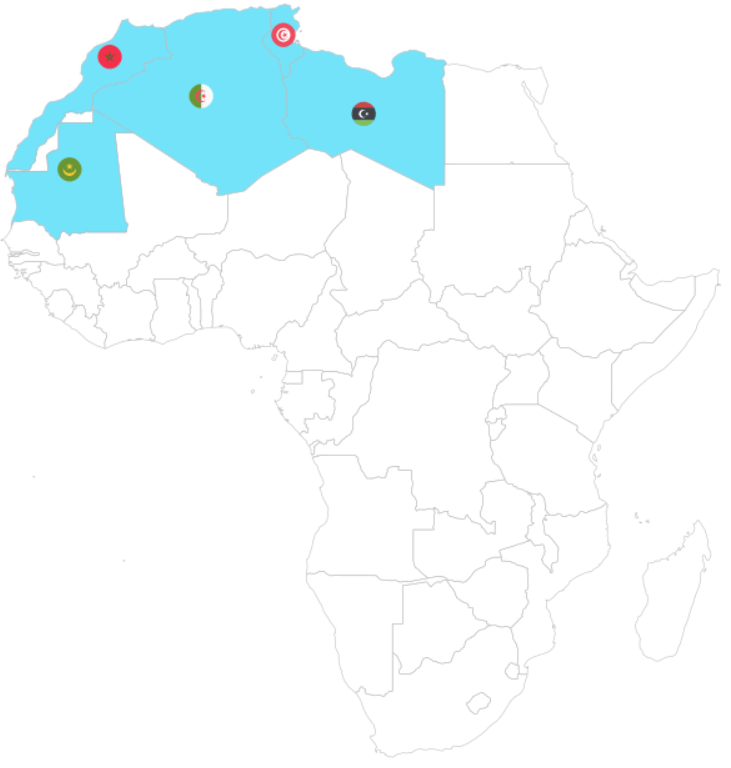
my_dig %>% 
  filter(!is.na(country)) %>% 
  group_by(country, dii_level) %>% 
  ggplot(aes(y = country, 
             x = total_values,
             fill = forcats::fct_rev(dii_level))) +
  geom_col(position = "fill", width = 0.7) + 
  scale_fill_manual(values = dii_pal) + 
  ggthemes::theme_pander() +
  coord_flip() +
  labs(title = "EU's Digital Intensity Index (DII) in 2020",
       subtitle = ("(% of enterprises with at least 10 persons employed)"),
       caption = "ec.europa/eurostat") +
  xlab("") + 
  ylab("") + 
  theme(text = element_text(family = "Verdana", color = "#154293"),
        axis.line.x = element_line(color = "black", size = 1.5),
        axis.text.x = element_text(angle = 90, size = 20, color = "#154293", hjust = 1),
        axis.text.y = element_text(color = "#808080", size = 13, face = "bold"),
        legend.position = "top", 
        legend.title = element_blank(),
        legend.text = element_text(color = "#808080", size = 20, face = "bold"),
        plot.title = element_text(size = 42, color = "#154293"),
        plot.subtitle = element_text(size = 25, color = "#154293"),
        plot.caption = element_text(size = 20, color = "#154293"),
        panel.background = element_rect(color = "#f2f2f2"))

It is not identical and I had to move the black line up and the Norway model more to the right with Paint on my computer! So a bit of cheating!

Click to read Part 1, Part 2 and Part 3 of the blog series on visualising Eurostat data

For information on the index discussed in this blog post: https://ec.europa.eu/eurostat/web/products-eurostat-news/-/ddn-20211029-1

Visualize EU data with Eurostat package in R: Part 2 (with maps)

In this post, we will map prison populations as a percentage of total populations in Europe with Eurostat data.

library(eurostat)
library(tidyverse)
library(sf)
library(rnaturalearth)
library(ggthemes)
library(countrycode)
library(ggflags)
library(viridis)
library(rvest)

Click here to read Part 1 about downloading Eurostat data.


prison_pop <- get_eurostat("crim_pris_pop", type = "label")

prison_pop$iso3 <- countrycode::countrycode(prison_pop$geo, "country.name", "iso3c")

prison_pop$year <- as.numeric(format(prison_pop$time, format = "%Y"))

Next we will download map data with the rnaturalearth package. Click here to read more about using this package.

We only want to zoom in on continental EU (and not include islands and territories that EU countries have around the world) so I use the coordinates for a cropped European map from this R-Bloggers post.

map <- rnaturalearth::ne_countries(scale = "medium", returnclass = "sf")

europe_map <- sf::st_crop(map, xmin = -20, xmax = 45,
                          ymin = 30, ymax = 73)

prison_map <- merge(prison_pop, europe_map, by.x = "iso3", by.y = "adm0_a3", all.x = TRUE)

We will look at data from 2000.

prison_map %>% 
  filter(year == 2000) -> map_2000

To add flags to our map, we will need ISO codes in lower case and longitude / latitude.

prison_map$iso2c <- tolower(countrycode(prison_map$geo, "country.name", "iso2c"))

coord <- read_html("https://developers.google.com/public-data/docs/canonical/countries_csv")

coord_tables <- coord %>% html_table(header = TRUE, fill = TRUE)

coord <- coord_tables[[1]]

prison_map <- merge(prison_map, coord, by.x= "iso_a2", by.y = "country", all.y = TRUE)

Nex we will plot it out!

We will focus only on European countries and we will change the variable from total prison populations to prison pop as a percentage of total population. Finally we multiply by 1000 to change the variable to per 1000 people and not have the figures come out with many demical places.

prison_map %>% 
  filter(continent == "Europe") %>% 
  mutate(prison_pc = (values / pop_est)*1000) %>% 
  ggplot() +
  geom_sf(aes(fill = prison_pc, geometry = geometry), 
          position = "identity") + 
  labs(fill='Prison population')  +
  ggflags::geom_flag(aes(x = longitude, 
                         y = latitude+0.5, 
                         country = iso2_lower), 
                     size = 9) +  
  scale_fill_viridis_c(option = "mako", direction = -1) +
  ggthemes::theme_map() -> prison_map

Next we change how it looks, including changing the background of the map to a light blue colour and the legend.

prison_map + 
  theme(legend.title = element_text(size = 20),
        legend.text = element_text(size = 14), 
         legend.position = "bottom",
        legend.background = element_rect(fill = "lightblue",
                                         colour = "lightblue"),
        panel.background = element_rect(fill = "lightblue",
                                        colour = "lightblue"))

I will admit that I did not create the full map in ggplot. I added the final titles and block colours with canva.com because it was just easier! I always find fonts very tricky in R so it is nice to have dozens of different fonts in Canva and I can play around with colours and font sizes without needing to reload the plot each time.

How to download EU data with Eurostat package in R: Part 1 (with pyramid graphs)

library(eurostat)
library(tidyverse)
library(janitor)
library(ggcharts)
library(ggflags)
library(rvest)
library(countrycode)
library(magrittr)

Eurostat is the statistical office of the EU. It publishes statistics and indicators that enable comparisons between countries and regions.

With the eurostat package, we can visualise some data from the EU and compare countries. In this blog, we will create a pyramid graph and a Statista-style bar chart.

First, we use the get_eurostat_toc() function to see what data we can download. We only want to look at datasets.

available_data <- get_eurostat_toc()

available_datasets <- available_data %>% 
  filter(type == "dataset")

A simple dataset that we can download looks at populations. We can browse through the available datasets and choose the code id. We feed this into the get_eurostat() dataset.

demo <- get_eurostat(id = "demo_pjan", 
                     type = "label")

View(demo)

Some quick data cleaning. First changing the date to a numeric variable. Next, extracting the number from the age variable to create a numeric variable.

demo$year <- as.numeric(format(demo$time, format = "%Y"))

demo$age_number <- as.numeric(gsub("([0-9]+).*$", "\\1", demo$age))

Next we filter out the data we don’t need. For this graph, we only want the total columns and two years to compare.


demo %>%
  filter(age != "Total") %>%
  filter(age != "Unknown") %>% 
  filter(sex == "Total") %>% 
  filter(year == 1960 | year == 2019 ) %>% 
  select(geo, iso3, values, age_number) -> demo_two_years

I want to compare the populations of the founding EU countries (in 1957) and those that joined in 2004. I’ll take the data from Wikipedia, using the rvest package. Click here to learn how to scrape data from the Internet.

eu_site <- read_html("https://en.wikipedia.org/wiki/Member_state_of_the_European_Union")

eu_tables <- eu_site %>% html_table(header = TRUE, fill = TRUE)

eu_members <- eu_tables[[3]]

eu_members %<>% janitor::clean_names()  %>% 
filter(!is.na(accession))

Some quick data cleaning to get rid of the square bracket footnotes from the Wikipedia table data.

eu_members$accession <- as.numeric(gsub("([0-9]+).*$", "\\1",eu_members$accession))

eu_members$name_clean <- gsub("\\[.*?\\]", "", eu_members$name)

We merge the two datasets, on the same variable. In this case, I will use the ISO3C country codes (from the countrycode package). Using the names of each country is always tricky (I’m looking at you, Czechia / Czech Republic).

demo_two_years$iso3 <- countrycode::countrycode(demo_two_years$geo, "country.name, "iso3c")

my_pyramid <- merge(demo_two_years, eu_members, by.x = "iso3", by.y = "iso_3166_1_alpha_3", all.x = TRUE)

We will use the pyramid_chart() function from the ggcharts package. Click to read more about this function.

The function takes the age group (we go from 1 to 99 years of age), the number of people in that age group and we add year to compare the ages in 1960 versus in 2019.

The first graph looks at the countries that founded the EU in 1957.

my_pyramid %>%  
  filter(!is.na(age_number)) %>%  
  filter(accession == 1957 ) %>% 
  arrange(age_number) %>% 
  group_by(year, age_number) %>% 
  summarise(mean_age = mean(values, na.rm = TRUE)) %>% 
  ungroup() %>% 
  pyramid_chart(age_number, mean_age, year,
                bar_colors = c("#9a031e", "#0f4c5c")) 
Source: Eurostat

The second graph is the same, but only looks at the those which joined in 2004.

my_pyramid %>%  
  filter(!is.na(age_number)) %>%  
  filter(accession == 2004 ) %>% 
  arrange(age_number) %>% 
  group_by(year, age_number) %>% 
  summarise(mean_age = mean(values, na.rm = TRUE)) %>% 
  ungroup() %>% 
  pyramid_chart(age_number, mean_age, year,
                bar_colors = c("#9a031e", "#0f4c5c")) 

Next we will use the Eurostat data on languages in the EU and compare countries in a bar chart.

I want to try and make this graph approximate the style of Statista graphs. It is far from identical but I like the clean layout that the Statista website uses.

Similar to above, we add the code to the get_eurostat() function and claen the data like above.

lang <- get_eurostat(id = "edat_aes_l22", 
                     type = "label")

lang$year <- as.numeric(format(lang$time, format = "%Y"))

lang$iso2 <- tolower(countrycode(lang$geo, "country.name", "iso2c"))

lang %>% 
  mutate(geo = ifelse(geo == "Germany (until 1990 former territory of the FRG)", "Germany", 
                      ifelse(geo == "European Union - 28 countries (2013-2020)", "EU", geo))) %>% 
  filter(n_lang == "3 languages or more") %>% 
  filter(year == 2016) %>% 
  filter(age == "From 25 to 34 years") %>% 
  filter(!is.na(iso2)) %>% 
  group_by(geo, year) %>% 
  mutate(mean_age = mean(values, na.rm = TRUE)) %>% 
  arrange(mean_age) -> lang_clean

Next we will create bar chart with the stat = "identity" argument.

We need to make sure our ISO2 country code variable is in lower case so that we can add flags to our graph with the ggflags package. Click here to read more about this package

lang_clean %>%
  ggplot(aes(x = reorder(geo, mean_age), y = mean_age)) + 
  geom_bar(stat = "identity", width = 0.7, color = "#0a85e5", fill = "#0a85e5") + 
  ggflags::geom_flag(aes(x = geo, y = -1, country = iso2), size = 8) +
  geom_text(aes(label= values), position = position_dodge(width = 0.9), hjust = -0.5, size = 5, color = "#000500") + 
  labs(title = "Percentage of people that speak 3 or more languages",
       subtitle = ("(% of overall population)"),
       caption = "         Source: Eurostat ") +
  xlab("") + 
  ylab("") -> lang_plot 
  

To try approximate the Statista graphs, we add many arguments to the theme() function for the ggplot graph!

lang_plot + coord_flip() + 
  expand_limits(y = 65) + 
  ggthemes::theme_pander() + 
  theme(plot.background = element_rect(color = "#f5f9fc"),
        panel.grid = element_line(colour = "#f5f9fc"),
        # axis.title.x = element_blank(),
        axis.text.x = element_blank(),
        axis.text.y = element_text(color = "#000500", size = 16),
        # axis.title.y = element_blank(),
        axis.ticks.x = element_blank(),
        text = element_text(family = "Gadugi"),
        plot.title = element_text(size = 28, color = "#000500"),
        plot.subtitle = element_text(size = 20, color = "#484e4c"),
        plot.caption = element_text(size = 20, color = "#484e4c") )

Next, click here to read Part 2 about visualizing Eurostat data with maps

Alternatives to pie charts: coxcomb and waffle charts

Packages we will need

library(tidyverse)
library(rnaturalearth)
library(countrycode)
library(peacesciencer)
library(ggthemes)
library(bbplot)

If we want to convey nuance in the data, sometimes that information is lost if we display many groups in a pie chart.

According to Bernard Marr, our brains are used to equal slices when we think of fractions of a whole. When the slices aren’t equal, as often is the case with real-world data, it’s difficult to envision the parts of a whole pie chart accurately.

Below are some slight alternatives that we can turn to and visualise different values across groups.

I’m going to compare regions around the world on their total energy consumption levels since the 1900s.

First, we can download the region data with information about the geography and income levels for each group, using the ne_countries() function from the rnaturalearth package.

map <- ne_countries(scale = "medium", returnclass = "sf")

Click here to learn more about downloading map data from the rnaturalearth package.

Next we will select the variables that we are interested in, namely the income group variable and geographic region variable:

map %>% 
  select(name_long, subregion, income_gr) %>% as_data_frame() -> region_var

And add a variable of un_code that it will be easier to merge datasets in a bit. Click here to learn more about countrycode() function.

region_var$un_code <- countrycode(region_var$name_long, "country.name", "un") 

Next, we will download national military capabilities (NMC) dataset. These variables – which attempt to operationalize a country’s power – are military expenditure, military personnel, energy consumption, iron and steel production, urban population, and total population. It serves as the basis for the most widely used indicator of national capability, CINC (Composite Indicator of National Capability) and covers the period 1816-2016.

To download them in one line of code, we use the create_stateyears() function from the peacesciencer package.

What, Like It'S Hard? Reese Witherspoon GIF - Find & Share on GIPHY
states <- create_stateyears(mry = FALSE) %>% add_nmc() 

Click here to read more about downloading Correlates of War and other IR variables from the peacesciencer package

Next we add a UN location code so we can easily merge both datasets we downloaded!

states$un_code <- countrycode(states$statenme, "country.name", "un")
states_df <- merge(states, region_var, by ="un_code", all.x = TRUE)

Next, let’s make the coxcomb graph.

First, we will create one high income group. The map dataset has a separate column for OECD and non-OECD countries. But it will be easier to group them together into one category. We do with with the ifelse() function within mutate().

Next we filter out any country that is NA in the dataset, just to keep it cleaner.

We then group the dataset according to income group and sum all the primary energy consumption in each region since 1900.

When we get to the ggplotting, we want order the income groups from biggest to smallest. To do this, we use the reorder() function with income_grp as the second argument.

To create the coxcomb chart, we need the geom_bar() and coord_polar() lines.

With the coord_polar() function, it takes the following arguments :

  • theta – the variable we map the angle to (either x or y)
  • start – indicates the starting point from 12 o’clock in radians
  • direction – whether we plot the data clockwise (1) or anticlockwise (-1)

We feed in a theta of “x” (this is important!), then a starting point of 0 and direction of -1.

Next we add nicer colours with hex values and label the legend in the scale_fill_manual() function.

I like using the fonts and size stylings in the bbc_style() theme.

Last we can delete some of the ticks and text from the plot to make it cleaner.

Last we add our title and source!

states_df %>% 
  mutate(income_grp = ifelse(income_grp == "1. High income: OECD", "1. High income", ifelse(income_grp == "2. High income: nonOECD", "1. High income", income_grp))) %>% 
  filter(!is.na(income_grp)) %>% 
  filter(year > 1899) %>% 
  group_by(income_grp) %>% 
  summarise(sum_pec = sum(pec, na.rm = TRUE)) %>% 
  ggplot(aes(x = reorder(sum_pec, income_grp), y = sum_pec, fill = as.factor(income_grp))) + 
  geom_bar(stat = "identity") + 
  coord_polar("x", start = 0, direction = -1)  + 
  ggthemes::theme_pander() + 
  scale_fill_manual(
    values = c("#f94144", "#f9c74f","#43aa8b","#277da1"), 
    labels = c("High Income", "Upper Middle Income", "Lower Middle Income", "Low Income"), name = "Income Level") +
  bbplot::bbc_style() + 
  theme(axis.text = element_blank(),
            axis.title.x = element_blank(),
            axis.title.y = element_blank(),
            axis.ticks = element_blank(),
            panel.grid = element_blank()) + 
  ggtitle(label = "Primary Energy Consumption across income levels since 1900", subtitle = "Source: Correlates of War CINC")

Happy Legally Blonde GIF - Find & Share on GIPHY

We can compare to the number of countries in each region :

states_df %>% 
  mutate(income_grp = ifelse(income_grp == "1. High income: OECD", "1. High income",
 ifelse(income_grp == "2. High income: nonOECD", "1. High income", income_grp))) %>% 
  filter(!is.na(income_grp)) %>% 
  filter(year == 2016) %>% 
  count(income_grp) %>% 
  ggplot(aes(reorder(n, income_grp), n, fill = as.factor(income_grp))) + 
  geom_bar(stat = "identity") + 
  coord_polar("x", start = 0, direction = - 1)  + 
  ggthemes::theme_pander() + 
  scale_fill_manual(
    values = c("#f94144", "#f9c74f","#43aa8b","#277da1"), 
    labels = c("High Income", "Upper Middle Income", "Lower Middle Income", "Low Income"), 
    name = "Income Level") +
  bbplot::bbc_style() + 
  theme(axis.text = element_blank(),
        axis.title.x = element_blank(),
        axis.title.y = element_blank(),
        axis.ticks = element_blank(),
        panel.grid = element_blank()) + 
  ggtitle(label = "Number of countries per region")

Another variation is the waffle plot!

It is important we do not install the CRAN version, but rather the version in development. I made the mistake of installing the non-github version and nothing worked.

Legally Blonde Liar GIF - Find & Share on GIPHY

It was an ocean of error messages.

So, instead, install the following version:

remotes::install_github("hrbrmstr/waffle")
library(waffle)

When we add the waffle::geom_waffle() there are some arguments we can customise.

  • n_rows – rhe default is 10 but this is something you can play around with to see how long or wide you want the chart
  • size – again we can play around with this number to see what looks best
  • color – I will set to white for the lines in the graph, the default is black but I think that can look a bit too busy.
  • flip – set to TRUE or FALSE for whether you want the coordinates horizontal or vertically stacked
  • make_proportional – if we set to TRUE, compute proportions from the raw values? (i.e. each value n will be replaced with n/sum(n)); default is FALSE

We can also add theme_enhance_waffle() to make the graph cleaner and less cluttered.

states_df %>% 
  filter(year == 2016) %>% 
  filter(!is.na(income_grp)) %>% 
  mutate(income_grp = ifelse(income_grp == "1. High income: OECD",
 "1. High income", ifelse(income_grp == "2. High income: nonOECD", "1. High income", income_grp))) %>% 
  count(income_grp) %>% 
  ggplot(aes(fill = income_grp, values = n)) +
  scale_fill_manual(
values = c("#f94144", "#f9c74f","#43aa8b","#277da1"), 
labels = c("High Income", "Upper Middle Income", 
"Lower Middle Income", "Low Income"), 
name = "Income Level") +
  waffle::geom_waffle(n_rows = 10, size = 0.5, colour = "white",
              flip = TRUE, make_proportional = TRUE) + bbplot::bbc_style() +  
  theme_enhance_waffle() + 
  ggtitle(label = "Number of countries per region")

We can also look at the sum of military expenditure across each region

states_df %>% 
  filter(!is.na(income_grp)) %>%
  filter(year > 1899) %>% 
  mutate(income_grp = ifelse(income_grp == "1. High income: OECD",
 "1. High income", ifelse(income_grp == "2. High income: nonOECD", 
"1. High income", income_grp))) %>% 
group_by(income_grp) %>%
  summarise(sum_military = sum(milex, na.rm = TRUE)) %>% 
  ggplot(aes(fill = income_grp, values = sum_military)) +
  scale_fill_manual(
    values = c("#f94144", "#f9c74f","#43aa8b","#277da1"), 
    labels = c("High Income", "Upper Middle Income", 
               "Lower Middle Income", "Low Income"), 
    name = "Income Level") +
  geom_waffle(n_rows = 10, size = 0.3, colour = "white",
              flip = TRUE, make_proportional = TRUE) + bbplot::bbc_style() +  
  theme_enhance_waffle() + 
  ggtitle(label = "Sum of military expenditure per region")
Sexy Girls Rule GIF - Find & Share on GIPHY

Compare Irish census years with compareBars and csodata package in R

Packages we will need:

library(csodata)
library(janitor)
library(ggcharts)
library(compareBars)
library(tidyverse)

First, let’s download population data from the Irish census with the Central Statistics Office (CSO) API package, developed by Conor Crowley.

You can search for the data you want to analyse via R or you can go to the CSO website and browse around the site.

I prefer looking through the site because sometimes I stumble across a dataset I didn’t even think to look for!

Keep note of the code beside the red dot star symbol if you’re looking around for datasets.

Click here to check out the CRAN PDF for the CSO package.

You can search for keywords with cso_search_toc(). I want total population counts for the whole country.

cso_search_toc("total population")

We can download the variables we want by entering the code into the cso_get_data() function

irish_pop <- cso_get_data("EY007")
View(irish_pop)

The EY007 code downloads population census data in both 2011 and 2016 at every age.

It needs a little bit of tidying to get it ready for graphing.

irish_pop %<>%  
  clean_names()

First, we can be lazy and use the clean_names() function from the janitor package.

GIF by The Good Place - Find & Share on GIPHY

Next we can get rid of the rows that we don’t want with select().

Then we use the pivot_longer() function to turn the data.frame from wide to long and to turn the x2011 and x2016 variables into one year variable.

irish_pop %>% 
  filter(at_each_year_of_age == "Population") %>% 
  filter(sex == 'Both sexes') %>% 
  filter(age_last_birthday != "All ages") %>% 
  select(!statistic) %>% 
  select(!sex) %>% 
  select(!at_each_year_of_age) -> irish_wide

irish_wide %>% 
  pivot_longer(!age_last_birthday,
    names_to = "year", 
    values_to = "pop_count",
    values_drop_na = TRUE) %>% 
    mutate(year = as.factor(year)) -> irish_long

No we can create our pyramid chart with the pyramid_chart() from the ggcharts package. The first argument is the age category for both the 2011 and 2016 data. The second is the actual population counts for each year. Last, enter the group variable that indicates the year.

irish_long %>%   
  pyramid_chart(age_last_birthday, pop_count, year)

One problem with the pyramid chart is that it is difficult to discern any differences between the two years without really really examining each year.

One way to more easily see the differences with the compareBars function

The compareBars package created by David Ranzolin can help to simplify comparative bar charts! It’s a super simple function to use that does a lot of visualisation leg work under the hood!

First we need to pivot the data.frame back to wide format and then input the age, and then the two groups – x2011 and x2016 – in the compareBars() function.

We can add more labels and colors to customise the graph also!

irish_long %>% 
  pivot_wider(names_from = year, values_from = pop_count) %>% 
  compareBars(age_last_birthday, x2011, x2016, orientation = "horizontal",
              xLabel = "Population",
              yLabel = "Year",
              titleLabel = "Irish Populations",
              subtitleLabel = "Comparing 2011 and 2016",
              fontFamily = "Arial",
              compareVarFill1 = "#FE6D73",
              compareVarFill2 = "#17C3B2") 

We can see that under the age of four-ish, 2011 had more at the time. And again, there were people in their twenties in 2011 compared to 2016.

However, there are more older people in 2016 than in 2011.

Similar to above it is a bit busy! So we can create groups for every five age years categories and examine the broader trends with fewer horizontal bars.

First we want to remove the word “years” from the age variable and convert it to a numeric class variable. We can easily do this with the parse_number() function from the readr package

irish_wide %<>% 
mutate(age_num = readr::parse_number(as.character(age_last_birthday))) 

Next we can group the age years together into five year categories, zero to 5 years, 6 to 10 years et cetera.

We use the cut() function to divide the numeric age_num variable into equal groups. We use the seq() function and input age 0 to 100, in increments of 5.

irish_wide$age_group = cut(irish_wide$age_num, seq(0, 100, 5))

Next, we can use group_by() to calculate the sum of each population number in each five year category.

And finally, we use the distinct() function to remove the duplicated rows (i.e. we only want to keep the first row that gives us the five year category’s population count for each category.

irish_wide %<>% 
  group_by(age_group) %>% 
  mutate(five_year_2011 = sum(x2011)) %>% 
  mutate(five_year_2016 = sum(x2016)) %>% 
  distinct(five_year_2011, five_year_2016, .keep_all = TRUE)

Next plot the bar chart with the five year categories

compareBars(irish_wide, age_group, five_year_2011, five_year_2016, orientation = "horizontal",
              xLabel = "Population",
              yLabel = "Year",
              titleLabel = "Irish Populations",
              subtitleLabel = "Comparing 2011 and 2016",
              fontFamily = "Arial",
              compareVarFill1 = "#FE6D73",
              compareVarFill2 = "#17C3B2") 

irish_wide2 %>% 
  select(age_group, five_year_2011, five_year_2016) %>% 
  pivot_longer(!age_group,
             names_to = "year", 
             values_to = "pop_count",
             values_drop_na = TRUE) %>% 
  mutate(year = as.factor(year)) -> irishlong2

irishlong2 %>%   
  pyramid_chart(age_group, pop_count, year)

The Good Place Yes GIF by NBC - Find & Share on GIPHY

Graph linear model plots with sjPlots in R

This blog post will look at the plot_model() function from the sjPlot package. This plot can help simply visualise the coefficients in a model.

Packages we need:

library(sjPlot)
library(kable)

We can look at variables that are related to citizens’ access to public services.

This dependent variable measures equal access access to basic public services, such as access to security, primary education, clean water, and healthcare and whether they are distributed equally or unequally according to socioeconomic position.

Higher scores indicate a more equal society.

I will throw some variables into the model and see what relationships are statistically significant.

The variables in the model are

  • level of judicial constraint on the executive branch,
  • freedom of information (such as freedom of speech and uncensored media),
  • level of democracy,
  • level of regime corruption and
  • strength of civil society.

So first, we run a simple linear regression model with the lm() function:

summary(my_model <- lm(social_access ~ judicial_constraint +
        freedom_information +
        democracy_score + 
        regime_corruption +
        civil_society_strength, 
        data = df))

We can use knitr package to produce a nice table or the regression coefficients with kable().

I write out the independent variable names in the caption argument

I also choose the four number columns in the col.names argument. These numbers are:

  • beta coefficient,
  • standard error,
  • t-score
  • p-value

I can choose how many decimals I want for each number columns with the digits argument.

And lastly, to make the table, I can set the type to "html". This way, I can copy and paste it into my blog post directly.

my_model %>% 
tidy() %>%
kable(caption = "Access to public services by socio-economic position.", 
col.names = c("Predictor", "B", "SE", "t", "p"),
digits = c(0, 2, 3, 2, 3), "html")
Access to public services by socio-economic position
Predictor B SE t p
(Intercept) 1.98 0.380 5.21 0.000
Judicial constraints -0.03 0.485 -0.06 0.956
Freedom information -0.60 0.860 -0.70 0.485
Democracy Score 2.61 0.807 3.24 0.001
Regime Corruption -2.75 0.381 -7.22 0.000
Civil Society Strength -1.67 0.771 -2.17 0.032
Kristin Cavallari GIF by E! - Find & Share on GIPHY

Higher democracy scores are significantly and positively related to equal access to public services for different socio-economic groups.

There is no statistically significant relationship between judicial constraint on the executive.

But we can also graphically show the coefficients in a plot with the sjPlot package.

There are many different arguments you can add to change the colors of bars, the size of the font or the thickness of the lines.

p <-  plot_model(my_model, 
      line.size = 8, 
      show.values = TRUE,
      colors = "Set1",
      vline.color = "#d62828",
      axis.labels = c("Civil Society Strength",  "Regime Corruption", "Democracy Score", "Freedom information", "Judicial constraints"), title = "Equal access to public services distributed by socio-economic position")

p + theme_sjplot(base_size = 20)

So how can we interpret this graph?

If a bar goes across the vertical red line, the coefficient is not significant. The further the bar is from the line, the higher the t-score and the more significant the coefficient!

Make a timeline graph with dates in ggplot2

We will use the geom_segment layer from ggplot2 to make a timeline graph!

This layer takes

  • x and xend for the start of the segment lines
  • y and yend inputs for the end of the segment lines

For our timeline, the x will be the start of each Irish Taoiseach’s term.

The xend will be the end of their term, when they get kicked out of office.

Taoisigh (plural of Taoiseach) are Irish prime ministers and are in charge of the executive branch when their party is in change.

For Ireland, that means that basically every Taoiseach has been the leader of one of the two main parties – Fianna Fail or Fine Gael.

Not very exciting.

Also they have all been men.

This is also not very exciting.

We have a bit more to go with increasing the diversity in Ireland’s top job.

The y argument is the Taoiseach number in office. Although there have been fifteen men that have held the office of Taoiseach, this does not mean that they only held office for one time only.

Ireland has a parliamentary system so when a party loses an election, the former Taoiseach can become the leader of the opposition and hope in the future they can become Taoiseach again. Some men have been Taoiseach two or three times in non-consecutive terms.

When we are adding the labels with the geom_text() layer, I created an order variable which indicates the first time each man took the office of Taoiseach.

This is so I only have the name of each man only once in the graph. If we don’t do this step, if a man held office more than once, their name appears every time on the graph and the plot becomes a crowded mess.

I add the ifelse statement so that the first name appears after the segment line and therefore text does not take up too much room on the left edge of the graph.

Last we use the scale_color_manual() function with nice hex colors for each of the political parties.

time_line <- df %>% 
 ggplot(aes(x = as.Date(start), y = number, color = party_factor)) +
 geom_segment(aes(xend = as.Date(end), yend = number, color =  party_factor), size = 6) +
 geom_text(aes(label = order, hjust = ifelse(taoiseach_number < 2, -0.7, 1.1)), size = 8, show.legend = FALSE) +
 scale_color_manual(values = c("Fine Gael" = "#004266", "Fianna Fáil" = "#FCB322", "Cumann na nGaedheal" = "#D62828"))

I increase the limits of the graph to accommodate the name labels. Most of the time, these extra bits of code in ggplot2 depend on the type of data you have and what fits on the graph plane nicely!

So this stages is often only finished after trial-and-error.

I add a snazzy theme_fivethirtyeight() theme from ggthemes package.

Last, with the theme() function, we can remove most of the elements of the graph to make the graph cleaner.

time_line <- time_line + 
  expand_limits(x = as.Date("1915-01-01")) +
  theme_fivethirtyeight() +
  theme(legend.position = "top",
        legend.title = element_blank(),
        legend.direction = "vertical",
        axis.title.y = element_blank(),
        axis.text.y = element_blank(),
        text = element_text(size = 20)) +
  labs(title = "Taoiseach Terms in Ireland",
 subtitle = "From 1922 to 2021") 

We can also create the pie chart to see which party has held power longest in Ireland.

With dplyr we can subtract the start date from the end date and add all the Taoiseach durations (in days) together with the cumsum() argument.

We then choose the highest duration value for each party with the slice(which.max()) functions.

I was lazy and I just re-wrote the values in a new data.frame and called it counts.

df %>%
  group_by(party_factor) %>% 
  dplyr::summarise(max_count = cumsum(duration_number)) %>%  
  slice(which.max(max_count)) %>% 
  select(party_factor, max_count) %>% 
  arrange(desc(max_count))

counts <- data.frame(group = c("Cumann na nGaedheal", "Fine Gael" ,"Fianna Fáil"), 
                     value = c(3381, 10143, 22539))

Create proportion values for our pie-chart graph. To do this divide value by the sum of the values and multiply by 100.

data <- counts %>% 
  arrange(desc(group)) %>%
  dplyr::mutate(prop = value / sum(value) * 100) 

Change the numeric variables to factors.

data$duration <- as.factor(data$value)
data$party_factor <- as.factor(data$group)

We use the coord_polar() to create the piechart. To learn more, check out the r-graph-gallery page about creating pie-charts:

pie_chart <- ggplot(data, aes(x = ", y = prop, fill = group)) + geom_bar(stat = "identity", width = 1, color = "white") + coord_polar("y", start = 0) +

theme(legend.position = "none") + scale_fill_manual(values = c("Fine Gael" = "#004266", "Fianna Fáil" = "#FCB322", "Cumann na nGaedheal" = "#D62828")) +
 labs(title = "Which party held the office of Taoiseach longest?", subtitle = "From 1922 to 2021")

We can tidy up the plot and get rid of theme elements we don’t want with theme_void()

pie_chart <- pie_chart + theme_void() + theme(legend.title = element_blank(), legend.position = none, text = element_text(size = 40))

I want to add both graphs together so I can save the pie chart with a transparent background with the ggsave() function. I also make sure the lines are not jagged with the type = "cairo" from with Cairo package.

ggsave(pie_chart, file="pie_chart.png", type="cairo", bg = "transparent", width = 50, height = 50, units = "cm")

And we can use canva.com to add them together and create a single chart

And viola!

Examining speeches from the UN Security Council Part 1

Let’s look at how many speeches took place at the UN Security Council every year from 1995 until 2019.

Hesitate Episode 16 GIF by The Simpsons - Find & Share on GIPHY

I want to only look at countries, not organisations. So a quick way to do that is to add a variable to indicate whether the speaker variable has an ISO code.

Only countries have ISO codes, so I can use this variable to filter away all the organisations that made speeches

library(countrycode)

speech$iso2 <- countrycode(speech$country, "country.name", "iso2c")

library(bbplot)

speech %>% 
  dplyr::filter(!is.na(iso2)) %>% 
  group_by(year) %>% 
  count() %>% 
  ggplot(aes(x = year, y = n)) + 
  geom_line(size = 1.2, alpha = 0.4) +
  geom_label(aes(label = n)) +
  bbplot::bbc_style() +
  theme(plot.title = element_text(hjust = 0.5)) +
  labs(title = "Number of speeches given by countries at UNSC")

We can see there has been a relatively consistent upward trend in the number of speeches that countries are given at the UN SC. Time will tell what impact COVID will have on these trends.

There was a particularly sharp increase in speeches in 2015.

We can look and see who was talking, and in the next post, we can examine what they were talking about in 2015 with some simple text analytic packages and functions.

First, we will filter only the year 2015 and count the number of observations per group (i.e. the number of speeches per country this year).

To add flags to the graph, add the iso2 code to the dataset (and it must be in lower case).

Click here to read more about adding circular flags to graphs and maps

speech %>% 
  dplyr::filter(year == 2015) %>% 
  group_by(country) %>% 
  dplyr::summarise(speech_count = n()) -> speech_2015

speech_2015$iso2_lower <- tolower(speech_2015$iso2)

We can clean up the names and create a variable that indicates whether the country is one of the five Security Council Permanent Members, a Temporary Member elected or a Non-,ember.

I also clean up the names to make the country’s names in the dataset smaller. For example, “United Kingdom Of Great Britain And Northern Ireland”, will be very cluttered in the graph compared to just “UK” so it will be easier to plot.

library(ggflags)
library(ggthemes)

speech_2015 %>% 
# To avoid the graph being too busy, we only look at countries that gave over 20 speeches
  dplyr::filter(speech_count > 20) %>% 

# Clean up some names so the graph is not too crowded
  dplyr::mutate(country = ifelse(country == "United Kingdom Of Great Britain And Northern Ireland", "UK", country)) %>%
  dplyr::mutate(country = ifelse(country == "Russian Federation", "Russia", country)) %>%
  dplyr::mutate(country = ifelse(country == "United States Of America", "USA", country)) %>%
  dplyr::mutate(country = ifelse(country == "Republic Of Korea", "South Korea", country)) %>%
  dplyr::mutate(country = ifelse(country == "Venezuela (Bolivarian Republic Of)", "Venezuela", country)) %>% 
  dplyr::mutate(country = ifelse(country == "Islamic Republic Of Iran", "Iran", country)) %>% 
  dplyr::mutate(country = ifelse(country == "Syrian Arab Republic", "Syria", country)) %>% 
 
# Create a Member status variable:
# China, France, Russia, the United Kingdom, and the United States are UNSC Permanent Members
  dplyr::mutate(Member = ifelse(country == "UK", "Permanent", 
  ifelse(country == "USA", "Permanent",
  ifelse(country == "China", "Permanent",
  ifelse(country == "Russia", "Permanent",
  ifelse(country == "France", "Permanent",

# Non-permanent members in their first year (elected October 2014)
  ifelse(country == "Angola", "Temporary (Elected 2014)",
  ifelse(country == "Malaysia", "Temporary (Elected 2014)",              
  ifelse(country == "Venezuela", "Temporary (Elected 2014)",       
  ifelse(country == "New Zealand", "Temporary (Elected 2014)",
  ifelse(country == "Spain", "Temporary (Elected 2014)",                 

# Non-permanent members in their second year (elected October 2013)        
  ifelse(country == "Chad", "Temporary (Elected 2013)",                                                               
  ifelse(country == "Nigeria", "Temporary (Elected 2013)",
  ifelse(country == "Jordan", "Temporary (Elected 2013)",
  ifelse(country == "Chile", "Temporary (Elected 2013)",
  ifelse(country == "Lithuania", "Temporary (Elected 2013)", 
 
# Non members that will join UNSC next year (elected October 2015)          
  ifelse(country == "Egypt", "Non-Member (Elected 2015)",                                                               
  ifelse(country == "Sengal", "Non-Member (Elected 2015)",
  ifelse(country == "Uruguay", "Non-Member (Elected 2015)",
  ifelse(country == "Japan", "Non-Member (Elected 2015)",
  ifelse(country == "Ukraine", "Non-Member (Elected 2015)", 

# Everyone else is a regular non-member           
               "Non-Member"))))))))))))))))))))) -> speech_2015

When we have over a dozen nested ifelse() statements, we will need to check that we have all our corresponding closing brackets.

Next choose some colours for each Memberships status. I always take my hex values from https://coolors.co/

membership_palette <- c("Permanent" = "#e63946", "Non-Member" = "#2a9d8f", "Non-Member (Elected 2015)" = "#a8dadc", "Temporary (Elected 2013)" = "#457b9d","Temporary (Elected 2014)" = "#1d3557")
Season 4 Applause GIF by The Simpsons - Find & Share on GIPHY

And all that is left to do is create the bar chart.

With geom_bar(), we can indicate stat = "identity" because we are giving the plot the y values and ggplot does not need to do the automatic aggregation on its own.

To make sure the bars are descending from most speeches to fewest speeches, we use the reorder() function. The second argument is the variable according to which we want to order the bars. So for us, we give the speech_count integer variable to order our country bars with x = reorder(country, speech_count).

We can change the bar from vertical to horizontal with coordflip().

I add flags with geom_flag() and feed the lower case ISO code to the country = iso2_lower argument.

I add the bbc_style() again because I like the font, size and sparse lines on the plot.

We can move the title of the plot into the centre with plot.title = element_text(hjust = 0.5))

Finally, we can supply the membership_palette vector to the values = argument in the scale_fill_manual() function to specify the colours we want.

speech_2015 %>%  ggplot(aes(x = reorder(country, speech_count), y = speech_count)) + 
  geom_bar(stat = "identity", aes(fill = as.factor(Member))) +
  coord_flip() +
  ggflags::geom_flag(mapping = aes(y = -15, x = country, country = iso2_lower), size = 10) +
  geom_label(mapping = aes( label = speech_count), size = 8) +
  theme(legend.position = "top") + 
  labs(title = "UNSC speeches given in 2015", y = "Number of speeches", x = "") +
  bbplot::bbc_style() +
  theme(text = element_text(size = 20),
  plot.title = element_text(hjust = 0.5)) +
  scale_fill_manual(values =  membership_palette)

In the next post, we will look at the texts themselves. Here is a quick preview.

library(tidytext)

speech_tokens <- speech %>%
  unnest_tokens(word, text) %>% 

  anti_join(stop_words)

We count the number of tokens (i.e. words) for each country in each year. With the distinct() function we take only one observation per year per country. This reduces the number of rows from 16601520 in speech_tokesn to 3142 rows in speech_words_count :

speech_words_count <- speech_tokens %>%
  group_by(year, country) %>%
  mutate(word_count = n_distinct(word)) %>%
  select(country, year, word_count, permanent, iso2_lower) %>%
  distinct() 

Subset the data.frame to only plot the five Permanent Members. Now we only have 125 rows (25 years of total annual word counts for 5 countries!)

permanent_words_summary <- speech_words_count %>% 
  filter(permanent == 1) 

Choose some nice hex colors for my five countries:

five_pal <- c("#ffbc42","#d81159","#8f2d56","#218380","#73d2de")

It is a bit convoluted to put the flags ONLY at the start and end of the lines. We need to subset the dataset two times with the geom_flag() sections. First, we subset the data.frame to year == 1995 and the flags appear at the start of the word_count on the y axis. Then we subset to year == 2019 and do the same

ggplot(data = permanent_word_summary) +
  geom_line(aes(x = year, y = word_count, group = as.factor(country), color = as.factor(country)), 
size = 2) +
  ggflags::geom_flag(data = subset(permanent_word_summary, year == 1995), aes(x = 1995, y = word_count,  country = iso2_lower), size = 9) +
  ggflags::geom_flag(data = subset(permanent_word_summary, 
year == 2019), 
aes(x = 2019, 
y = word_count, 
country = iso2_lower), 
size = 12) + 
  bbplot::bbc_style() +
 theme(legend.position = "right") + labs(title = "Number of words spoken by Permanent Five in the UN Security Council") + 
  scale_color_manual(values = five_pal)

We can see that China has been the least chattiest country if we are measuring chatty with number of words spoken. Translation considerations must also be taken into account. We can see here again at around the 2015 mark, there was a discernible increase in the number of words spoken by most of the countries!

Episode 16 GIF by The Simpsons - Find & Share on GIPHY